Simple audio amplifier with a BC547B
Music from a phone goes in at the AUX plug, one transistor and one cell drive the speaker, and the speaker plays the music quietly. In the video the cone pumps with the beat; a real small cone barely moves.
From the Short Simple Audio Amplifier Circuit | BC547 + Speaker (320K views, posted 5 October 2026). Opens on YouTube.
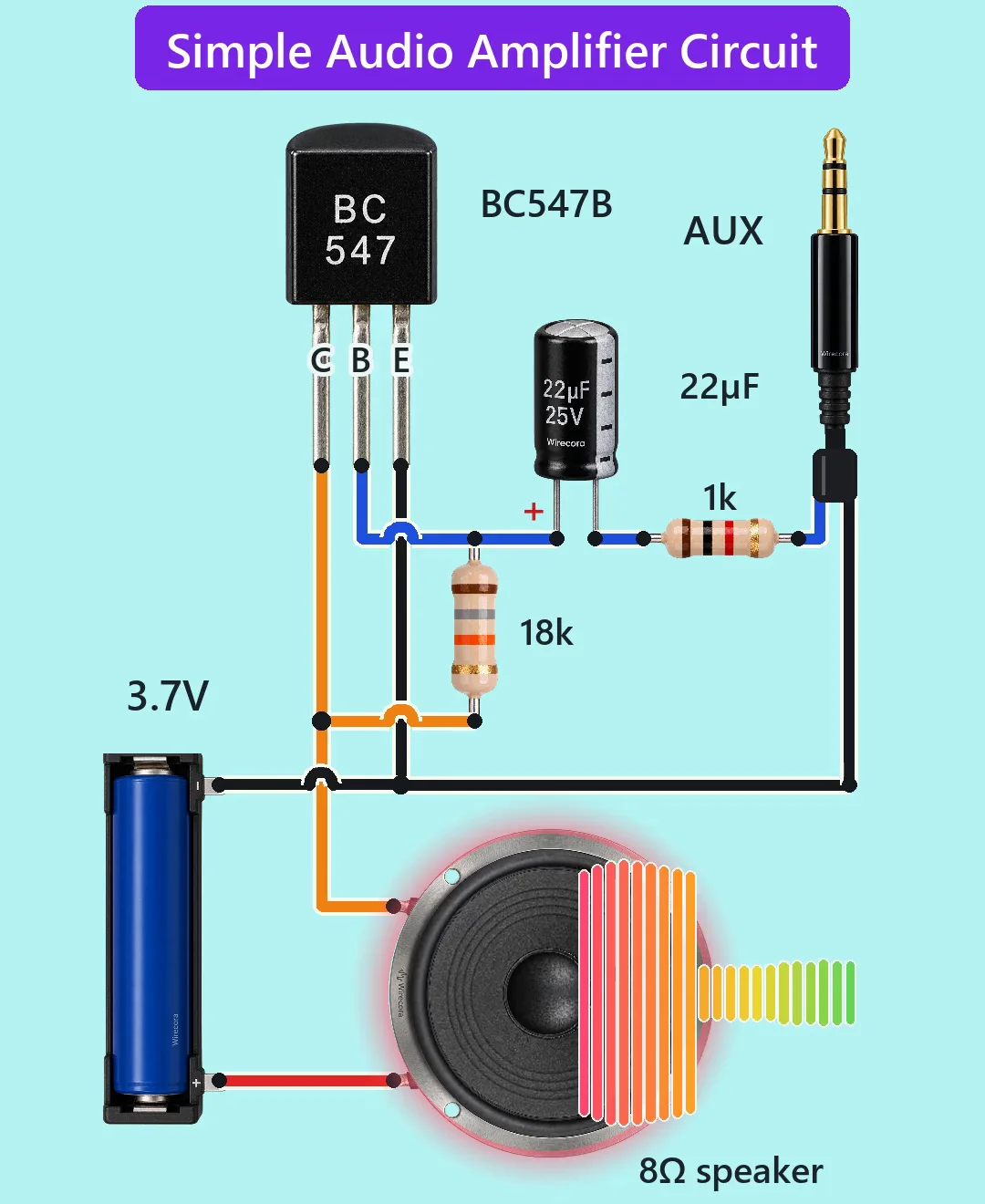
Parts
- BC547B NPN transistor, TO-92 (flat printed face towards you, legs down: C, B, E from the left)
- 18 k resistor, 1/4 W, from collector to base (bands brown, grey, orange, gold). If your transistor is a BC547C, use 22 k instead.
- 1 k resistor, 1/4 W, in the AUX input (bands brown, black, red, gold)
- 22 uF 25 V electrolytic capacitor (the long leg is +; the stripe with minus signs is the minus side)
- 8 ohm speaker, small full-range, 0.5 W or more
- 18650 Li-ion cell in a holder, 3.7 V nominal (3.0 V empty, 4.2 V full)
- 3.5 mm TRS stereo plug (AUX): tip = left channel, ring = right channel, sleeve = ground
How it is wired
- Cell + lug to the speaker's + lug.
- Speaker - lug to the BC547B collector and to the lower end of the 18 k resistor.
- Upper end of the 18 k resistor to the BC547B base and to the + leg of the 22 uF capacitor.
- - leg of the 22 uF capacitor to one end of the 1 k resistor.
- Other end of the 1 k resistor to the AUX plug's tip (left channel). The ring (right channel) is left open, so this is a one-channel (mono) amplifier.
- BC547B emitter, cell - lug and the AUX plug's sleeve all to ground.
How it works
- The 18 k resistor from collector to base turns the transistor on a little all the time, so a steady current of about 41 mA (typical BC547B, 3.7 V) flows from the cell through the speaker and the transistor to ground, even with no music. That standing current warms the speaker coil by about 12 mW and holds the cone slightly off centre; harmless for a 0.5 W speaker.
- The music from the phone comes in through the 22 uF capacitor, which lets the wobbling sound signal through but blocks the steady 0.72 V on the base from reaching the phone.
- The sound signal makes the base current rise and fall, and the transistor copies that as a much bigger rise and fall of the speaker current (about 190 times): about 154 mA for every volt at the AUX, typically, so 100 mV peak of music moves the speaker current about 15 mA up and down.
- The 1 k input resistor keeps the stage from clipping at normal phone levels: distortion stays under about 3 % up to 150 mV peak. At those levels the collector voltage never drops below about 2.8 V, so the transistor stays in its linear range; the swing is limited by the current reaching zero, not by saturation.
- This is a quiet current stage, not a loud voltage amplifier: the voltage gain is only about 1.2 and the speaker gets under 1 mW at the level shown and about 6 mW at most before it distorts badly. An LM386 chip is the step up for real loudness.
What the video simplifies
- The coloured bars streaming out of the speaker are the envelope of the music, drawn for the video; sound is invisible.
- The cone pumping up to 10 % and the pink halo are drawn; a small cone really moves a millimetre at most.
- The music is synthesised for the video and plays louder than the real 0.8 mW would.
- The phone at the other end of the AUX cable is not drawn.
- All currents and powers are from a circuit simulation (ngspice with a data-sheet-fitted BC547 model), not measured on a built board; your numbers will differ with the transistor's gain, the cell voltage and the speaker.
Everything runs on one 3.7 V cell (4.2 V at most), so there is no shock risk. The transistor gets warm (about 140 mW; up to around 95 C at the junction in the worst BC547B case), so do not touch it after a long play. Keep the phone volume low (under about 30 %): at full volume the transistor current peaks above its 100 mA rating and the sound clips badly. A BC547C at the top of its gain range with a full cell, a 6 ohm speaker and a warm room can draw about 110 mA steady, over the rating; use 22 k instead of 18 k for a C part. Keep the Li-ion cell out of short circuits.
Build it yourself
The wiring board has no capacitor, speaker or audio input yet, so this one cannot be opened on it. Start with the guided first build on the wiring board, where a circuit really works as you wire it, then try the ready-made ones.
Your first circuit, step by stepAll circuits from the Shorts
Stuck, or built it?
Ask about this circuit or show your build in the Wirecora Discord. Questions get an answer every day.