Circuits from the Shorts
Every Short has a page here. Type the short address shown under a card, or on the part in the video, and it opens straight away. New Shorts get their page on the day they come out.
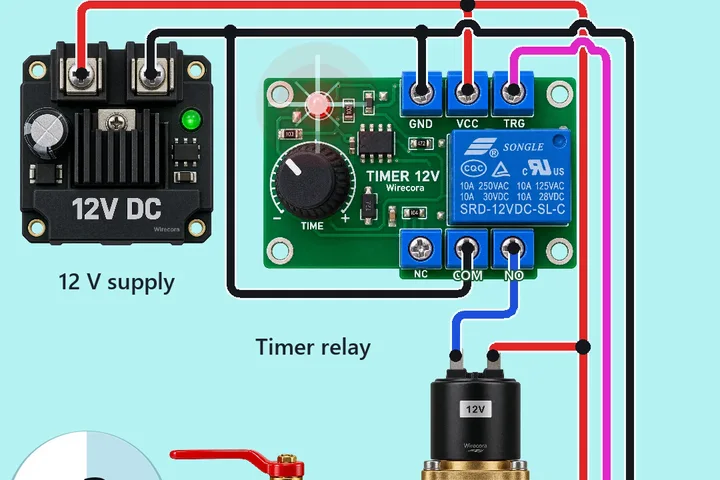
Automatic water filling system
wirecora.com/water
Put a bottle under the tap: the sensor sees it, the timer relay closes, the solenoid valve opens and water runs. After the set time the relay lets go, the valve closes and the water stops.
Parts and how it works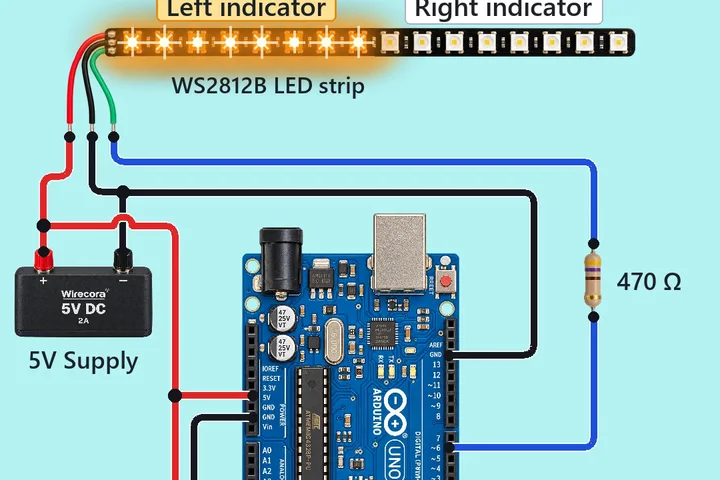
Smart bike indicators
wirecora.com/bike
Lean the bike to the left and the left half of the LED strip sweeps amber from the middle outwards. Lean right and the right half does. Straighten up and the strip goes dark.
Parts and how it works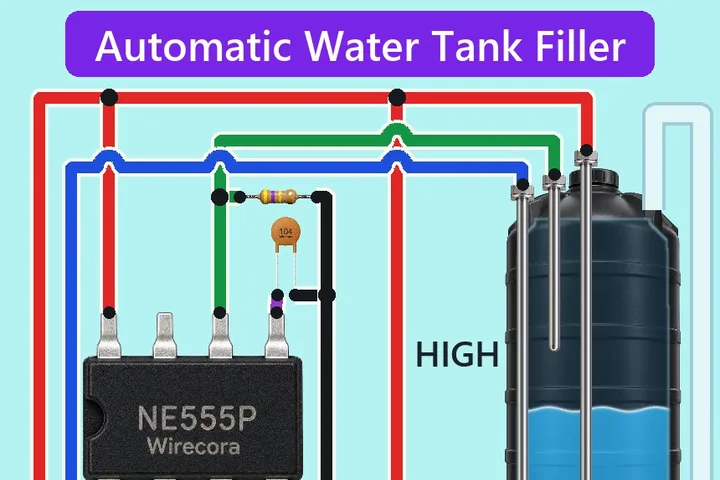
Automatic water tank filler with a 555
wirecora.com/tank
Water leaves the LOW probe: the 555 switches the pump on. Water reaches the HIGH probe: the pump stops. In between, the pump keeps doing what it was doing, so the tank fills from LOW to HIGH and then waits.
Parts and how it works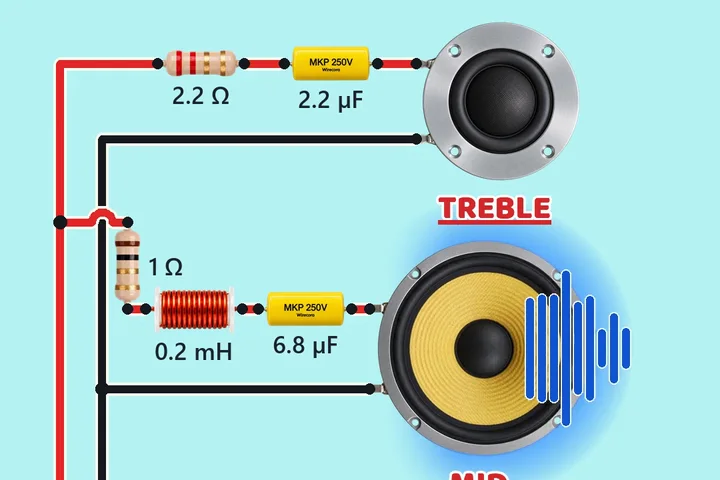
3-way speaker crossover
wirecora.com/crossover
A test tone sweeps from high to low. Sound waves appear on the tweeter first, then on the midrange, then on the woofer, because each speaker gets only the part of the sound its filter lets through.
Parts and how it works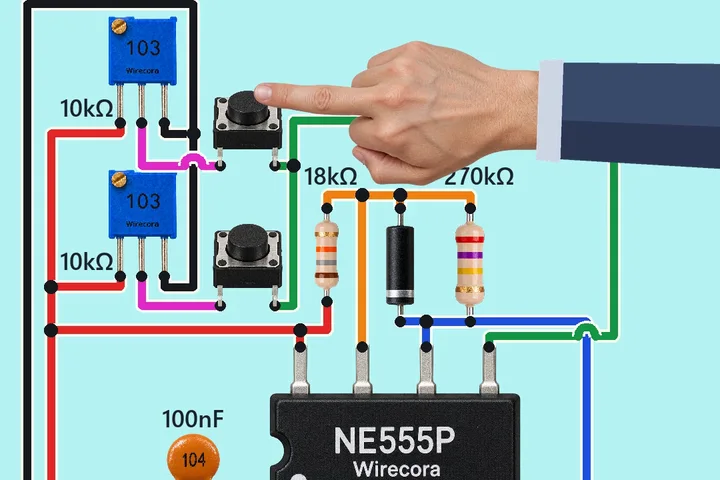
Servo control with a 555 and two buttons
wirecora.com/servo
Hold the top button and the servo horn swings one way. Let go and it comes back to its rest position. Hold the lower button and the horn swings the other way, then comes back again when the finger lifts. In the Short the horn swings a full half turn each way; a real MG995 moves about a quarter turn each way with these pulses (see Simplified).
Parts and how it works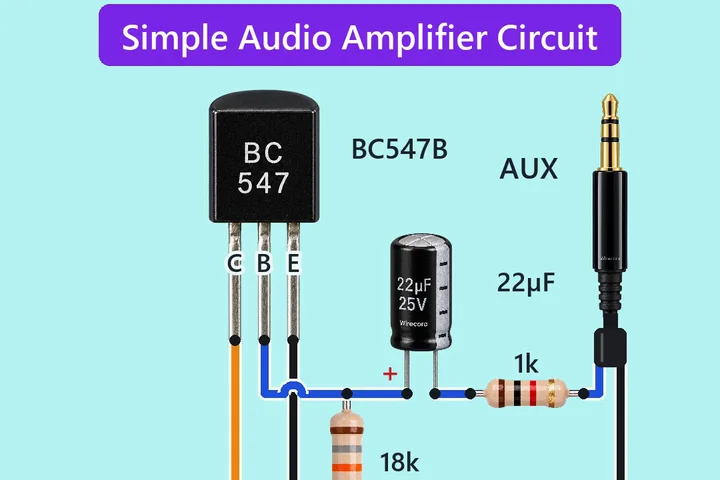
Simple audio amplifier with a BC547B
wirecora.com/amp
Music from a phone goes in at the AUX plug, one transistor and one cell drive the speaker, and the speaker plays the music quietly. In the video the cone pumps with the beat; a real small cone barely moves.
Parts and how it works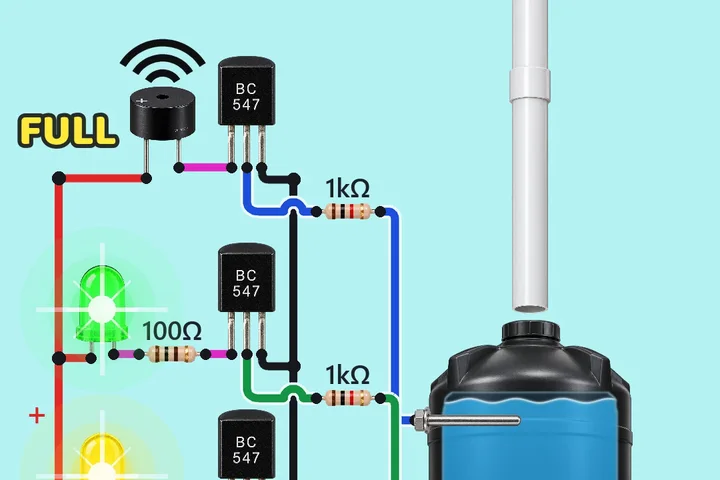
Water level indicator with a buzzer
wirecora.com/level
Water pours into the tank. As the level climbs, the red LED lights first, then the yellow, then the green. When the water reaches the top probe the buzzer sounds: the tank is full.
Parts and how it works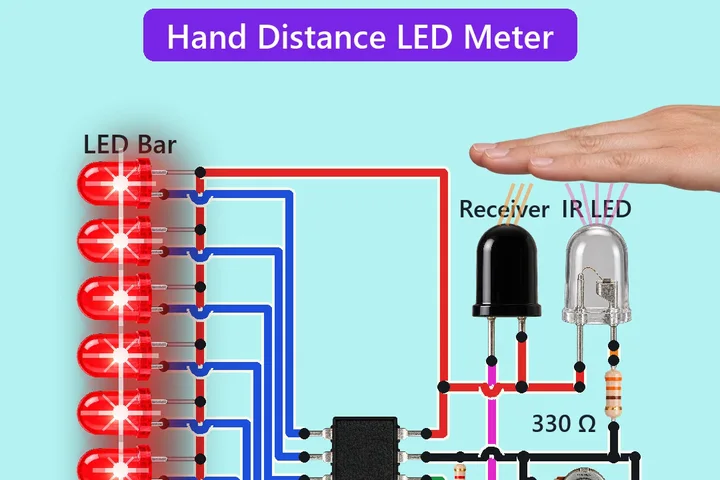
Hand distance sensor with a 10-LED bar
wirecora.com/bar
Hold your hand over the two small sensors: the closer it gets, the more of the ten red LEDs light up, from the bottom of the bar to the top. Pull the hand away and the bar goes dark again.
Parts and how it works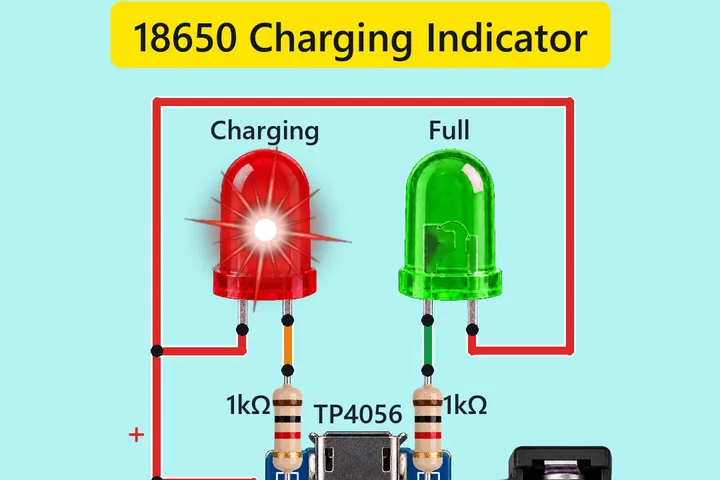
18650 charger with a full indicator
wirecora.com/charger
The charger is plugged in and the holder is empty, so the green Full LED is already lit. Drop an 18650 cell into the holder and the green LED goes out, the red Charging LED comes on and a counter climbs. When the cell is full the red LED goes out and the green Full LED lights again. Lift the cell out and the green LED stays on.
Parts and how it works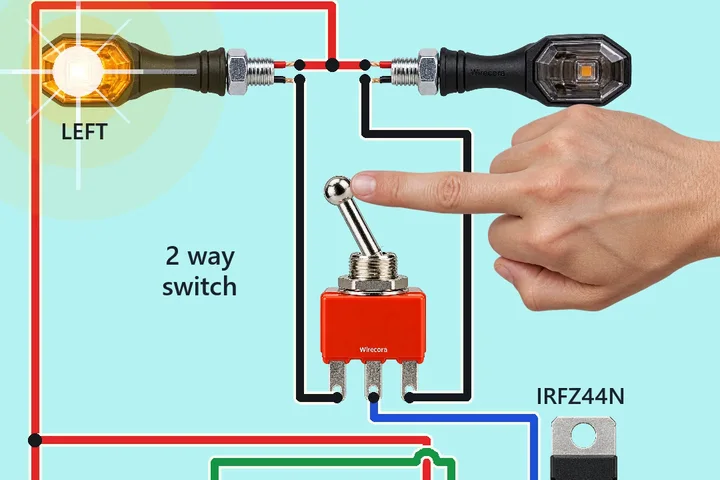
12 V bike indicator flasher with a 555
wirecora.com/flasher
Hold the toggle to the left and the left lamp flashes amber about twice a second for as long as you hold it (three flashes in the clip). Hold it to the right and the right lamp flashes. Let go and the lever springs back to the middle, so both lamps stay dark.
Parts and how it works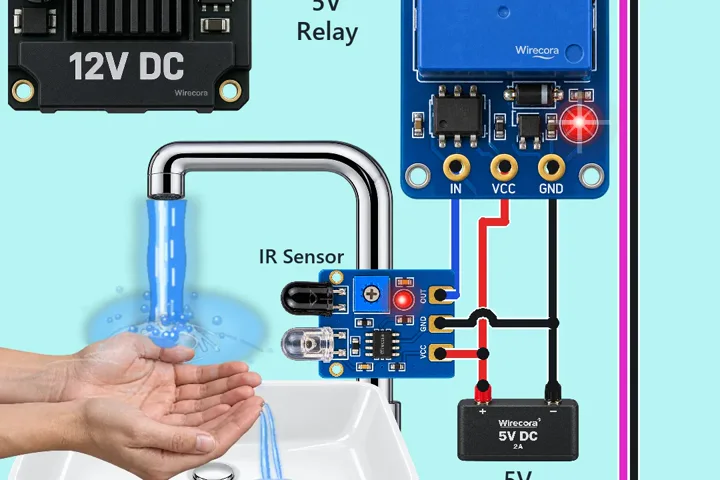
Automatic water tap
wirecora.com/faucet
Hold your hands under the tap: the IR sensor sees them, the relay clicks and water pours onto your hands. Take your hands away and the relay clicks off and the water stops.
Parts and how it works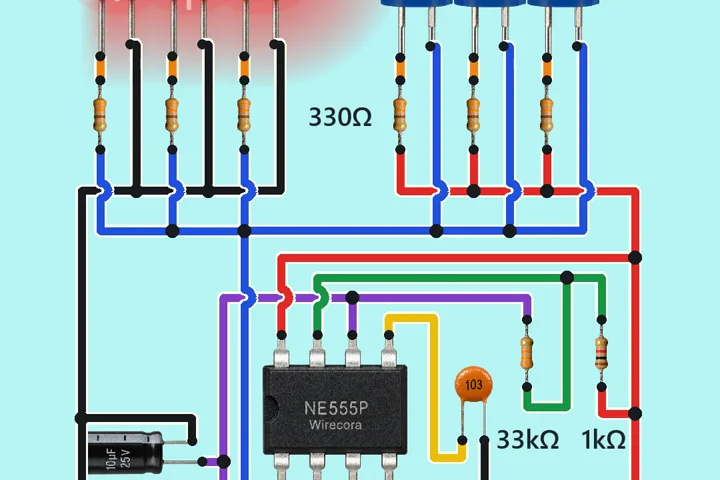
Police lights with a 555
wirecora.com/police
A finger presses the rocker switch on. The three red LEDs light first, then the red and the blue LEDs take turns, about four swaps a second, like the lights on a police car. Press the switch off and everything goes dark.
Parts and how it works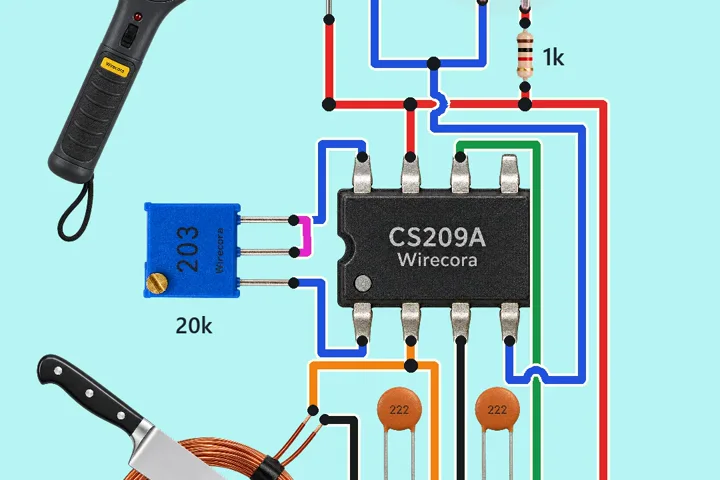
Metal detector with a CS209A
wirecora.com/metal
Slide a kitchen knife onto the search coil and the red LED lights and the buzzer sounds. Take the knife away and both stop. Then a key goes onto the coil and the LED and buzzer come on again.
Parts and how it works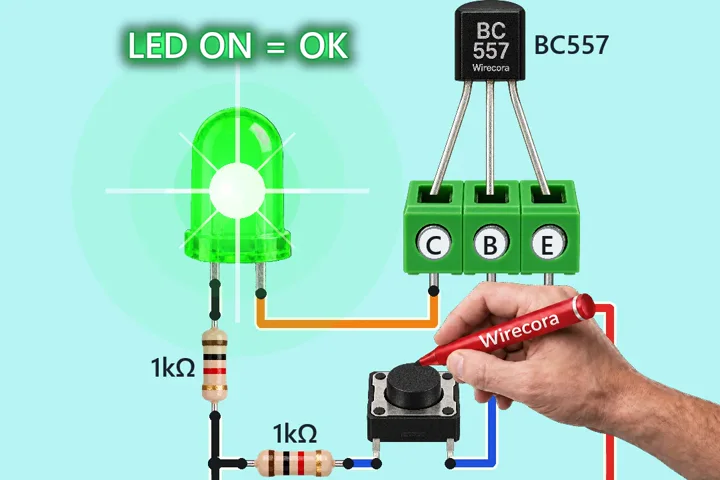
PNP transistor checker with an LED
wirecora.com/pnp
Plug a BC557 into the C, B and E terminals and press TEST: if the transistor works, the green LED lights. Let go and the LED goes out. Pull the transistor out and nothing lights, even with TEST pressed.
Parts and how it works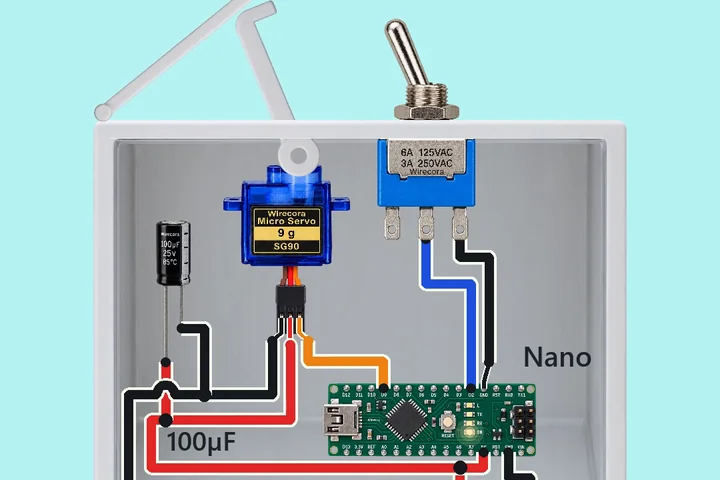
Arduino useless box
wirecora.com/useless
Flip the switch ON and the box pushes its lid open, reaches out with a plastic arm and flips the switch straight back OFF, then hides again. The second time it is angry: the arm comes out at full speed, the lid slams, and a moment later the lid peeks up once.
Parts and how it works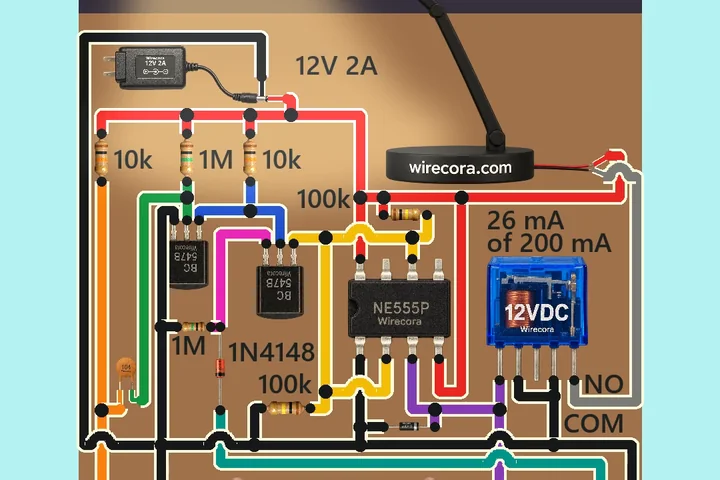
Clap switch lamp with a 555
wirecora.com/clap
Clap once and the desk lamp turns on. Clap again and it turns off. A sound that comes less than about half a second after a clap is ignored, so the clap's own echo and the relay's click do not switch it back.
Parts and how it works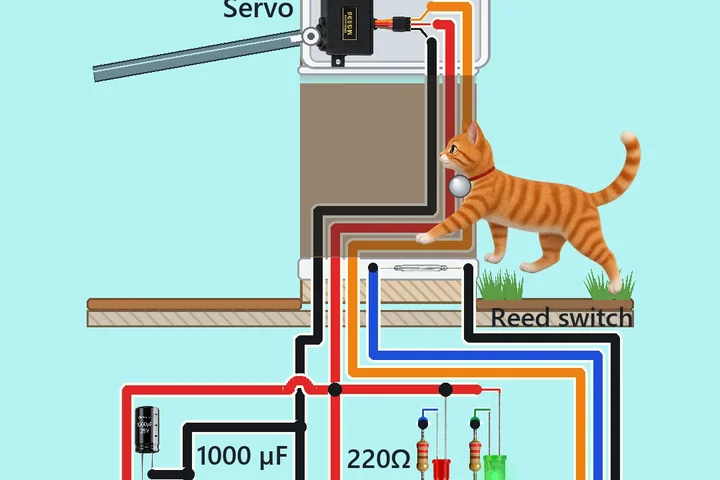
Smart cat door with a magnet tag
wirecora.com/catdoor
The cat walks up to the door. The magnet tag on its collar passes a reed switch in the sill, the green LED lights and a servo swings the flap up. Two seconds after the tag has gone the flap closes slowly and the red LED lights. A raccoon with no tag pushes its nose on the flap, and the flap stays locked.
Parts and how it works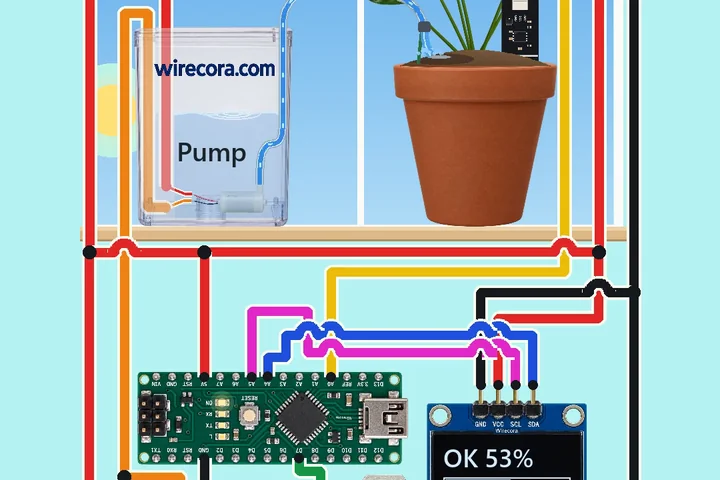
Self-watering plant with a soil sensor
wirecora.com/plant
When the soil dries out, the screen reads DRY, a small pump in the water reservoir starts and water runs through a clear hose into the pot. The number on the screen climbs as the soil gets wet, the drooping leaves lift, and at 70 % the pump stops until the soil is dry again.
Parts and how it works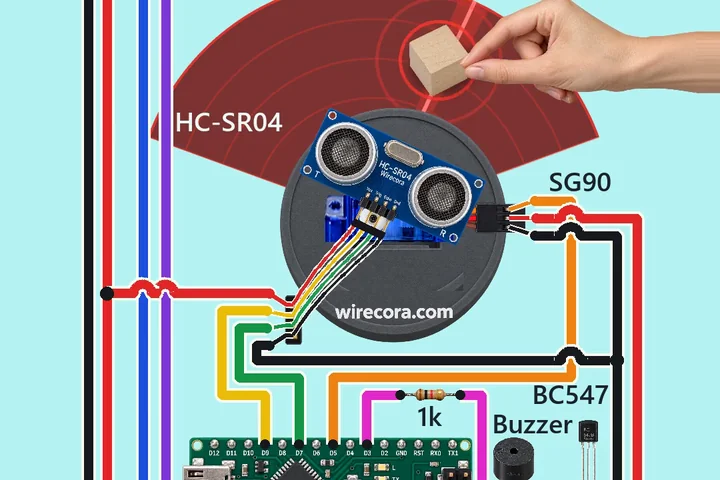
Arduino radar guard with an HC-SR04 and a servo
wirecora.com/radar
An ultrasonic sensor on a servo sweeps from side to side. Put something within 30 cm in front of it: the sweep stops on it, the LCD says WARNING! Object at 15 cm and the buzzer beeps three times. Move the object and the sensor follows it in 5 degree steps. Take it away and the screen says Area is Empty and the sweep starts again.
Parts and how it works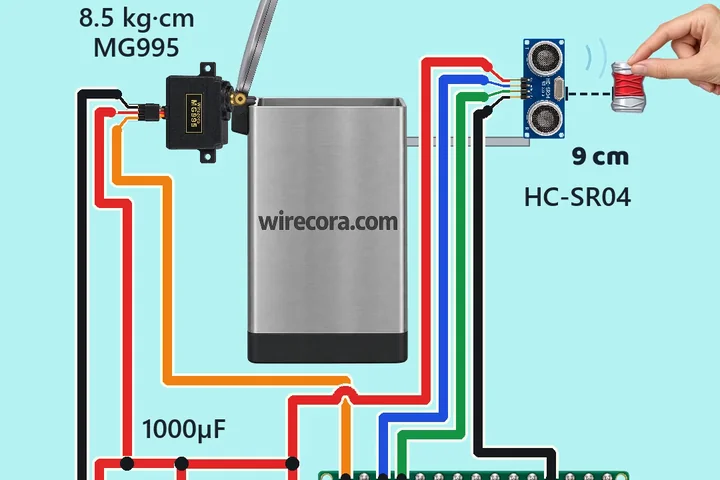
Touchless trash can with an Arduino and an HC-SR04
wirecora.com/trash
Bring a hand with rubbish within 20 cm of the sensor and the lid swings up by itself. Drop the rubbish in and take your hand away: one second later the lid closes, slower than it opened.
Parts and how it works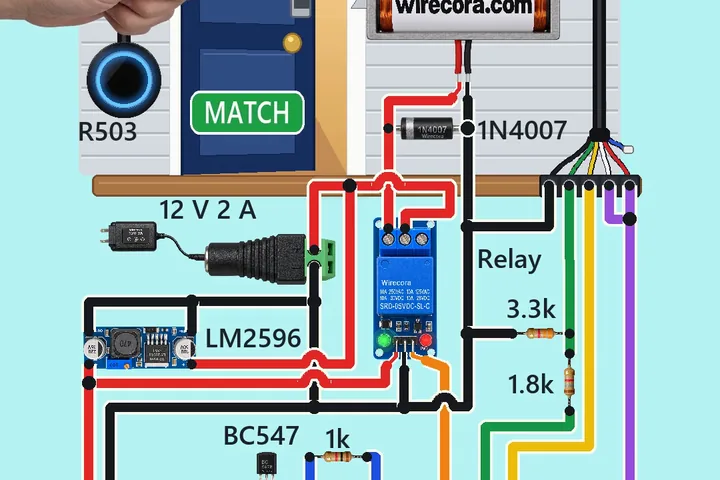
Fingerprint door lock with an Arduino and an R503
wirecora.com/lock
Touch the sensor's ring with an enrolled finger: about half a second later the ring turns blue, the relay clicks and the solenoid pulls its bolt back, so the little door swings open with a push. After 2.2 s the bolt springs out again. A finger the sensor does not know gets two red flashes on the ring and one short buzz, and the bolt stays in.
Parts and how it works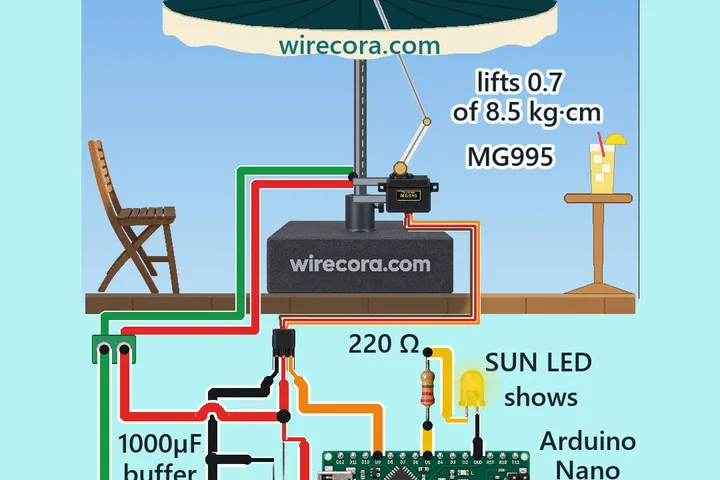
Sun-sensing patio umbrella with an Arduino, an LDR and a servo
wirecora.com/shade
A cloud slides off the sun: the light sensor on top of the pole sees it, the yellow SUN LED lights and a servo pushes the umbrella's runner up the pole, so the canopy opens and shades the chair. When a cloud covers the sun and the sky stays dark, the umbrella folds again, slower than it opened.
Parts and how it works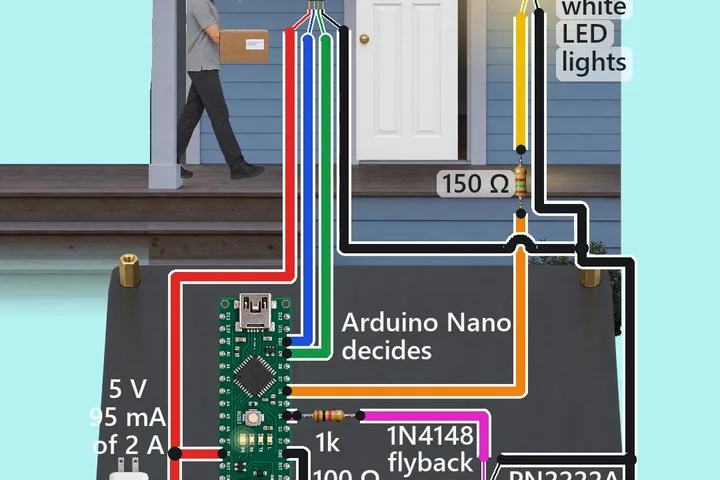
Hands-free porch doorbell with an Arduino and an HC-SR04
wirecora.com/bell
Walk up to the door with your hands full and you do not have to press anything. When you come within 60 cm of the sensor, the porch light comes on and the chime plays ding-dong, once. Stand there as long as you like: it does not ring again. When you leave, the light stays on for a moment, then fades out. After 3 s with nobody near, it is ready for the next visitor.
Parts and how it works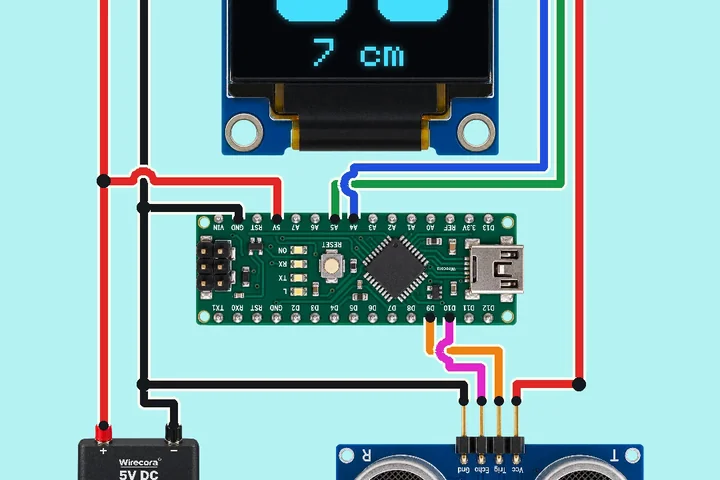
Robot eyes that react to your hand, with an Arduino, an OLED and an HC-SR04
wirecora.com/eyes
A pair of robot eyes on a small screen watches your hand. Far away, the eyes look happy. Closer than 40 cm they turn worried, and closer than 15 cm they turn angry and shake. Take the hand away and they calm down again, back to happy. The distance in cm shows under the eyes.
Parts and how it works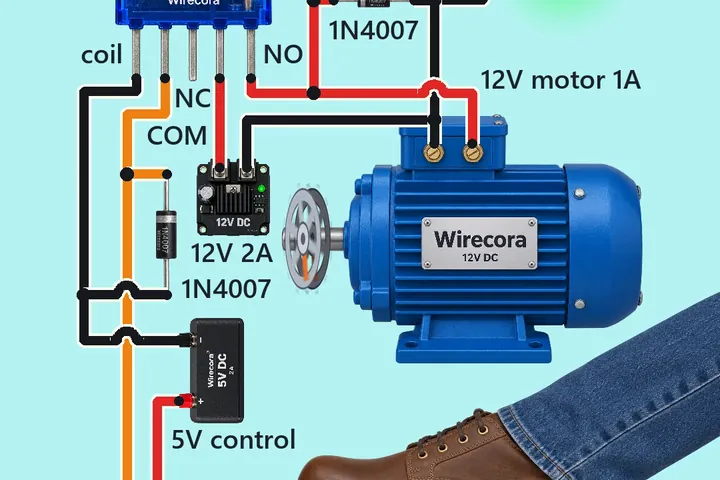
Foot pedal motor switch with a 5 V relay and a 12 V motor
wirecora.com/pedal
Step on the pedal and the 12 V motor runs and the green RUN lamp lights. Lift your foot and the motor coasts to a stop, and the lamp fades out as it slows. The pedal never carries the motor's current: it only switches the relay's coil, and the relay switches the motor.
Parts and how it works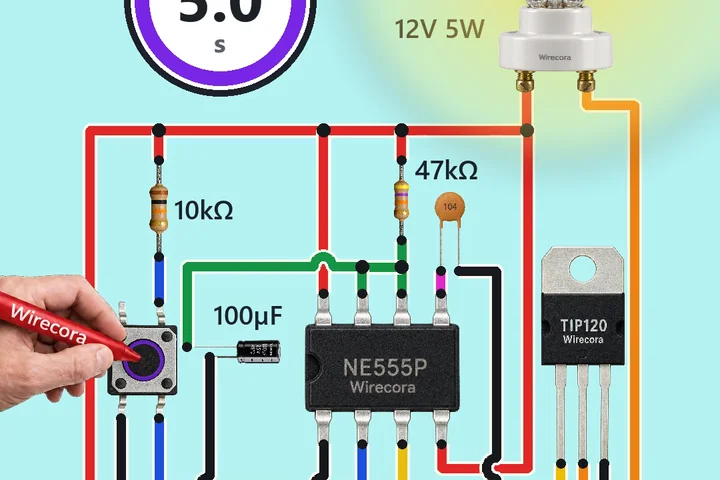
Delay OFF timer with a 555
wirecora.com/delay
Press the button once: the 12 V lamp lights straight away, stays on for about 5 seconds and then switches itself off. Letting go of the button early changes nothing, and pressing it again while the lamp is on does not restart the time.
Parts and how it works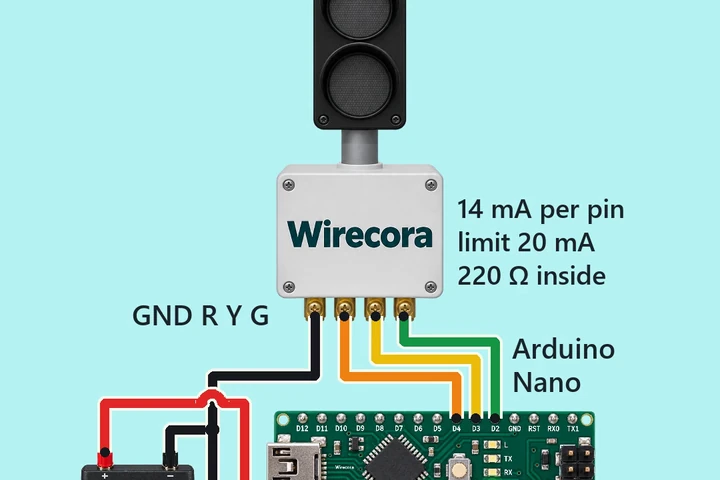
Traffic light with an Arduino Nano
wirecora.com/traffic
An Arduino Nano runs a small traffic light: green, then yellow, then red, then green again. On the road below, toy cars drive through on green, brake on yellow and queue at the stop line on red. When the light turns green they pull away one after another.
Parts and how it works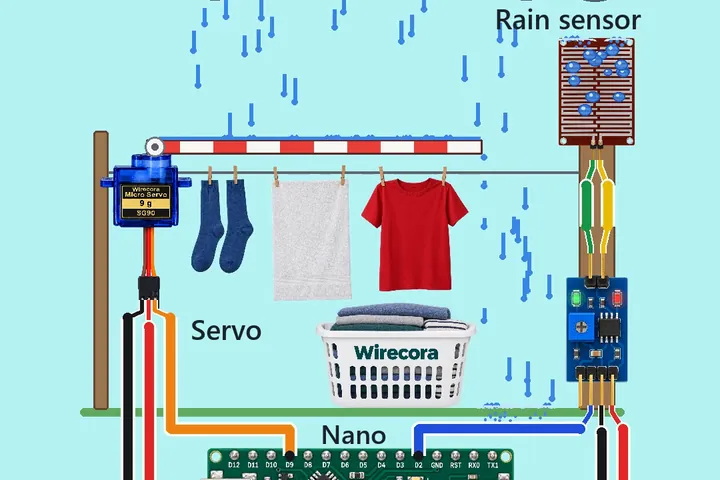
Automatic rain cover for the washing with an Arduino and a rain sensor
wirecora.com/rain
Rain starts to fall on the sensor plate and, within half a second, a servo swings a cover down flat over the clothes on the line. The rain lands on the cover, not on the washing. When the plate has stayed dry for a while, the cover lifts back up.
Parts and how it works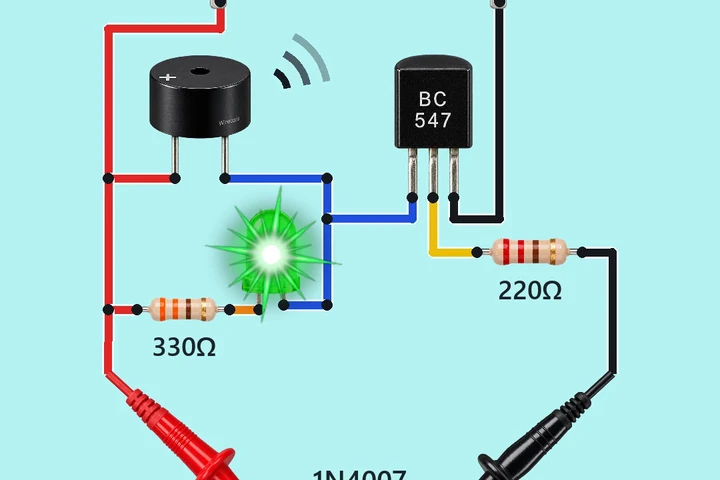
Continuity and diode tester with a BC547 and a buzzer
wirecora.com/beep
Touch the two probes to a wire, a good fuse, or a diode with its band towards the black probe: the buzzer beeps and the green LED lights. A blown fuse stays silent, and so does a diode the wrong way round. That is how you find which end of a diode is which: it beeps one way only.
Parts and how it works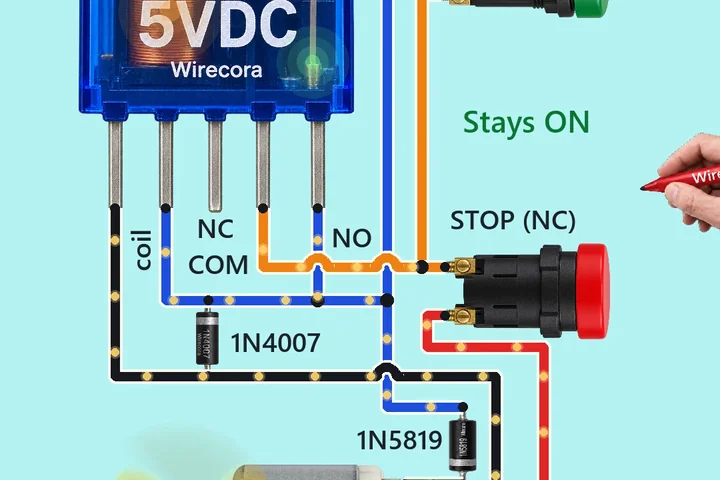
Start/stop latch with one 5 V relay
wirecora.com/latch
Press the green START button once and let go: the relay clicks in and the motor keeps spinning its propeller. Press the red STOP button: the relay drops out and the propeller coasts to a stop. Let go of STOP and nothing starts again until you press START. Machine motor starters use the same start/stop latch; this one runs on a safe 5 V.
Parts and how it works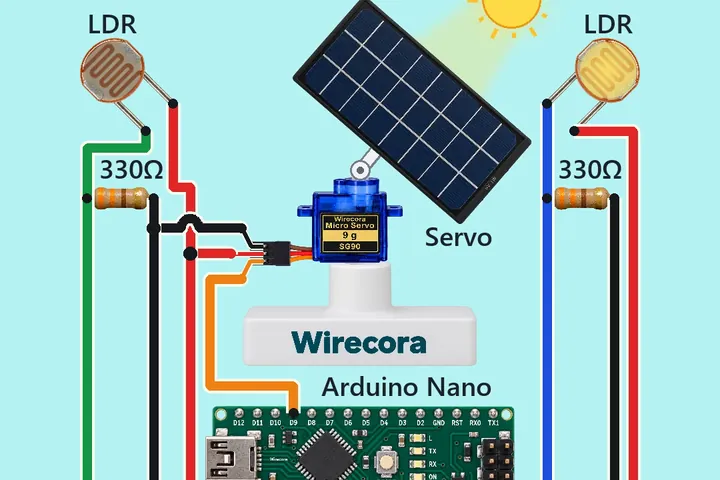
Arduino solar tracker with two LDRs and a servo
wirecora.com/tracker
As the sun crosses the sky, two light sensors tell an Arduino which side is brighter, and a servo turns a small solar panel to face the sun, a few degrees at a time. At sunset it goes back to the middle, ready to swing towards the next sunrise.
Parts and how it works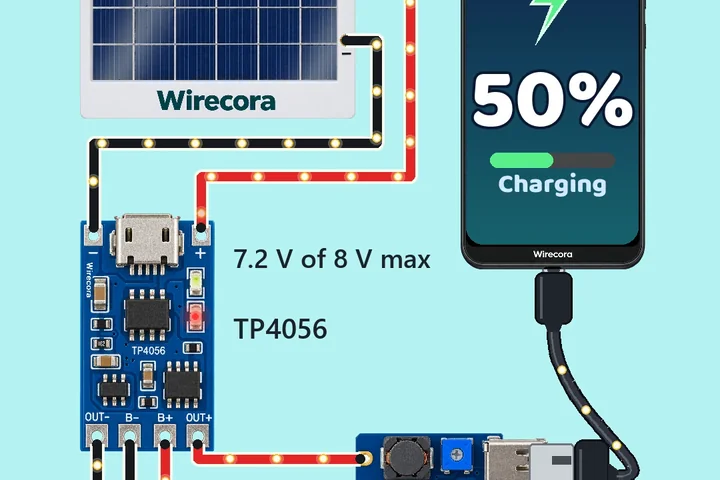
Solar power bank with a TP4056 and an 18650 cell
wirecora.com/solar
The sun shines on a small solar panel and slowly fills one 18650 lithium cell. Push the USB plug into the phone and the screen lights up: the cell, lifted to 5 V by a boost board, charges the phone. Pull the plug and the panel goes back to filling the cell. It is a top-up: one cell gives about a third of a phone charge.
Parts and how it works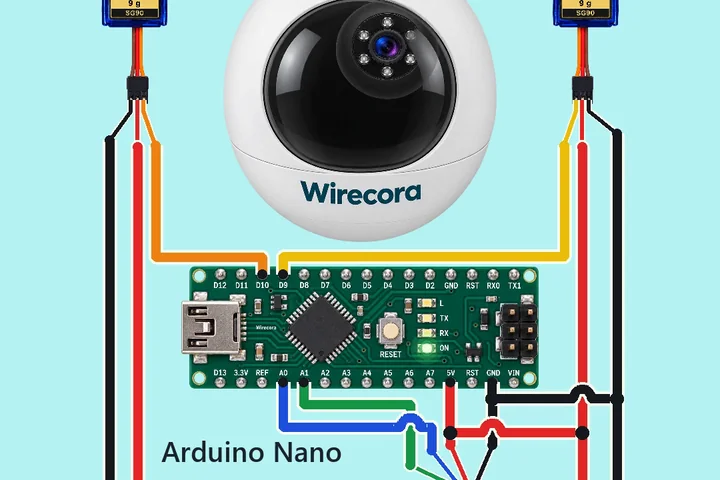
Joystick pan-and-tilt camera with an Arduino and two SG90 servos
wirecora.com/camera
Push the thumb stick and the camera's lens follows it: left, right, up and down. Let go and the stick springs back to the middle, and the camera looks straight ahead again. Two small servos turn the camera: one turns it left and right (pan), the other tips it up and down (tilt).
Parts and how it works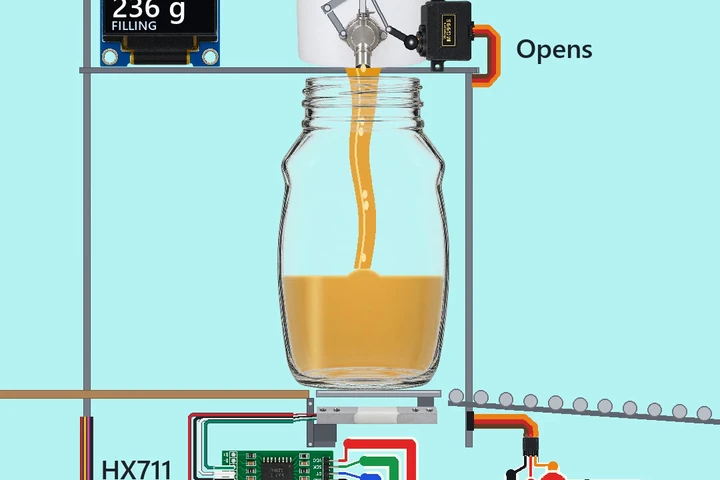
Arduino honey jar filler with an HX711 scale and an MG995 servo
wirecora.com/honey
Set an empty jar on the scale and the honey gate opens by itself. A load cell weighs the jar while the honey runs in. The gate shuts about 5 g before 500 g, because the reading lags a little and the gate needs 0.2 s to close, so the jar ends within a few grams of 500 g (about 1 lb). Take the full jar off, set down the next empty one, and it starts again. It stops by weight, not by time: thick cold honey runs slower, but the scale still shuts the gate at the same weight.
Parts and how it works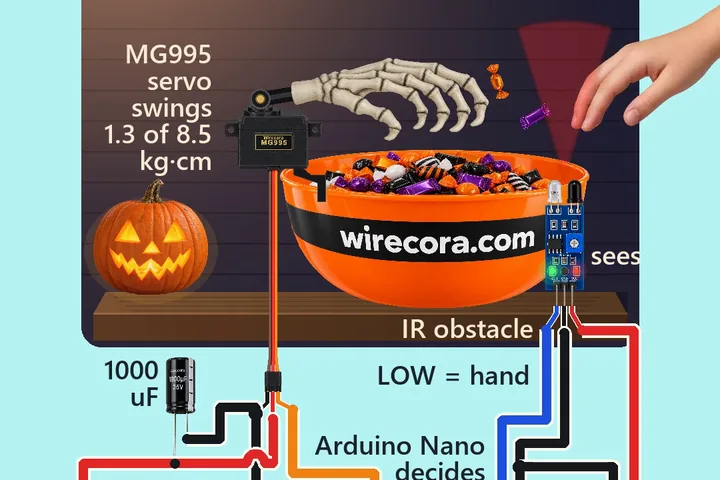
Grabbing candy bowl with an Arduino, an IR sensor and an MG995 servo
wirecora.com/grab
Reach into the candy bowl and a skeleton hand swings down beside your fingers. It taps twice over the candy, then folds slowly back up and waits. It stops about 1 cm above the candy, next to the reaching hand, never on it. Pull the plug and it is just a candy bowl again.
Parts and how it works
Take-one candy bowl with an Arduino, a load cell and an MG995 servo
wirecora.com/candy
The bowl weighs its own candy. Take one bar and nothing happens. Grab a fistful and the light bar under the bowl flashes red, the screen says ONLY ONE! and a skeleton arm throws up a sign. Put the extras back: the count on the screen drops with every bar, and at one bar the light turns green, the screen says THANK YOU and the arm folds down. A second later the bowl counts again from its new weight.
Parts and how it works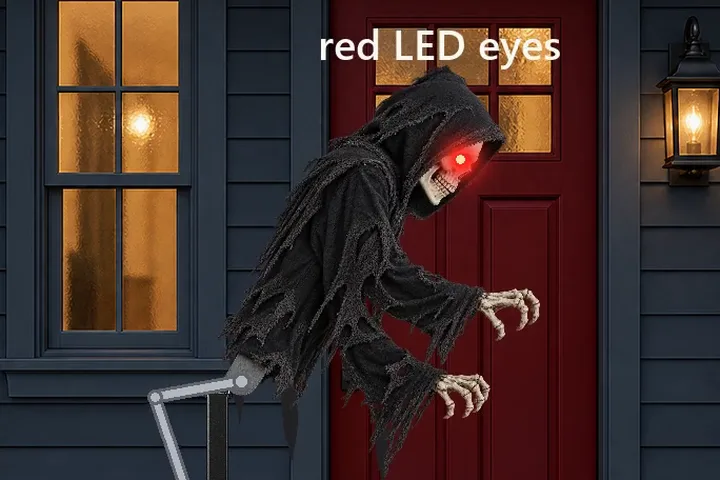
Step-pad porch reaper with a 555 timer and a worm gear motor
wirecora.com/reaper
Step on the STEP HERE mat and the hooded reaper by the door lunges at you twice with glowing red eyes, then leans back and waits for the next visitor. A 555 timer and a gear motor do it all: there is no code and no microcontroller.
Parts and how it works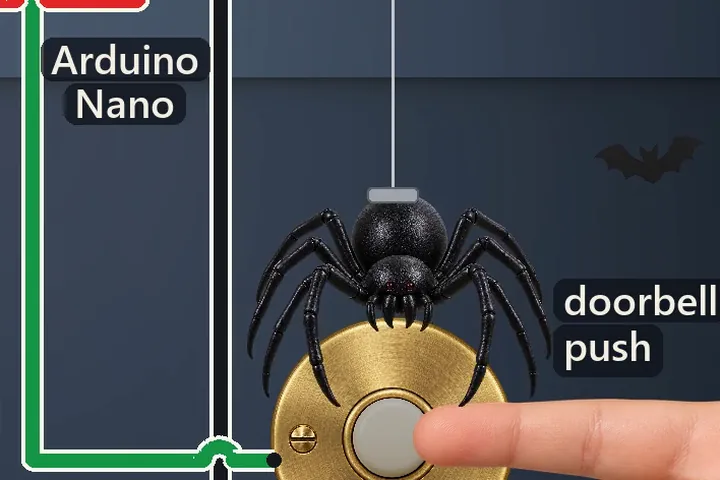
Doorbell spider drop with an Arduino Nano, an L298N and a TT gear motor
wirecora.com/spider
Press the doorbell and a big rubber spider drops 10 cm onto the finger that rang it, bobs on its elastic line, then climbs back up in three tugs and parks at exactly the same spot, ready for the next trick-or-treater. It drops once per press and only for whoever rings, not for every passer-by.
Parts and how it works
Flying yard ghost with a motion sensor, an Arduino Nano and a 12 V gear motor
wirecora.com/ghost
A trick-or-treater walks up the path, a motion sensor sees them, and a white cloth ghost launches from beside the porch, swoops across the yard right over their head, flies one lap of a fishing-line loop and parks itself back in its hiding spot, ready for the next visitor. One lap per visitor, and it always stops in the same place.
Parts and how it works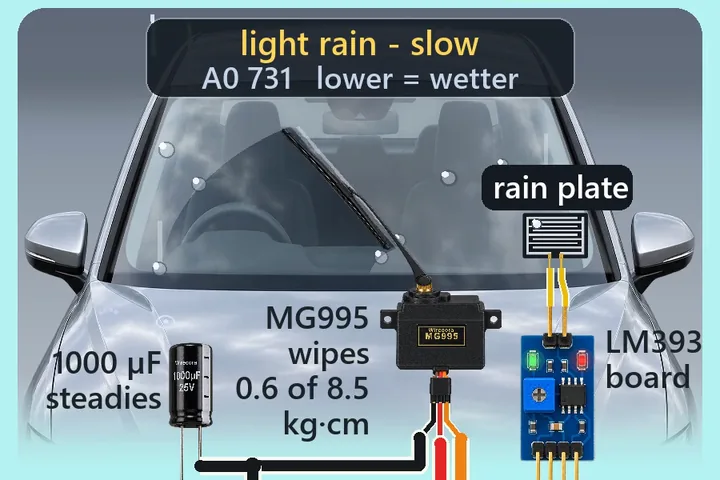
Automatic rain wiper with an Arduino, a rain sensor and a servo
wirecora.com/wiper
The first drops land on a small rain plate on the glass and the wiper starts by itself. When the rain gets heavy it wipes faster with no pause. When the rain eases it slows down again, and once the plate is dry the blade goes back to rest along the bottom of the glass.
Parts and how it works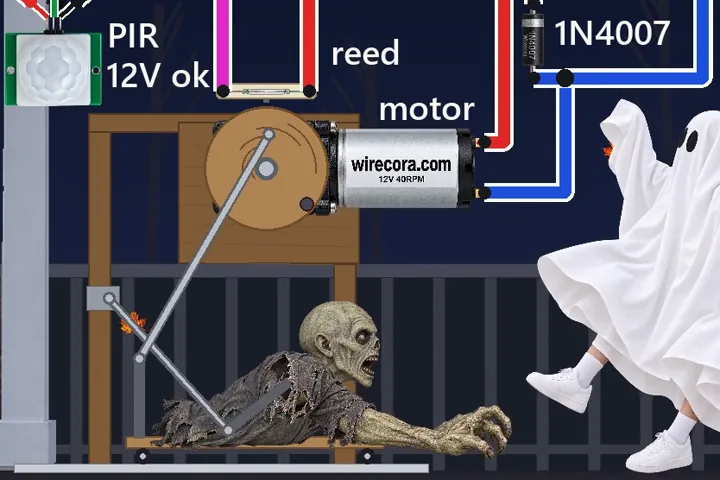
Crawling porch zombie with a PIR sensor, two BC547s, an IRFZ44N and a worm gear motor
wirecora.com/zombie
A trick-or-treater walks onto the porch and the legless zombie by the railing lunges at their feet, claw first, slides back and lunges again, then parks in exactly the same spot for the next visitor. A motion sensor, two transistors and a MOSFET run it: there is no code and no microcontroller.
Parts and how it works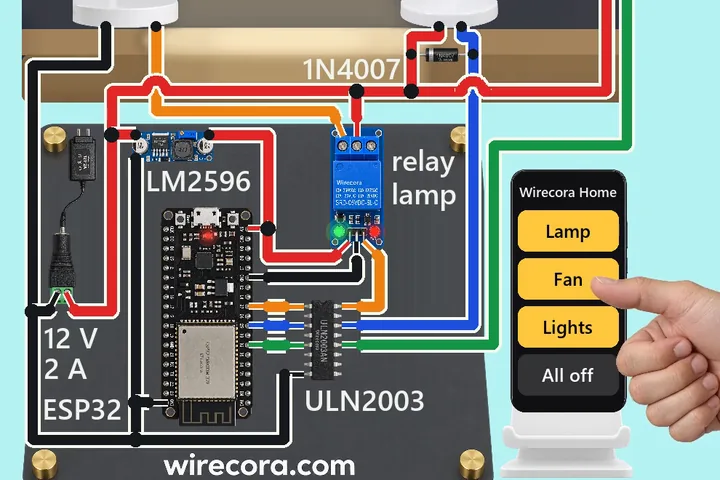
Phone-controlled smart desk with an ESP32, a ULN2003 and a relay
wirecora.com/phone
Tap Lamp on your phone and the desk lamp comes on with a relay click. Tap Fan and the desk fan spins up, tap Lights and the LED strip under the shelf glows, tap All off and the whole desk goes dark. The page on the phone is served by the ESP32 itself on your home Wi-Fi: no app, no cloud, no account, and it keeps working when the internet is down.
Parts and how it works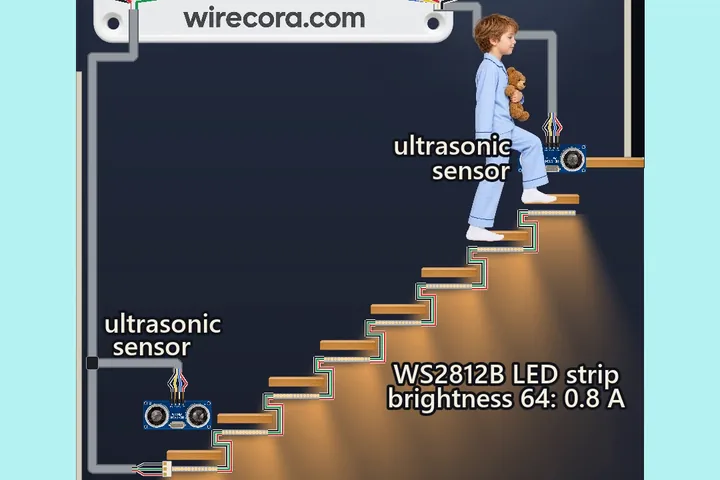
Stair lights that follow you, with an Arduino and two HC-SR04 sensors
wirecora.com/steps
Walk up to the bottom step and the stair lights up one step after another, ahead of you, all the way to the top. Leave at the top and the steps fade out behind you in the same order, a little slower. Coming down from the top works the same way in reverse.
Parts and how it works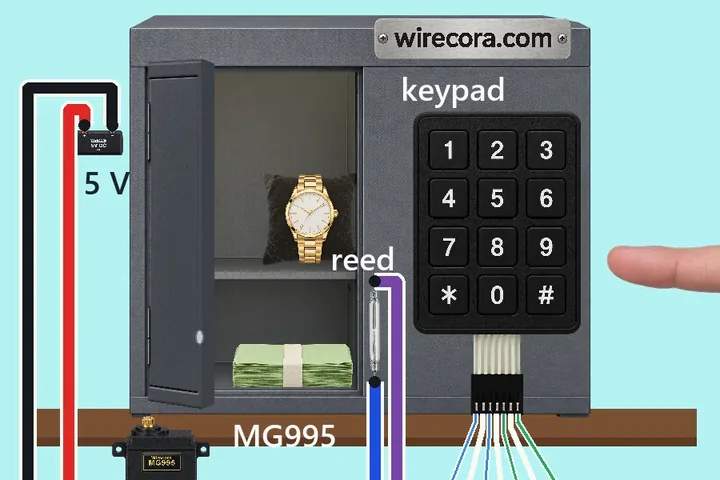
Keypad code door with an Arduino, an MG995 servo and a reed switch
wirecora.com/safe
Type a wrong four-digit code and the screen says WRONG CODE, the buzzer buzzes and the backlight blinks. Type 4-7-8-9 and the screen says OPEN, a servo under the hinge swings the little door 75 degrees open, and 1.2 s later it closes it again slowly. A reed switch on the frame tells the Arduino the door is really shut, and the screen says CLOSED. Three wrong codes in a row lock the keypad for 30 s. It is a code door, not a lock: see below.
Parts and how it works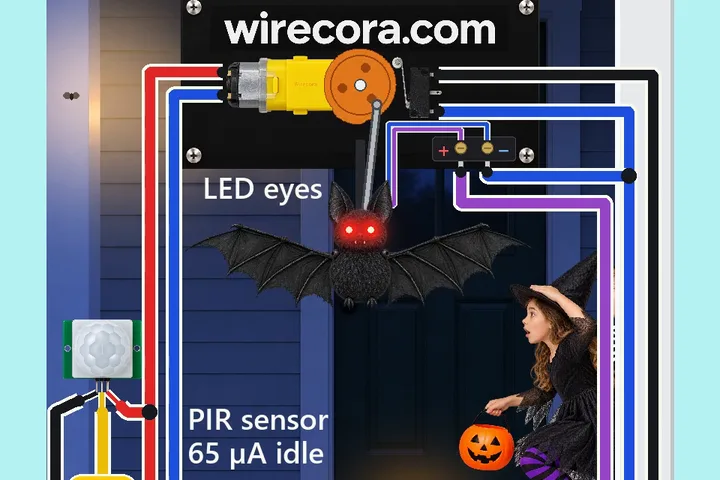
Flapping porch bat with a motion sensor, a TIP120 and a TT gear motor
wirecora.com/bat
Trick-or-treaters walk up to the door, a motion sensor sees them, and the big bat under the porch roof lights its red eyes and beats its wings, about two a second. A few seconds later it folds its wings neatly and waits for the next group. There is no Arduino and no code: the sensor's own timer, one transistor and a switch on the crank do it all, on four AA cells.
Parts and how it works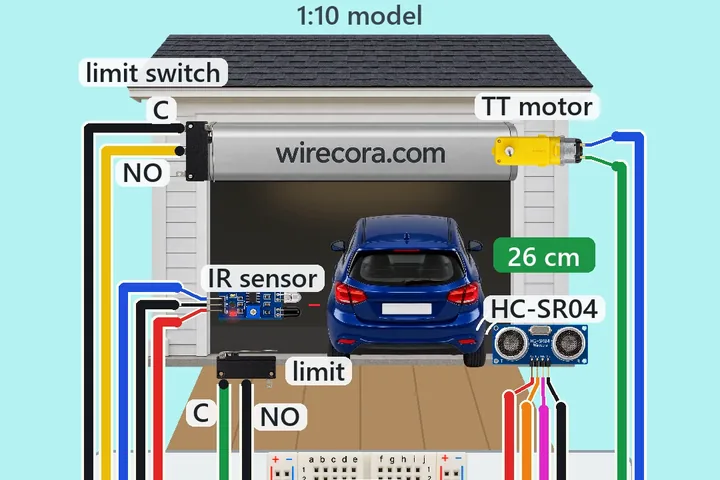
Model garage door that opens for a car, with an Arduino Nano, an HC-SR04 and an L298N
wirecora.com/garage
A car rolls up the driveway. When it is closer than 150 cm the roller door opens by itself and stops at the top. The car drives in past an IR sensor in the doorway, and 0.6 s after it has passed, the door rolls down and stops on the floor. If anything is in the doorway while it closes, it opens again. It is a 1:10 model on 12 V, not a real garage door.
Parts and how it works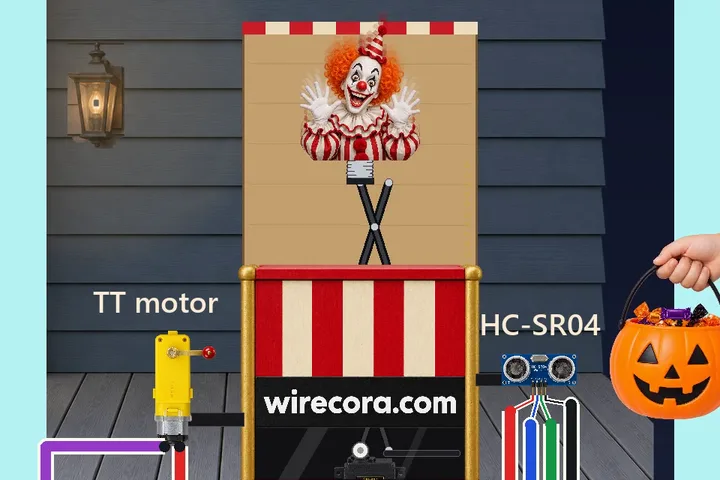
Porch jack-in-the-box with an Arduino Nano, an HC-SR04, an MG995 servo and a TT gear motor
wirecora.com/jack
Hold your trick-or-treat pail out to the box. When it comes within 20 cm, the crank on the side turns once, the lid flies open and a clown springs up about 24 cm, bobbing on its spring neck. About 3 seconds later it folds back in slowly, the lid drops shut on top of it, and once nothing has been near for a second it waits for the next kid.
Parts and how it works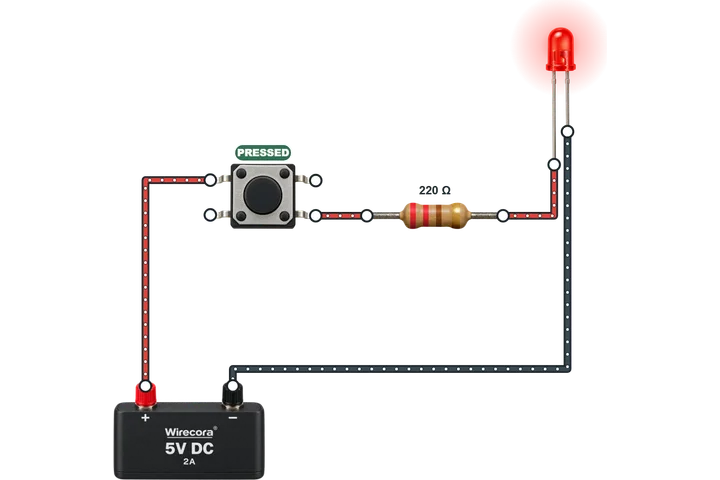
Your first circuit, step by step
wirecora.com/build
A button, a resistor and an LED. You join four wires; the board shows every step.
Build this one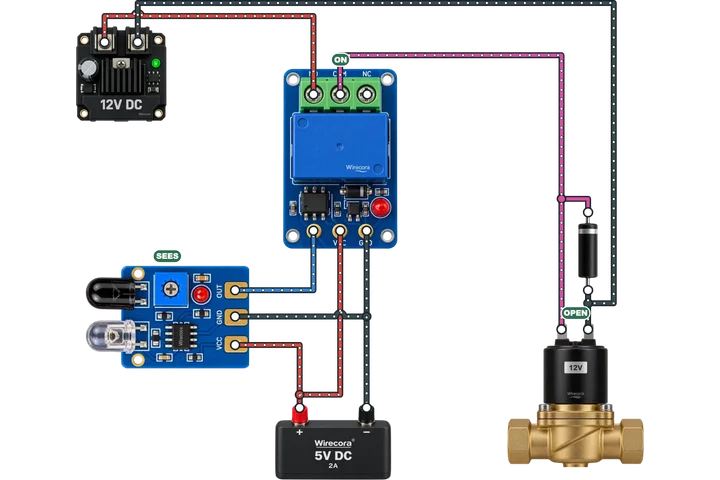
Touchless tap
wirecora.com/tap
Hand near the sensor: the relay clicks and the valve opens. Hands away, water stops.
Build this one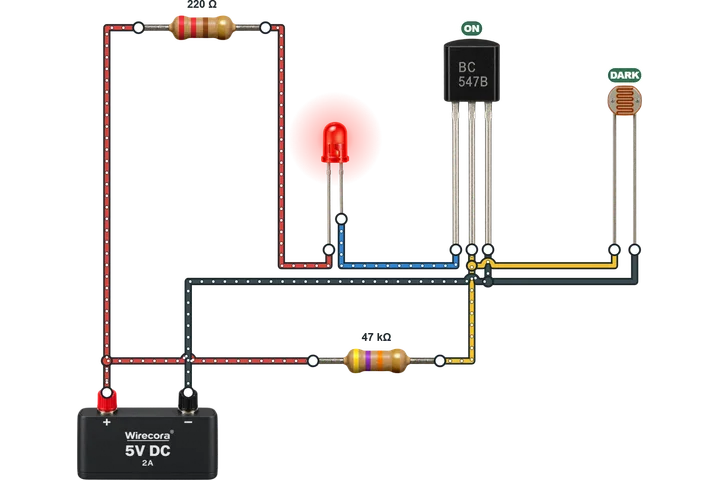
Night light
wirecora.com/night
Cover the light sensor and the transistor switches the LED on.
Build this one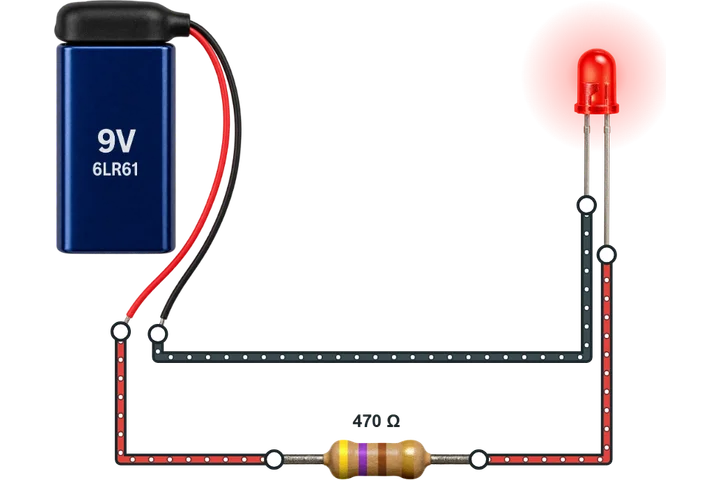
LED with a resistor
wirecora.com/led
The simplest circuit that works: a 9 V battery, a resistor and an LED.
Build this one
Saw a Short whose circuit is not here yet? It is coming. Meanwhile build it yourself from the parts.