Automatic water tank filler with a 555
Water leaves the LOW probe: the 555 switches the pump on. Water reaches the HIGH probe: the pump stops. In between, the pump keeps doing what it was doing, so the tank fills from LOW to HIGH and then waits.
From the Short Automatic Water Tank Filler Using 555 Timer (posted 13 October 2026). Opens on YouTube.
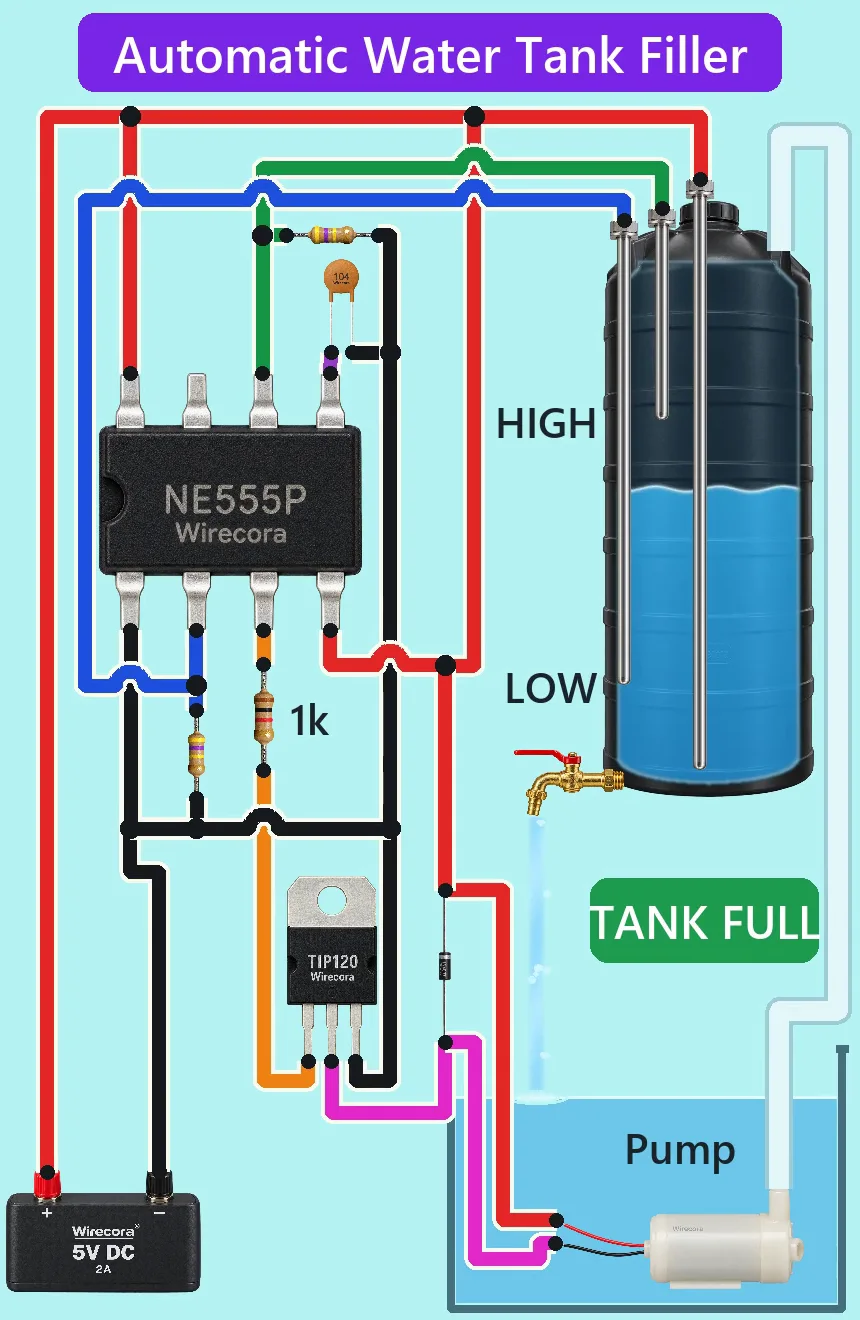
Parts
- NE555P timer, DIP-8
- TIP120 Darlington transistor, TO-220 (legs B C E from the left, flat face forward)
- 1N4007 diode across the pump (band to plus)
- 100 nF ceramic capacitor (104) on pin 5
- Two 470 k resistors, one 1 k resistor
- Mini submersible pump, 3 to 6 V, about 130 to 220 mA
- 5 V 2 A power supply
- Three stainless steel probes: COMMON, LOW and HIGH
How it is wired
- 5 V plus to 555 pin 8 (VCC) and pin 4 (RESET), to the COMMON probe, to the pump's red wire and to the diode's band.
- Minus to 555 pin 1 (GND), the lower ends of both 470 k resistors, one side of the 100 nF, and the TIP120 emitter.
- 555 pin 2 (TRIG) to the LOW probe and to one 470 k resistor (down to minus).
- 555 pin 6 (THRES) to the HIGH probe and to the other 470 k resistor (down to minus).
- 555 pin 5 (CONT) to the 100 nF (down to minus). Pin 7 is left unconnected.
- 555 pin 3 (OUT) through the 1 k resistor to the TIP120 base.
- TIP120 collector to the pump's black wire and to the diode's other end.
How it works
- Water conducts a little. While a probe is under water it is joined to COMMON, so its 555 pin sits near 5 V. A dry probe's pin is pulled down to near 0 V by its 470 k resistor.
- The 555 is used as a latch. Pin 2 going low (LOW probe dry) sets the output high: the TIP120 turns on and the pump runs.
- Pin 6 going high (HIGH probe wet) with pin 2 already high resets the output: the pump stops.
- Between the two probes nothing changes, so a falling level does not restart the pump until it drops under LOW again.
- With the pump running the TIP120 carries about 160 mA and the pump sees about 4.3 V. The diode takes the coil's kick when the pump switches off.
What the video simplifies
- The water speed is sped up for the video; a real tank fills in minutes.
- The tank is drawn cut away so the level can be seen.
- Plain DC on the probes slowly corrodes them: use stainless steel and expect to clean them.
- Water resistance between the probes was taken as 10 k to 100 k; very pure water may need a different pull-down value.
All 5 V. Keep the supply and the circuit dry and above the tank; only the probes and the pump go in the water.
Build it yourself
The wiring board has no 555 yet, so this one cannot be opened on it. Start with the guided first build on the wiring board, where a circuit really works as you wire it, then try the ready-made ones.
Your first circuit, step by stepAll circuits from the Shorts
Stuck, or built it?
Ask about this circuit or show your build in the Wirecora Discord. Questions get an answer every day.