Water level indicator with a buzzer
Water pours into the tank. As the level climbs, the red LED lights first, then the yellow, then the green. When the water reaches the top probe the buzzer sounds: the tank is full.
From the Short Water Level Indicator with Buzzer | BC547 (305K views, posted 2026). Opens on YouTube.
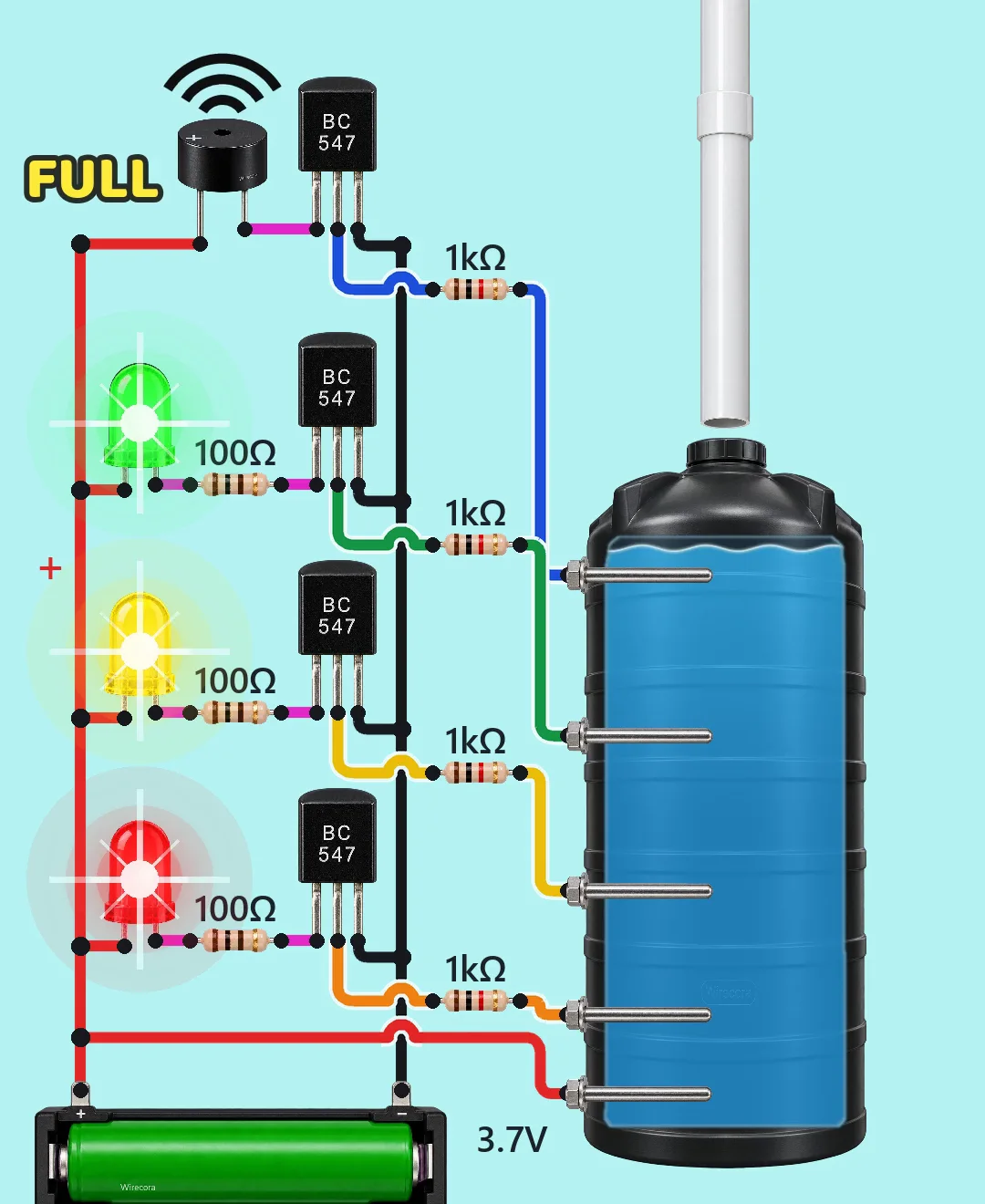
Parts
- 18650 lithium cell, 3.7 V, in a holder
- Four BC547 NPN transistors, TO-92 (legs C, B, E from the left with the flat face toward you and the legs pointing down)
- Three LEDs: red, yellow and green
- Three 100 ohm resistors, one for each LED
- Four 1 k resistors, one in each base wire
- Active buzzer for 3 V to 5 V (it makes its own tone; a 12 V type will not sound from one cell)
- Five metal probes: one common probe at the bottom of the tank and four level probes (red, yellow, green, buzzer, from the bottom up)
- Thick wires and a tank with a pipe
How it is wired
- Cell plus to the red plus rail. The plus rail joins the buzzer's plus leg (the long one), the anode (long leg) of each LED, and the common probe at the bottom of the tank.
- Cell minus to the black ground rail. The ground rail joins the emitter (right leg) of all four BC547s.
- Each LED: cathode (short leg) to a 100 ohm resistor, the resistor to the collector (left leg) of that LED's BC547.
- Buzzer minus leg (short) straight to the collector (left leg) of the buzzer's BC547.
- Each BC547 base (middle leg) to a 1 k resistor, the resistor to that row's level probe in the tank. The base wires hop over the ground rail.
- Probes from the bottom up: common (plus), red, yellow, green, buzzer.
How it works
- Water conducts a little electricity. The common probe at the bottom sits at the cell's plus. When the water climbs up to a level probe, a small current flows through the water, through the 1 k resistor and into that transistor's base.
- That small base current (0.2 to 0.4 mA with the water resistance assumed in the video) switches the BC547 on, and its collector pulls down to about 0.1 V. The LED then gets current through its 100 ohm resistor: 15 to 17 mA, enough to light it well.
- The probes are at different heights, so the red LED lights first, then the yellow, then the green as the level rises. When the water reaches the top probe the fourth transistor switches on and the buzzer sees nearly the full 3.7 V and sounds (about 20 mA for the buzzer assumed in the video).
- When the water drops below a probe, the base current stops, that transistor turns off and its LED or buzzer goes dark.
- The 1 k resistors keep the base current under 3 mA even if the water conducts very well. With the BC547's gain of at least 110 and water of a few kilohms, every row switches fully on; the buzzer row has the least margin (its probe is farthest from the common probe), so with poorer water it is the first to go dim or stay silent.
What the video simplifies
- The tank fills in 4 seconds in the Short; a real tank takes minutes or hours. The probe spacing is for readability, not to scale.
- The tank is drawn cut away so you can see the water level; a real tank is opaque.
- The water's resistance in the video is illustrative (a few kilohms). Soft or very pure water conducts worse: a real build may need a Darlington pair or a comparator stage.
- The video's numbers use 3.7 V. A freshly charged cell is 4.2 V, so the LED currents are a little higher (up to about 22 mA); the 100 ohm resistors still keep them within what an ordinary LED takes.
- The original circuit wires the probes straight to the bases; the 1 k resistors are our addition to limit the base current.
- Plain DC on the probes slowly corrodes them; use stainless steel and expect to clean them.
- The falling water, splash, halos, FULL tag and sound arcs are drawn for the video, and the audio is synthesized.
Everything runs from a single 3.7 V cell, so nothing here can shock you. An 18650 can push a very large current if its terminals are shorted, so keep it in a holder, never let bare wires touch across it, and use a protected cell if you have one. Keep the cell and the circuit dry and above the tank; only the probes go in the water.
Build it yourself
The wiring board has a BC547, LEDs and a buzzer, but no water tank or probes to act as the water switch, so this one cannot be opened on it yet. Start with the guided first build on the wiring board, where a circuit really works as you wire it, then try the ready-made ones.
Your first circuit, step by stepAll circuits from the Shorts
Stuck, or built it?
Ask about this circuit or show your build in the Wirecora Discord. Questions get an answer every day.