Electrolytic capacitor wired backwards on 12 V
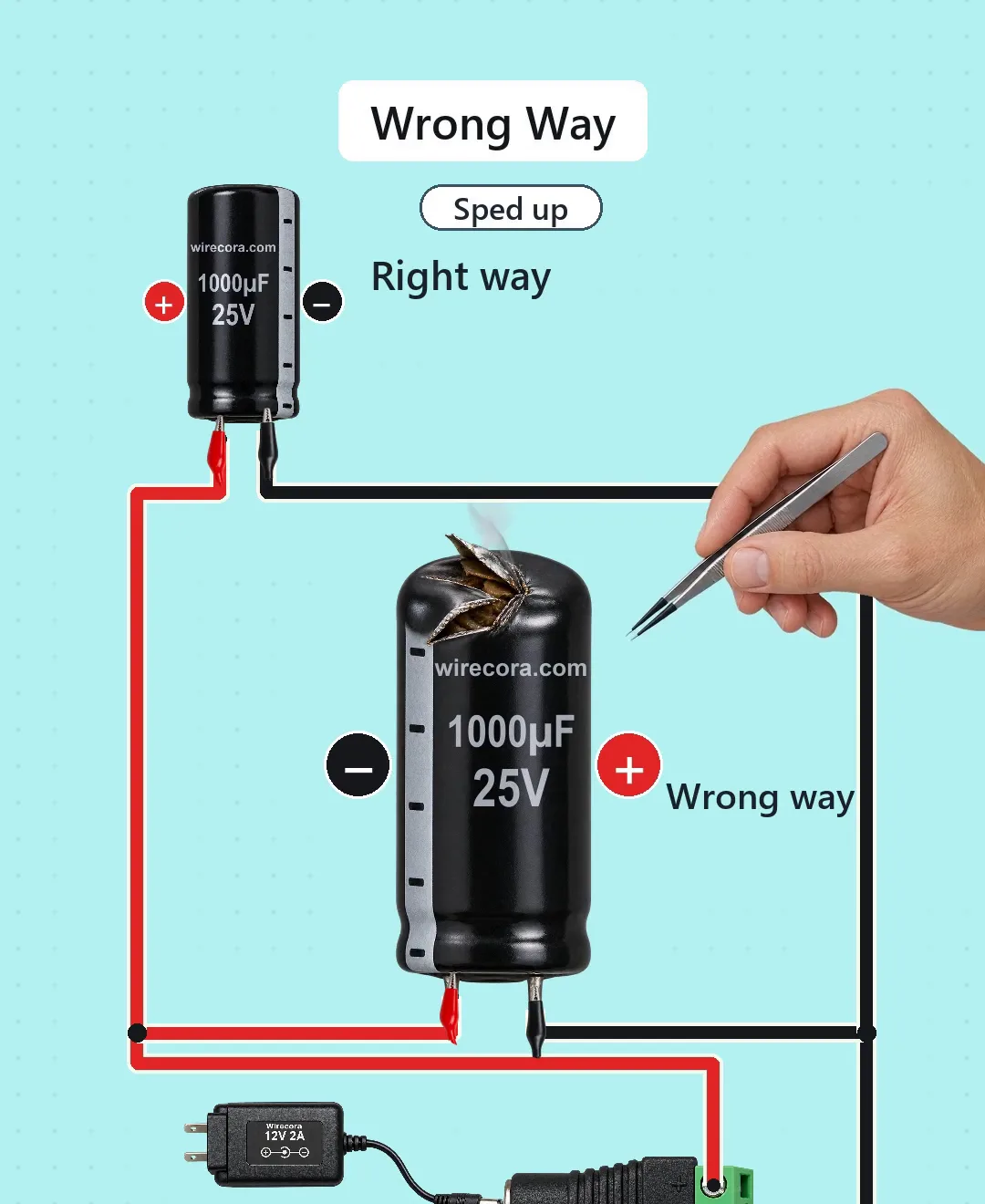
Two capacitors on the same 12 V. The one with its stripe on minus just charges and sits there. The one turned round lets current leak through, gets hot, and its vent on top tears open.
- 3 parts
- 3 wiring steps
- No code needed
- 12 V supply
Quick answer
The short version. Every pin is in the full wiring below.What you need
- Two 1000 µF 25 V electrolytic capacitors
- 12 V 2 A adapter with a barrel-jack screw terminal
- Four alligator clip leads
How to wire it
- Right way: the adapter's + to the long leg, and the leg by the stripe (minus) to the adapter's −.
- Wrong way: the same two wires, swapped.
- Both capacitors are straight on the adapter.
Before you power it: Do not do this for fun. The gas from the vent is hot electrolyte vapour, over 100 °C: keep your face and eyes away. Sometimes the rubber seal at the bottom blows out instead and the can is thrown. Never do it on a car battery, which can give hundreds of amps. If a capacitor vents, unplug the power and let it cool before you touch it. Tantalum capacitors fail worse. Ceramic and film capacitors have no plus or minus.
Parts list
- Two 1000 µF 25 V electrolytic capacitors
- 12 V 2 A adapter with a barrel-jack screw terminal
- Four alligator clip leads
Wiring, step by step
- Right way: the adapter's + to the long leg, and the leg by the stripe (minus) to the adapter's −.
- Wrong way: the same two wires, swapped. The leg by the stripe goes to + and the long leg goes to −.
- Both capacitors are straight on the adapter. There is no resistor and no fuse.
How it works
- An electrolytic capacitor has a plus and a minus leg. The stripe on the can marks minus, and the minus leg is the shorter one.
- Inside, a very thin oxide layer on one foil is the insulator. It holds only when that foil is the plus side.
- The right way round, the capacitor charges to 12 V in a moment and then takes almost no current. 12 V is well inside its 25 V rating.
- Backwards, the oxide layer does not hold. Current leaks through, the can heats up, and the liquid inside makes gas.
- The gas pushes on the scored cross on the top of the can. The vent tears open there, so the can does not burst in one piece.
What the video simplifies
- The Short is sped up. A real one takes about ten seconds to a minute or more.
- A real can does not shake or steam before the vent opens. It gets hot and the top bulges.
- A real vent mostly hisses and sprays, not one clean puff.
- The burst can is changed with the power on, with tweezers. On a real bench, unplug first and wait until it is cool.
- It assumes the adapter keeps giving about 2 A. Many adapters cut out instead, and then the capacitor only gets hot.
- This was checked with maker technical notes only, not built.
You found this by searching. Here's the whole path.
- Read how it works
- See it work
- Try it on the board
- Build it
- Show it
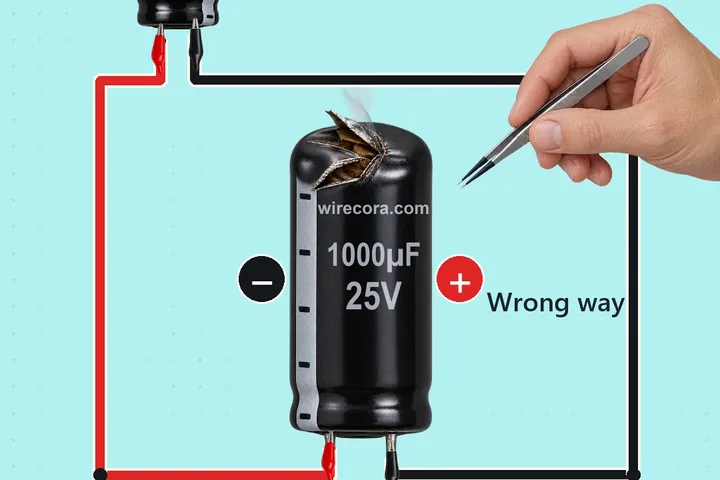
Thirty seconds of video shows the circuit doing its job. Then this whole circuit is on the wiring board. Wire it there first and watch it work before you touch a real part.
Do not do this for fun. The gas from the vent is hot electrolyte vapour, over 100 °C: keep your face and eyes away. Sometimes the rubber seal at the bottom blows out instead and the can is thrown. Never do it on a car battery, which can give hundreds of amps. If a capacitor vents, unplug the power and let it cool before you touch it. Tantalum capacitors fail worse. Ceramic and film capacitors have no plus or minus.
Built it, or stuck halfway? Post a photo in the Wirecora Discord. Questions get an answer every day.
What to build next
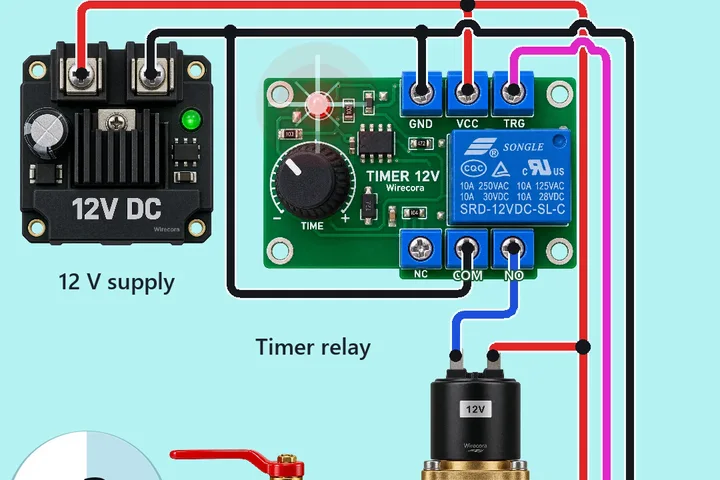 Similar partsAutomatic water filling systemPut a bottle under the tap: the sensor sees it, the timer relay closes, the solenoid valve opens and water runs.
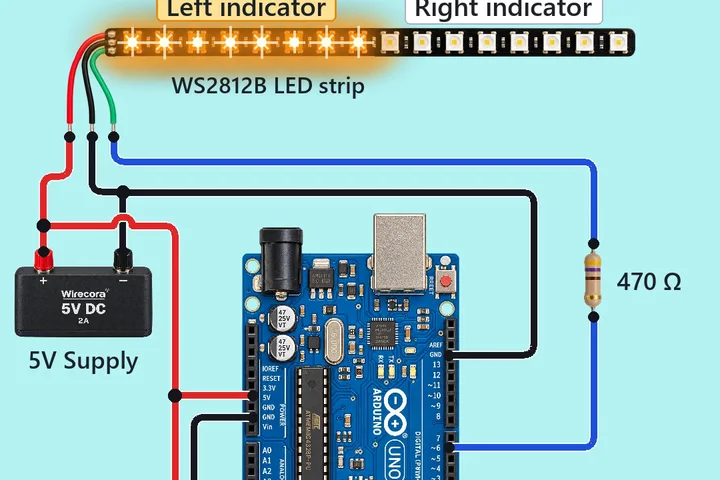 Something new: an ArduinoSmart bike indicatorsLean the bike to the left and the left half of the LED strip sweeps amber from the middle outwards.
 Similar partsAutomatic water tank filler with a 555Water leaves the LOW probe: the 555 switches the pump on.