Mini Bluetooth speaker from one 18650 cell, no boost board
A Bluetooth amplifier board plays music from a phone through two speakers, powered by one 18650 Li-ion cell through a TP4056 charge and protection board. Turning the volume knob makes it louder or silent. There is no boost converter: the amplifier chip runs straight from the cell.
- 6 parts
- 5 wiring steps
- No code needed
- 4.2 V supply
Quick answer
The short version. Every pin is in the full wiring below.What you need
- PAM8403-type Bluetooth amplifier board with a volume knob
- TP4056 charger module with DW01A protection
- One 18650 Li-ion cell, 3.7 V nominal, 4.2 V full
- Two 8 ohm 3 W speakers
- A slide switch in the OUT+ wire
- Wire
How to wire it
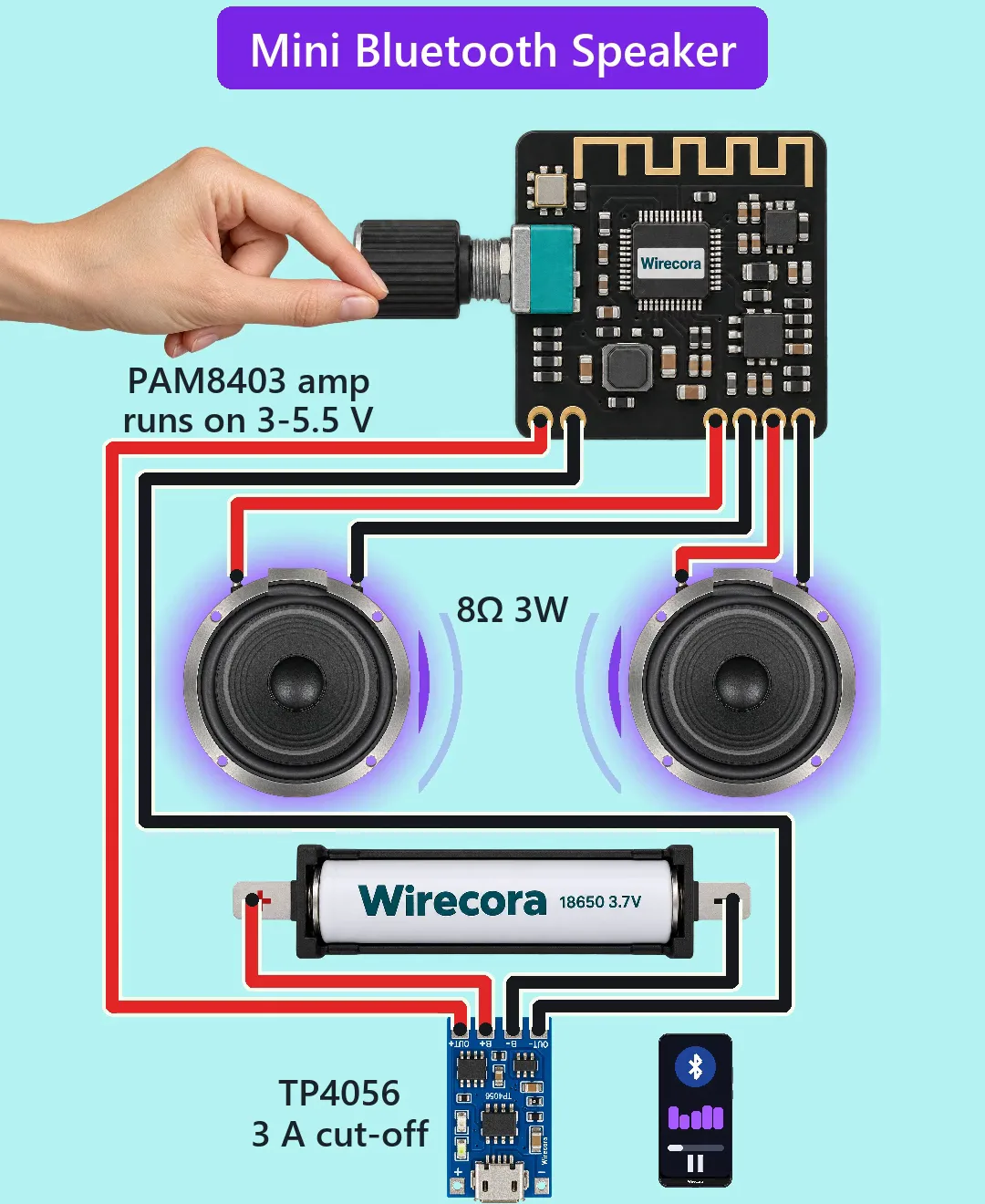
- Cell + to TP4056 B+.
- TP4056 OUT+ to the amplifier's power + pad, through the slide switch.
- Amplifier L+ and L- to the left speaker.
- The outputs are bridge-tied: L- and R- are NOT ground.
- The USB charging cable is not plugged in while the speaker plays.
Before you power it: Everything runs on one Li-ion cell, 3 to 4.2 V. The cell goes through the TP4056 module, which has over-current and over-discharge protection; never short the cell. Do not join L- or R- to ground.
Parts list
- PAM8403-type Bluetooth amplifier board with a volume knob (check the print on your board; pads as drawn: power +, power -, L+, L-, R+, R-). The chip runs from 2.5 to 5.5 V
- TP4056 charger module with DW01A protection (pads OUT+, B+, B-, OUT-, and a USB socket for charging)
- One 18650 Li-ion cell, 3.7 V nominal, 4.2 V full (2200 mAh assumed), in a holder
- Two 8 ohm 3 W speakers
- A slide switch in the OUT+ wire (the board draws about 30 mA even at volume zero)
- Wire
Wiring, step by step
- Cell + to TP4056 B+. Cell - to TP4056 B-.
- TP4056 OUT+ to the amplifier's power + pad, through the slide switch. TP4056 OUT- to the amplifier's power - pad.
- Amplifier L+ and L- to the left speaker. Amplifier R+ and R- to the right speaker.
- The outputs are bridge-tied: L- and R- are NOT ground. Never join them to each other or to the battery minus.
- The USB charging cable is not plugged in while the speaker plays. Playing while charging may stop the charge from ending cleanly.
How it works
- The cell gives 3 to 4.2 V. The amplifier chip takes 2.5 to 5.5 V, so it runs from the cell directly and a boost converter is not needed. (The original used an XL6019 boost board.)
- The phone streams music over Bluetooth to the board. The volume knob sets the gain, so at zero you hear nothing even though the phone keeps playing.
- Power: about 0.7 to 0.9 W per channel into 8 ohm at 3.6 V, up to about 1.2 W on a full cell (1.4 to 1.8 W at 5 V). Two channels at 0.5 W draw about 0.32 A, so 2200 mAh plays for about 6 hours.
- The TP4056 board's protection cuts out at about 3 A and 2.4 V (over-current and over-discharge).
What the video simplifies
- The sound rings and purple glow are drawn effects, and the speaker cone travel is slightly exaggerated.
- The parts are drawn at mixed scales: the hand smaller, the board and knob larger than real.
- The music is our own loop.
- The USB charging cable is not plugged in while playing.
- This circuit was checked by simulation and datasheets, not built.
You found this by searching. Here's the whole path.
- Read how it works
- See it work
- Build it
- Show it
Thirty seconds of video shows the circuit doing its job.
Everything runs on one Li-ion cell, 3 to 4.2 V. The cell goes through the TP4056 module, which has over-current and over-discharge protection; never short the cell. Do not join L- or R- to ground.
Built it, or stuck halfway? Post a photo in the Wirecora Discord. Questions get an answer every day.
What to build next
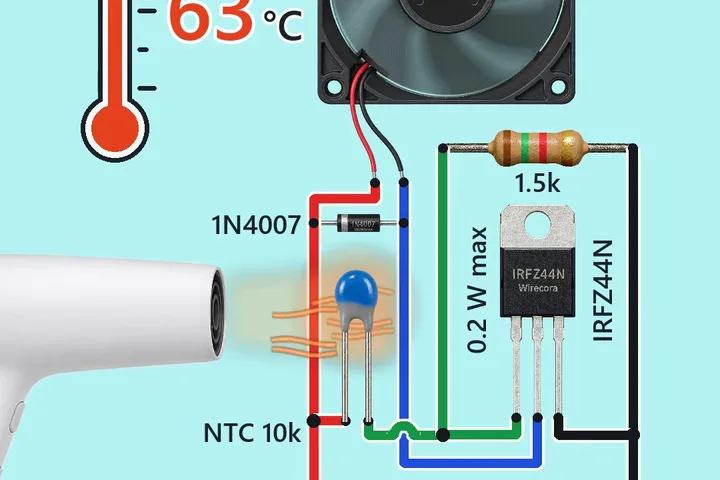 Similar partsFan that turns on by itself when it gets hot (NTC thermistor and IRFZ44N MOSFET)A hair dryer warms a 10k NTC thermistor.
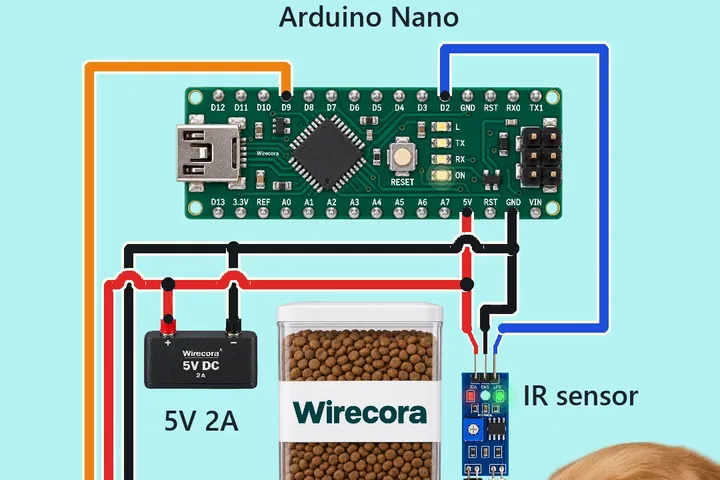 Something new: an ArduinoAutomatic pet feeder with an Arduino Nano, an IR sensor and a servo flapA dog, then a cat, walk up to the bowl.
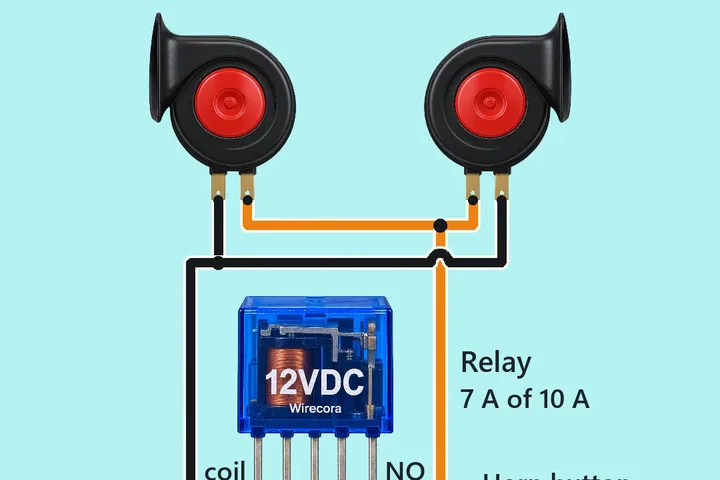 Similar partsCar horn relay wiring: a small button sounds two loud hornsPress the horn button and a 12 V relay clicks in, so both horns sound.