Door handle touch alarm
While a hand holds the metal door handle, a red strobe siren flashes and wails. The moment the hand lets go it falls silent.
- 6 parts
- 6 wiring steps
- No code needed
- 12 V supply
Quick answer
The short version. Every pin is in the full wiring below.What you need
- 12 V 2 A DC power supply
- 7805 voltage regulator
- TTP223 touch board
- IRLZ44N logic-level MOSFET
- 12 V wired strobe siren
- A metal lever door handle on a wooden door
How to wire it
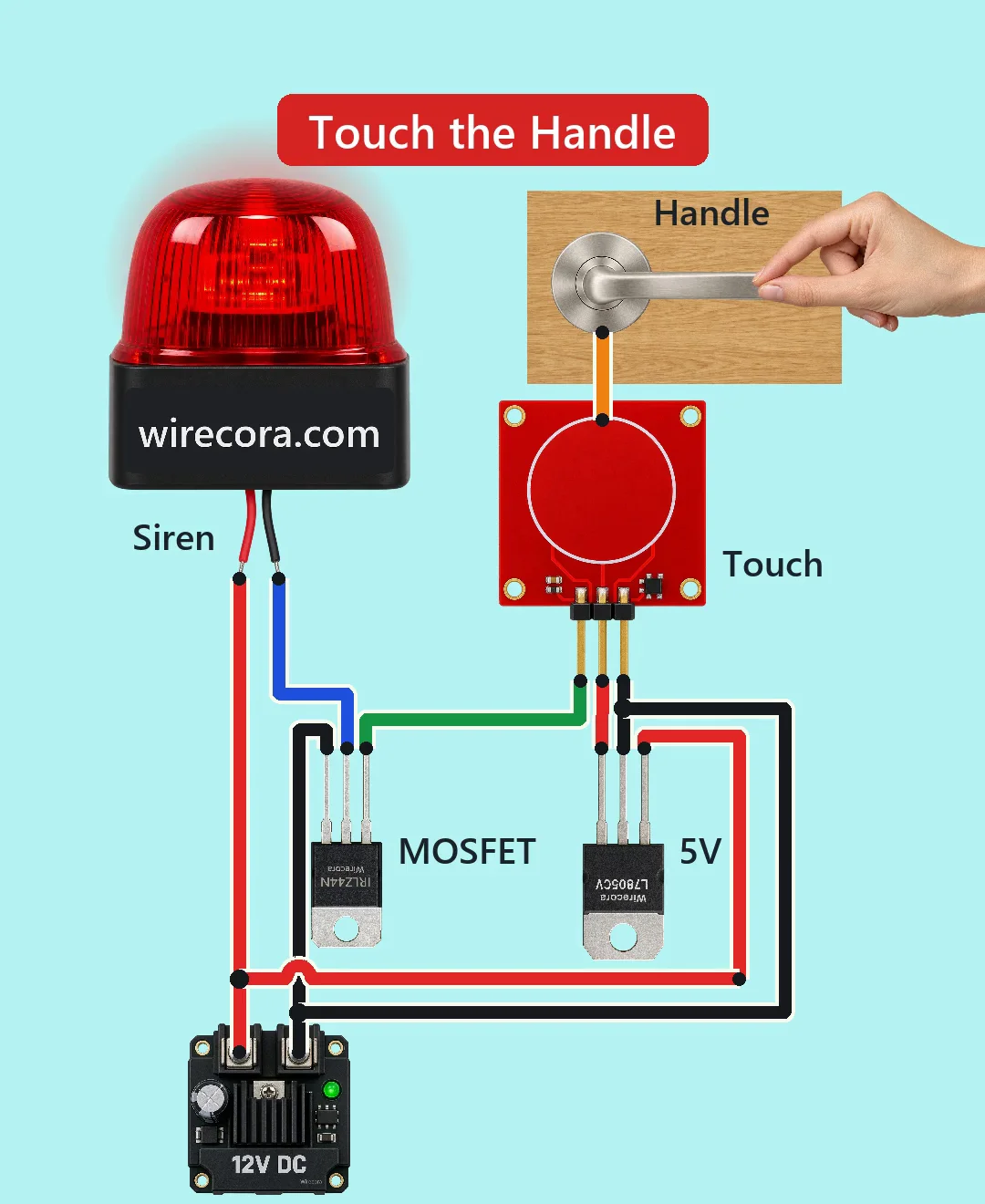
- Supply plus to the 7805's IN pin and to the red lead of the siren.
- 7805 OUT to the TTP223's VCC.
- Supply minus to the 7805's GND, the TTP223's GND and the IRLZ44N's source.
- TTP223 SIG to the IRLZ44N gate.
- Black lead of the siren to the IRLZ44N drain.
- Thin wire from the door handle's lug to the TTP223's round touch pad.
Before you power it: 12 V DC. Sirens like this reach 100 to 115 dB, so test it away from your ears. Never connect the 12 V to the handle: only the thin sensing wire goes there.
Parts list
- 12 V 2 A DC power supply
- 7805 voltage regulator, 5 V output, for the touch board
- TTP223 touch board (the red one with a round pad), direct mode with both solder pads open; the chip is rated 2 to 5.5 V
- IRLZ44N logic-level MOSFET (55 V, 47 A, gate threshold 1 to 2 V, 0.025 ohm at 5 V)
- 12 V wired strobe siren (about 0.28 A, about 115 dB, piezo type)
- A metal lever door handle on a wooden door, and a thin wire from the handle to the touch pad
Wiring, step by step
- Supply plus to the 7805's IN pin and to the red lead of the siren.
- 7805 OUT to the TTP223's VCC. This gives the chip its 5 V.
- Supply minus to the 7805's GND, the TTP223's GND and the IRLZ44N's source.
- TTP223 SIG to the IRLZ44N gate.
- Black lead of the siren to the IRLZ44N drain.
- Thin wire from the door handle's lug to the TTP223's round touch pad. The handle carries only the tiny sensing signal, never 12 V.
How it works
- With nobody touching, the TTP223's output is low, the MOSFET is off and the siren has no path to minus.
- A hand on the metal handle adds capacitance to the pad. The chip notices and sets its output to 5 V (active high).
- The 5 V on the gate turns the IRLZ44N on, which connects the siren's black lead to minus, so the 12 V siren flashes and wails.
- When the hand lets go the output drops, the MOSFET turns off and the siren stops. In direct mode it sounds only while the handle is touched.
What the video simplifies
- Capacitive touch through a whole door handle and a wire is demo-grade. It works best on a wooden door with the handle insulated; on a metal door the whole door becomes the pad. Gloves, rain or a long pad wire cause misses or false alarms, and keep hands off the handle for half a second after power-on.
- The strobe pulses between dim and bright in the video; a real one goes fully dark between flashes. The 0.1 s response delay is drawn; the datasheet gives up to about 60 ms in fast mode or 220 ms in low-power mode.
- The siren figures come from one seller's listing of a similar 12 V siren, not from a measurement. For a coil-horn siren instead of a piezo one, add a 1N4007 across it.
- Not drawn, and a real build adds them: two small capacitors at the 7805, a 100 k resistor from gate to ground, and a series resistor at the pad against static. TTP223 pin order differs between sellers, so read the print on yours.
- The parts are drawn larger than the door and hand, and the wire leaves the handle's rose where a real build uses a screw lug.
- A real alarm would latch or run a timer. This circuit was checked against the datasheets, not built.
You found this by searching. Here's the whole path.
- Read how it works
- See it work
- Build it
- Show it
Next: see it work
Thirty seconds of video shows the circuit doing its job.
Then build it
12 V DC. Sirens like this reach 100 to 115 dB, so test it away from your ears. Never connect the 12 V to the handle: only the thin sensing wire goes there.
Then show it
Built it, or stuck halfway? Post a photo in the Wirecora Discord. Questions get an answer every day.
What to build next
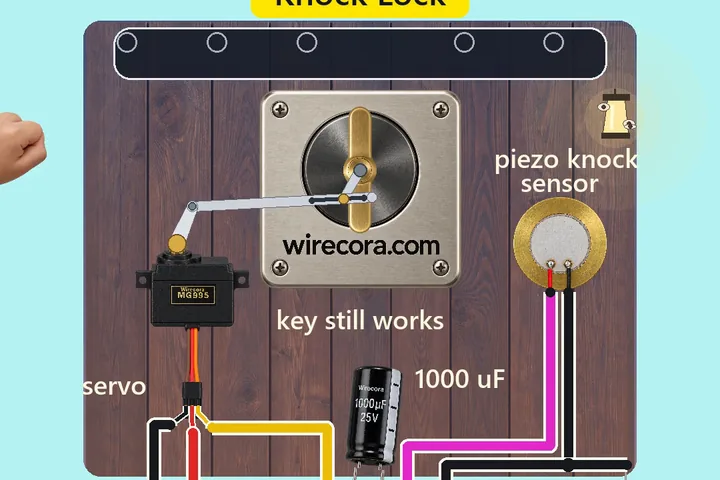 Same buzzerSecret knock door lockKnock the secret rhythm on the door and the deadbolt turns for you.
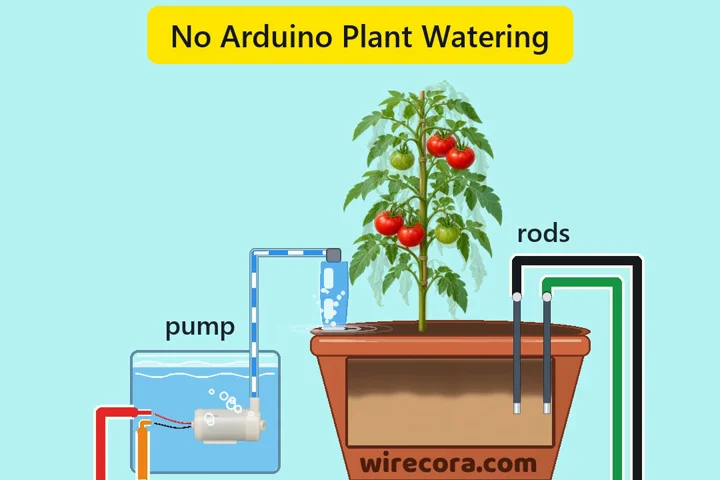 Next step: adds a pumpSelf-watering plant with one MOSFET (no Arduino)Two steel rods in the soil decide when the pump runs.
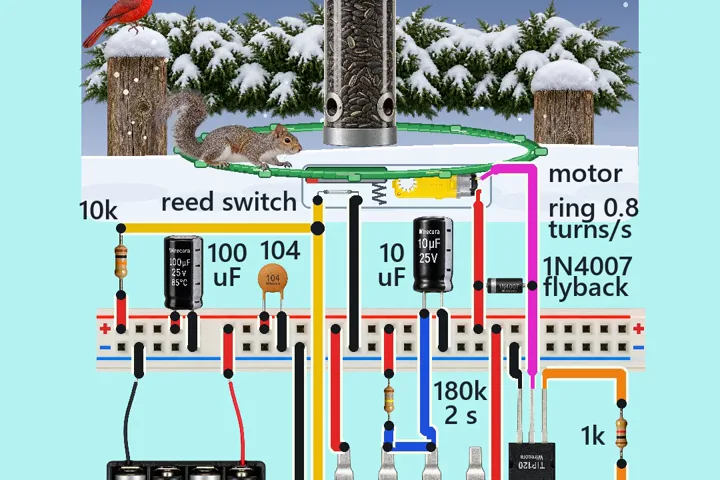 Something new: a 555 timerSpinning bird feeder perch that turns when a squirrel climbs onA squirrel hops onto the feeder's perch ring and the ring starts to turn.