Car hazard lights with a thermal flasher
Two amber car bulbs blink on their own with the familiar click-clack. A press on the red triangle stops them, and a second press starts them again after a short pause. There is no chip, no transistor and no relay: the silver can is a thermal flasher.
- 5 parts
- 5 wiring steps
- No code needed
- 12 V supply
Quick answer
The short version. Every pin is in the full wiring below.What you need
- 12 V 7 Ah sealed lead-acid battery
- 10 A fuse
- 2-pin thermal hazard flasher can
- Latching hazard push switch, rated 10 A or more
- 12 V 21 W amber bulb
How to wire it
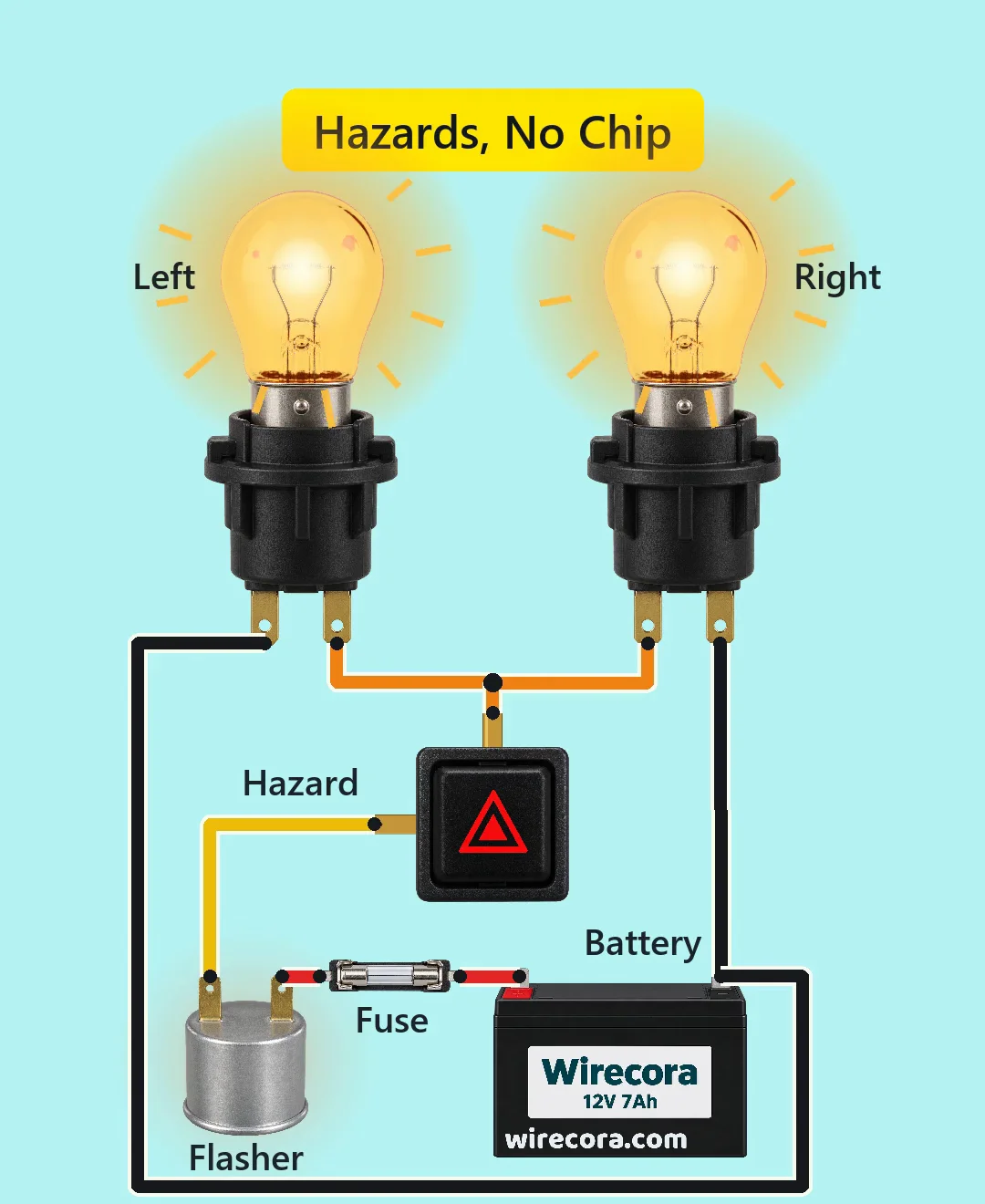
- Battery plus to one end of the fuse.
- The other end of the fuse to the flasher's B terminal.
- The flasher's L terminal to terminal A of the hazard switch.
- Hazard switch terminal B to one tag of the left bulb and one tag of the right bulb.
- The other tag of each bulb back to battery minus.
Before you power it: Everything runs on 12 V DC from a small battery, with about 3.5 A flowing, so keep the 10 A fuse in the plus lead. The 21 W bulbs get hot, so do not touch them while they are on.
Parts list
- 12 V 7 Ah sealed lead-acid battery
- 10 A fuse (a slow-blow type is better, because cold bulbs surge for a few milliseconds)
- 2-pin thermal hazard flasher can, 12 V, variable-load type
- Latching hazard push switch, rated 10 A or more
- 12 V 21 W amber bulb (PY21W / 1156NA class), two of them, in bayonet sockets
Wiring, step by step
- Battery plus to one end of the fuse.
- The other end of the fuse to the flasher's B terminal. B is the battery side.
- The flasher's L terminal to terminal A of the hazard switch.
- Hazard switch terminal B to one tag of the left bulb and one tag of the right bulb. A bulb has no plus or minus side, so either tag will do.
- The other tag of each bulb back to battery minus.
How it works
- With the switch in, current flows from the battery through the fuse and the flasher to the switch and both bulbs. Inside the can a thin heater wire warms a strip made of two metals.
- The strip bends and closes a contact, and both bulbs light. That contact shorts out the heater, so the strip cools, straightens and opens, and the bulbs go dark. Every make and break is the click you know from a car.
- This repeats about 90 times a minute (typical hazard flashers are listed at 60 to 120 a minute). After you press the switch off and on again, the strip starts cold, so the first flash comes after a short warm-up, drawn as 0.5 s (an assumed figure; one maker's sheet gives under 1.5 s).
- Each bulb draws about 1.75 A (21 W at 12 V), so 3.5 A in total. That is inside the flasher's load range (one 12 V listing says 1 to 10 hazard lamps) and well inside the 10 A fuse. The flasher has no coil, so no diode is needed.
- A turn-signal flasher is a different part: it speeds up when a bulb burns out, while this hazard type keeps its rate. Many newer cars use a chip and a relay instead.
What the video simplifies
- A car's hazard switch has several contacts. Here one contact feeds both bulbs.
- The orange glow on the flasher shows the metal strip warming up. A real can does not glow. The light rays and the click marks are graphics.
- The flash rate (90 a minute, inside the 60 to 120 a minute that listings give) and the first-flash delay (0.5 s, chosen inside one sheet's under 1.5 s) are assumed, not measured.
- On this small battery the hazards would run about 3 hours; a car battery lasts many times longer. The 21 W bulbs get hot.
- The switch rating (10 A or more) is assumed. Cold bulbs surge about ten times their running current for a few milliseconds.
- This circuit was checked on paper, not built.
You found this by searching. Here's the whole path.
- Read how it works
- See it work
- Build it
- Show it
Thirty seconds of video shows the circuit doing its job.
Everything runs on 12 V DC from a small battery, with about 3.5 A flowing, so keep the 10 A fuse in the plus lead. The 21 W bulbs get hot, so do not touch them while they are on.
Built it, or stuck halfway? Post a photo in the Wirecora Discord. Questions get an answer every day.
What to build next
 Same lampTouch switch lampA finger taps a red TTP223 touch pad.
 Next step: adds a buzzerCookie jar lid alarmA little lever under the glass lid keeps this cookie jar quiet.
 Something new: an ArduinoSelf-cleaning litter boxWhen the cat has been out of the drum for seven minutes, an Arduino Nano turns the drum half a turn.