Ski lift stop bar
One rider stays seated at the top. His skis push the stop bar and the whole lift stops at once. The bar rests on a small lever switch, and the motor only gets power while the lever is pressed. Push the bar, the lever springs out and the motor stops. When the bar falls back, the motor runs again.
- 4 parts
- 4 wiring steps
- No code needed
- 12 V supply
Quick answer
The short version. Every pin is in the full wiring below.What you need
- 12 V 2 A adapter
- Omron SS-5FL111-3 lever switch
- 12 V 10 rpm worm gear motor
- 1N4007 diode across the motor
How to wire it
- Jack plus goes to the switch's COM tag.
- The switch's NO tag goes to one motor tab and to the band (cathode) of the 1N4007.
- Jack minus goes to the other motor tab and to the plain end (anode) of the 1N4007.
- That is only three wires.
Before you power it: 12 V DC only. With a battery, put a fuse right next to it, because a battery can push a large current into a shorted wire. This is a toy model and not a safety system. Never use it to stop a real lift.
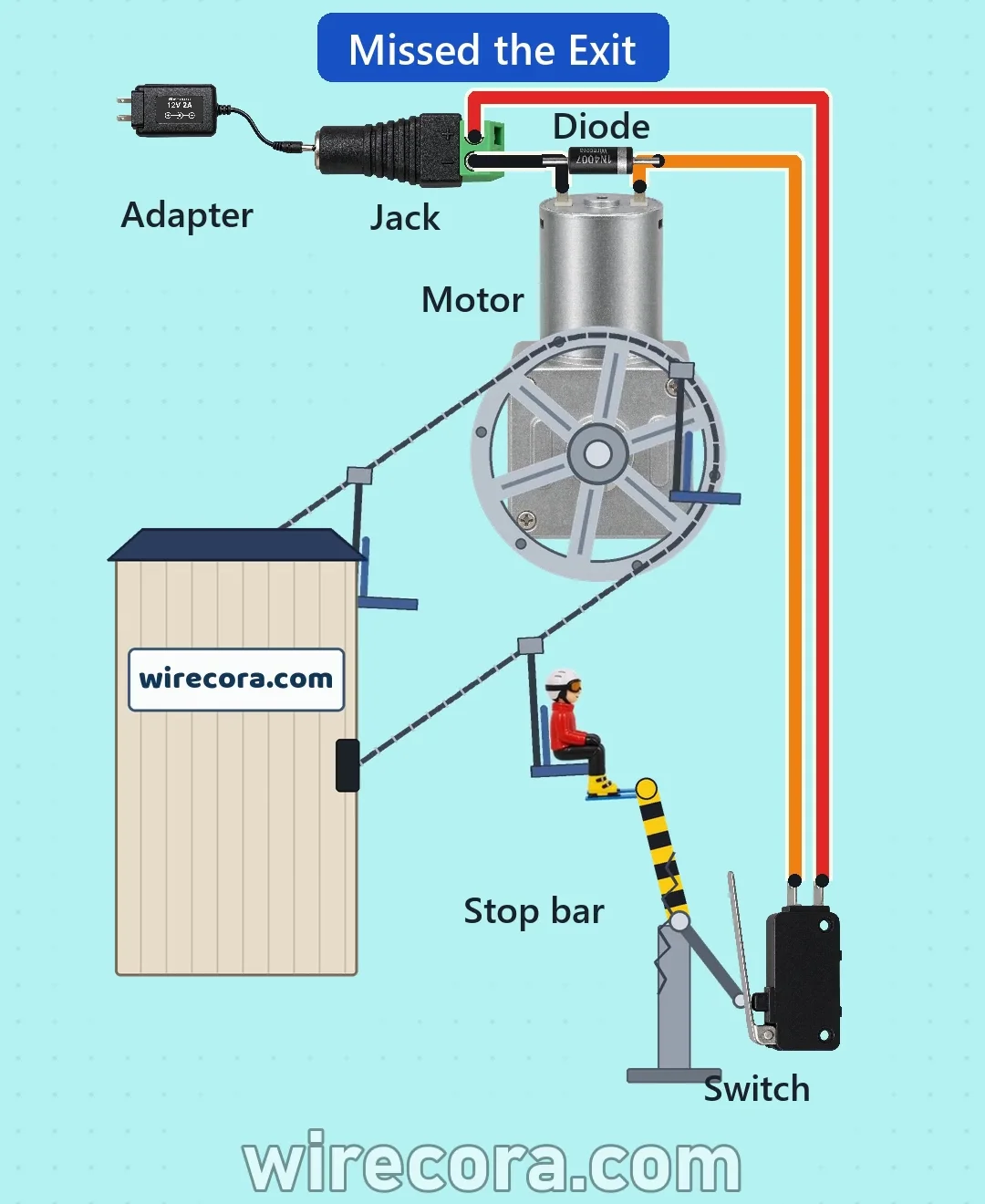
Parts list
- 12 V 2 A adapter (centre plus) and a barrel jack
- Omron SS-5FL111-3 lever switch (30 V DC, 5 A)
- 12 V 10 rpm worm gear motor (about 60 mA running, from one seller's listing)
- 1N4007 diode across the motor, with its band on the plus side
Wiring, step by step
- Jack plus goes to the switch's COM tag.
- The switch's NO tag goes to one motor tab and to the band (cathode) of the 1N4007.
- Jack minus goes to the other motor tab and to the plain end (anode) of the 1N4007.
- That is only three wires. Mount the switch so the stop bar's tail presses its lever while the bar rests.
How it works
- The bar rests on the lever, so the lever is pressed and the switch contact is closed. 12 V reaches the motor and the lift runs.
- When a rider's skis push the bar, the bar tips, the lever springs out and the contact opens. The motor loses its supply and stops.
- The worm gear locks, so the cable cannot roll back when the motor stops.
- A broken wire or a switch that fails open also stops the lift. A switch with welded contacts would not, so a real lift uses a safety-rated switch.
- The 1N4007 across the motor takes the voltage kick when the motor switches off.
- When the bar falls back, the lever is pressed again and the motor runs again.
What the video simplifies
- This is a model. A real lift does not start again by itself: the operator checks and restarts it. Ours runs again as soon as the bar falls back.
- The wheels stand upright so you see both cable lines. Real ones lie flat. A station house hides where the riders sit down, and a hand lifts the skier off to let the bar fall back.
- The parts are not drawn to one scale. The switch (about 2.5 times its real size) and the diode are drawn larger so you can see them. The switch is also drawn in a simplified shape.
- The stop time of about 0.05 s, the chair swing and the bar's small trip angle (about 5.5 degrees) are our estimates and were not measured.
- The motor speed and current come from one seller's listing, which contradicts itself in other places and gives no stall current. Treat the 60 mA as unverified.
- Run it from the adapter. With a battery, add a 1 A slow-blow fuse next to it. The motor's start current is not known, so that rating is a guess.
- This circuit was checked against the switch datasheet and the motor listing and was not built.
You found this by searching. Here's the whole path.
- Read how it works
- See it work
- Build it
- Show it
Thirty seconds of video shows the circuit doing its job.
12 V DC only. With a battery, put a fuse right next to it, because a battery can push a large current into a shorted wire. This is a toy model and not a safety system. Never use it to stop a real lift.
Built it, or stuck halfway? Post a photo in the Wirecora Discord. Questions get an answer every day.
What to build next
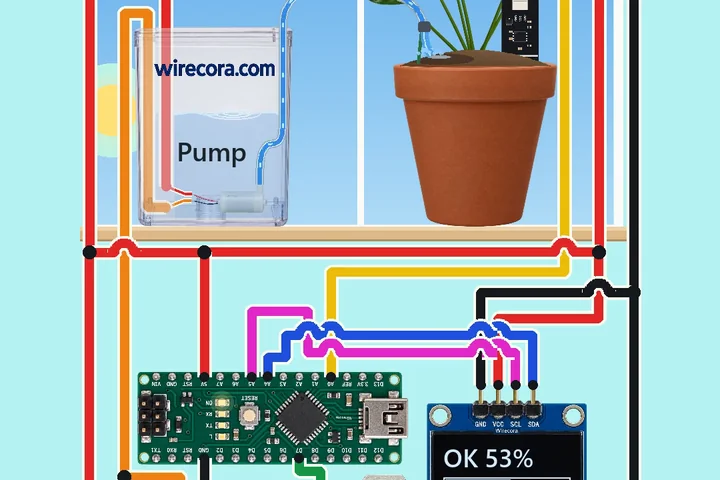 Same motorSelf-watering plant with a soil sensorWhen the soil dries out, the screen reads DRY, a small pump in the water reservoir starts and water runs through a clear hose into the pot.
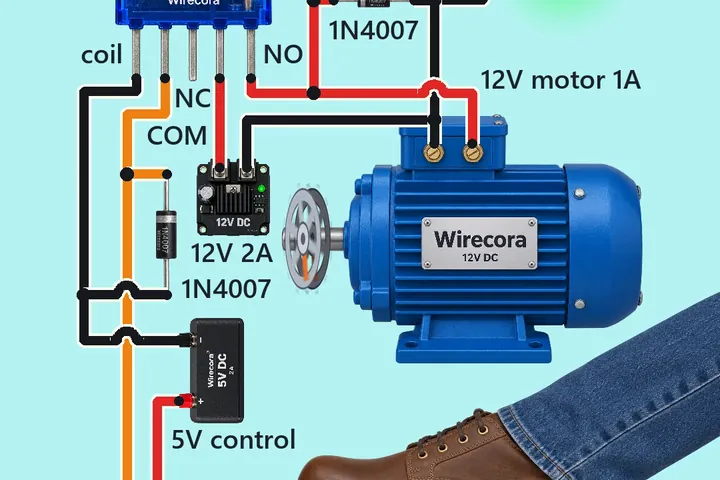 Next step: adds a relayFoot pedal motor switch with a 5 V relay and a 12 V motorStep on the pedal and the 12 V motor runs and the green RUN lamp lights.
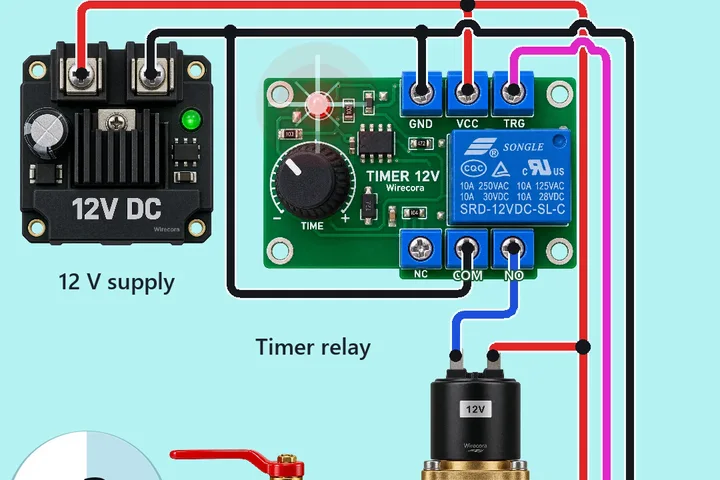 Something new: a timer relayAutomatic water filling systemPut a bottle under the tap: the sensor sees it, the timer relay closes, the solenoid valve opens and water runs.