Speakers in series or parallel
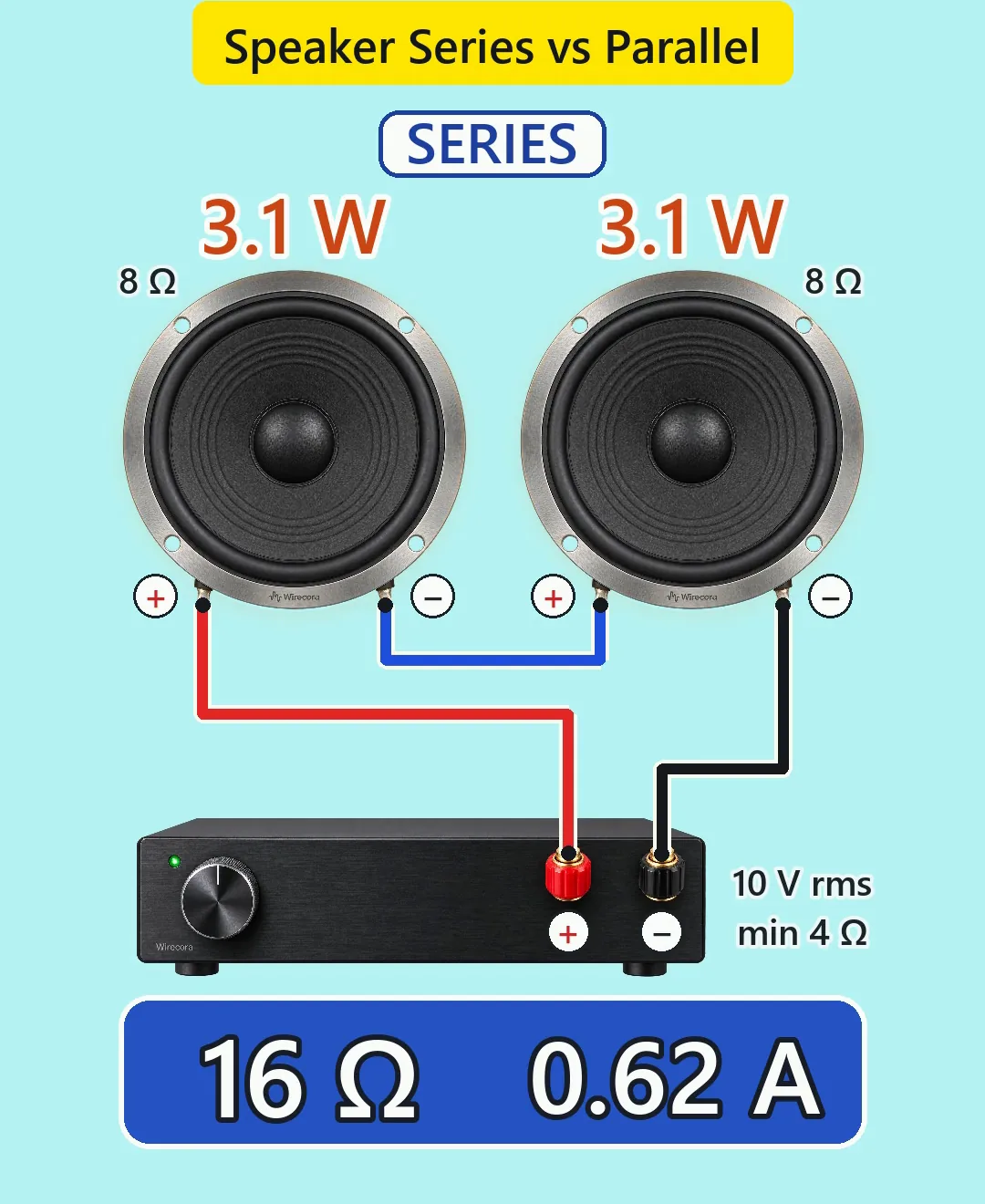
Two 8 ohm speakers on one amplifier. Wired in series the amplifier sees 16 ohm (0.62 A) and each speaker gets 3.1 W. Flip them to parallel and the amplifier sees 4 ohm (2.49 A) and each speaker gets 12.4 W.
- 2 parts
- 6 wiring steps
- No code needed
Quick answer
The short version. Every pin is in the full wiring below.What you need
- Speaker, 8 ohm, two of them
- Audio amplifier
How to wire it
- Series: amplifier plus to speaker 1 plus.
- Series: speaker 1 minus to speaker 2 plus.
- Series: speaker 2 minus to amplifier minus.
- Parallel: both speaker plus terminals to amplifier plus.
- Parallel: both speaker minus terminals to amplifier minus.
- Wire both speakers with the same polarity, using the marked terminals.
Before you power it: Switch the amplifier off before changing speaker wires. Two 8 ohm speakers in parallel present 4 ohm to the amplifier, so check its minimum load first.
Parts list
- Speaker, 8 ohm, two of them
- Audio amplifier (example numbers, not a product: 10 V rms test signal, 0.02 ohm output impedance, constant-voltage output, minimum load 4 ohm)
Wiring, step by step
- Series: amplifier plus to speaker 1 plus.
- Series: speaker 1 minus to speaker 2 plus.
- Series: speaker 2 minus to amplifier minus.
- Parallel: both speaker plus terminals to amplifier plus.
- Parallel: both speaker minus terminals to amplifier minus.
- Wire both speakers with the same polarity, using the marked terminals. Otherwise one cone moves against the other and the bass cancels.
How it works
- In series the same current flows through both speakers, each has half the voltage and so a quarter of the power it would get alone. Together the pair draws half of what one speaker alone would.
- At 10 V rms the amplifier sees 16 ohm and 0.62 A, and each speaker gets 3.1 W.
- In parallel each speaker has the full voltage and gets what it would get alone, but the amplifier must supply twice the current of one speaker, four times the series current.
- At 10 V rms the amplifier sees 4 ohm and 2.49 A, and each speaker gets 12.4 W. The 0.02 ohm output impedance is why the screen says 2.49 A and 12.4 W instead of the ideal 2.5 A and 12.5 W.
What the video simplifies
- The wires move by themselves in the video. In real life switch the amplifier off before changing speaker wires.
- During the change the clip passes through one speaker alone (8 ohm, 12.4 W) for about 0.9 s in total and, for about 0.05 s, one speaker shorted by its own wires. It is shown truthfully; the amplifier never sees less than 4 ohm.
- The cone movement, glow and sound are illustrative, and the music is synthesised. The plus and minus marks are a drawing convention.
- The amplifier numbers are assumed, not a product. A real amplifier is limited by its own current and power, so check YOUR amplifier's minimum load before wiring speakers in parallel.
- Real 8 ohm speakers are not flat 8 ohm: their impedance dips to about 6.4 ohm, so two in parallel can dip to about 3.2 ohm, slightly below the 4 ohm shown.
- The numbers are computed from the drawn wiring and checked in a SPICE simulation (ngspice); they were not measured on real hardware.
You found this by searching. Here's the whole path.
- Read how it works
- See it work
- Build it
- Show it
Next: see it work
Thirty seconds of video shows the circuit doing its job.
Then build it
Switch the amplifier off before changing speaker wires. Two 8 ohm speakers in parallel present 4 ohm to the amplifier, so check its minimum load first.
Then show it
Built it, or stuck halfway? Post a photo in the Wirecora Discord. Questions get an answer every day.
What to build next
 Similar partsHelmet that closes its own visorYou lower the helmet onto your head and the visor swings down by itself.
 Something new: a pumpSelf-watering plant with one MOSFET (no Arduino)Two steel rods in the soil decide when the pump runs.
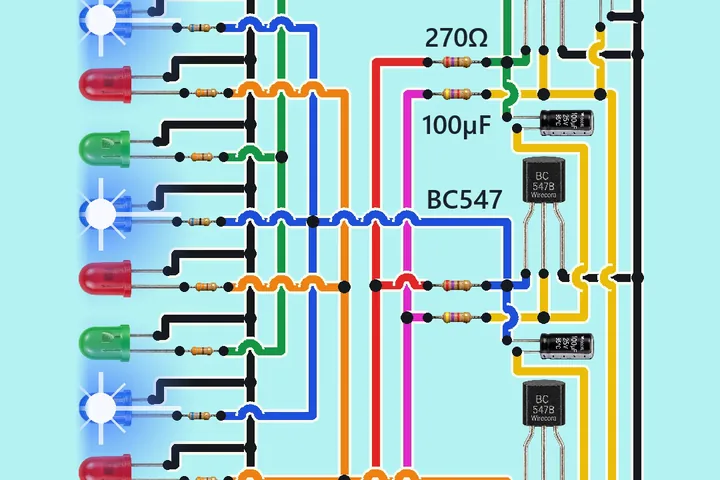 Similar partsLED chaser with three transistorsTurning the knob anticlockwise speeds up the running light on nine LEDs, from about 0.5 s to 0.2 s per step.