NPN transistor · TO-92
BC337 Pinout
Flat face toward you, legs pointing down, left to right: 1 collector, 2 base, 3 emitter (C-B-E).
A small NPN with a big current rating: up to 800 mA in a TO-92 case, for LED strips, relays and small motors.
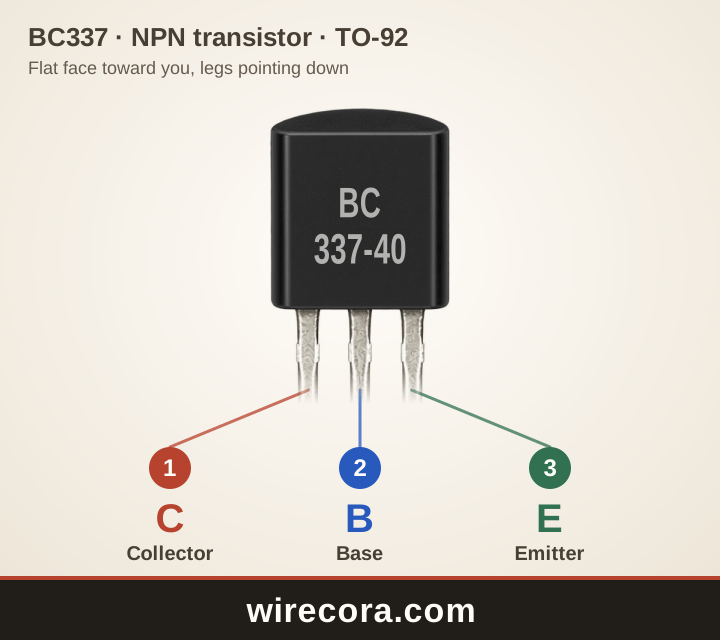
- Pin 1: Collector (C)Goes to the load (LED, relay, buzzer). Current flows in here and out of the emitter.
- Pin 2: Base (B)The control pin. A small current into it, always through a resistor, switches the transistor on.
- Pin 3: Emitter (E)Goes to 0 V (ground) when the transistor is used as a switch.
Check your part before wiring. Read the maker and the full part number printed on it, open that maker's datasheet, or test the legs with a multimeter's diode setting.
PNG 1440 × 1280 pixels, SVG to any size. Both keep the wirecora.com mark along the bottom.
Pinout table
Which leg of the BC337 is which?
| Pin | Name | What it does |
|---|---|---|
| 1 | Collector C | Goes to the load (LED, relay, buzzer). Current flows in here and out of the emitter. |
| 2 | Base B | The control pin. A small current into it, always through a resistor, switches the transistor on. |
| 3 | Emitter E | Goes to 0 V (ground) when the transistor is used as a switch. |
Key ratings
How much can the BC337 take?
From the onsemi (Fairchild) datasheet: BC337 / BC338 NPN Epitaxial Silicon Transistor (Rev. 1.1.0, October 2014). Stay well inside these limits: they are the most the part takes, not what it should run at.
Open the onsemi (Fairchild) datasheet (PDF)Pin order by maker
Is every BC337 wired C-B-E?
The onsemi (Fairchild) and Diotec datasheets number the legs 1 collector, 2 base, 3 emitter: C-B-E with the flat face toward you, the same order as the BC547.
NXP (now Nexperia) numbers the same legs the other way: 1 emitter, 2 base, 3 collector. Its drawing looks at the part from the other side, so the legs in your hand are still C-B-E from the left. Do not read NXP's pin numbers left to right.
The makers also differ on current: 800 mA at onsemi and Diotec, 500 mA at NXP. No maker we checked uses another leg order, but parts from unknown makers should still be checked with a meter.
A first circuit
Light a 12 V LED strip from an Arduino pin
- A short 12 V LED strip (up to about 300 mA) from +12 V to the collector. Emitter to 0 V, shared with the Arduino's 0 V.
- A 330 Ω resistor from a 5 V Arduino pin to the base: about 13 mA into the base (from a 3.3 V pin, use 180 Ω).
- Pin high: the transistor turns fully on and the strip lights. Pin low: it goes dark.
- Use analogWrite() on a PWM pin to dim the strip.
Keep it to about 300 mA without a heatsink: at 500 mA up to 0.7 V stays across the transistor, which is 0.35 W of its 625 mW. For amps, use an IRLZ44N.
BC337 questions
What is the BC337 pinout?
With the flat face toward you and the legs pointing down, from left to right: collector, base, emitter (C-B-E). That is pin 1, 2 and 3 in the onsemi (Fairchild) and Diotec datasheets.
How much current can a BC337 switch?
800 mA continuous in the onsemi (Fairchild) and Diotec datasheets, 500 mA in NXP's. Heat sets the real limit: 625 mW in free air, so plan on about 300 mA without a heatsink.
What do BC337-16, BC337-25 and BC337-40 mean?
The number after the dash is the gain group, measured at 100 mA: -16 is 100 to 250, -25 is 160 to 400 and -40 is 250 to 630. For switching, any of them works.
Can I use a BC337 instead of a BC547?
Yes, in the same holes: both are C-B-E and rated 45 V. The BC337 carries up to 800 mA, the BC547 only 100 mA.
What is the PNP version of the BC337?
The BC327 is its PNP partner, rated −45 V and −800 mA, with the same C-B-E leg order. Its own page has the picture.
Can I use this pinout picture?
Yes. Download it as PNG or SVG and use it in notes, lessons or posts. The wirecora.com mark along the bottom stays in the picture.
Pin order and ratings from the onsemi (Fairchild) datasheet named above. Last reviewed .