NPN transistor · TO-92
S8050 Pinout
Flat face toward you, legs pointing down, left to right: 1 emitter, 2 base, 3 collector (E-B-C).
A low-voltage NPN for up to 0.5 A, common in kits and on cheap modules.
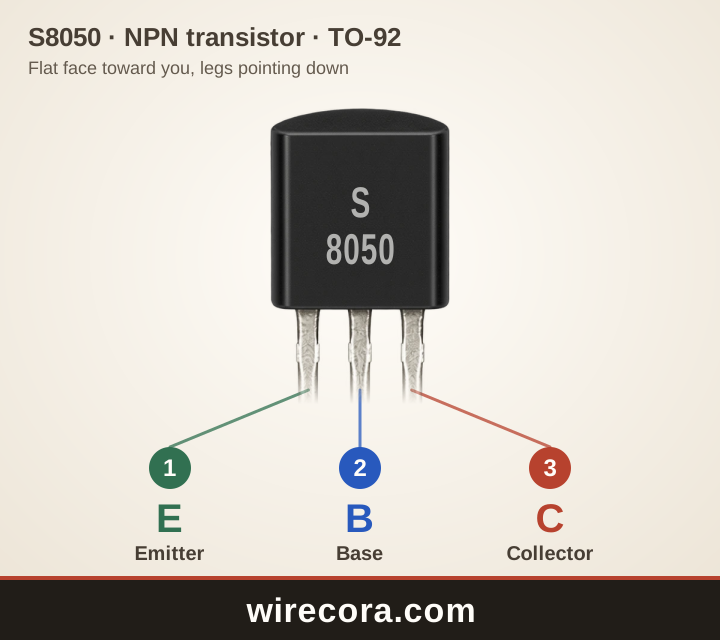
- Pin 1: Emitter (E)Goes to 0 V (ground) when the transistor is used as a switch.
- Pin 2: Base (B)The control pin. A small current into it, always through a resistor, switches the transistor on.
- Pin 3: Collector (C)Goes to the load (LED, relay, buzzer). Current flows in here and out of the emitter.
Check your part before wiring. Read the maker and the full part number printed on it, open that maker's datasheet, or test the legs with a multimeter's diode setting.
PNG 1440 × 1280 pixels, SVG to any size. Both keep the wirecora.com mark along the bottom.
Pinout table
Which leg of the S8050 is which?
| Pin | Name | What it does |
|---|---|---|
| 1 | Emitter E | Goes to 0 V (ground) when the transistor is used as a switch. |
| 2 | Base B | The control pin. A small current into it, always through a resistor, switches the transistor on. |
| 3 | Collector C | Goes to the load (LED, relay, buzzer). Current flows in here and out of the emitter. |
Key ratings
How much can the S8050 take?
From the JCET (Jiangsu Changjiang Electronics Technology) datasheet: S8050 TO-92 Plastic-Encapsulate Transistor (NPN). Stay well inside these limits: they are the most the part takes, not what it should run at.
Open the JCET (Jiangsu Changjiang Electronics Technology) datasheet (PDF)Pin order by maker
Is every S8050 wired E-B-C?
The JCET S8050 datasheet numbers the legs 1 emitter, 2 base, 3 collector: E-B-C with the flat face toward you.
The letters around 8050 change the part. The same maker's 8050S is E-C-B, with the collector in the middle, and its SS8050 is E-B-C but rated 1.5 A. Read every letter on the part before you wire it.
A first circuit
Run a small 5 V motor or fan from a microcontroller
- Motor from +5 V to the collector. Emitter to 0 V.
- A diode (1N4148 or 1N4007) across the motor, its striped end to +5 V, to catch the motor's voltage kick.
- A 470 Ω resistor from the pin (5 V or 3.3 V) to the base: about 5 to 9 mA, enough for a motor of up to about 200 mA.
- Pin high: the motor runs. Pin low: it stops.
Keep the motor's running current well under 0.5 A; its start-up current is higher still. For bigger motors use a TIP120 or a MOSFET.
S8050 questions
What is the S8050 pinout?
For the JCET S8050, flat face toward you and legs down, from left to right: emitter, base, collector (E-B-C). Check the letters: an 8050S from the same maker is E-C-B.
Is the S8050 the same as the SS8050?
No. Both are 25 V NPN parts with E-B-C legs in JCET's datasheets, but the SS8050 is rated 1.5 A and 1 W, the S8050 0.5 A and 625 mW.
What is the PNP version of the S8050?
The S8550. In JCET's datasheets both are E-B-C, so a pair can sit the same way round.
Can an S8050 replace a BC547?
In 5 V to 12 V circuits, usually yes, and it carries more current. Mind two things: it is rated only 25 V, and its legs are E-B-C where the BC547 is C-B-E.
Can I use this pinout picture?
Yes. Download it as PNG or SVG and use it in notes, lessons or posts. The wirecora.com mark along the bottom stays in the picture.
Pin order and ratings from the JCET (Jiangsu Changjiang Electronics Technology) datasheet named above. Last reviewed .