1.5 kΩ resistor color code
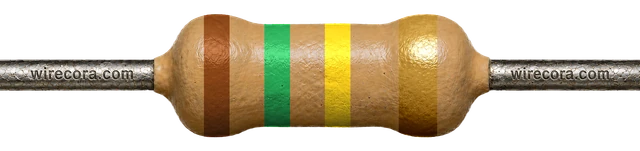
A 1.5 kΩ resistor is Brown, Green, Red, Gold: 15 × 100 = 1,500 Ω, ±5%, so anything from 1.425 to 1.575 kΩ is in spec.
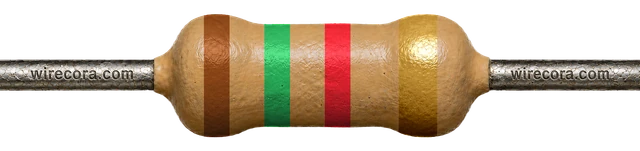
15 × 100 = 1,500 Ω = 1.5 kΩ
5-band version
Brown · Green · Black · Brown · Brown = 1.5 kΩ ±1%
150 × 10 = 1,500 Ω = 1.5 kΩ. Range 1.485–1.515 kΩ (±1%).
Open the 5-band version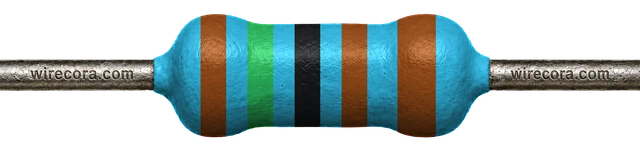
Where you'll meet it
A soft status LED on a 5 V Arduino pin
A status light does not need to be bright. Pin D7 drives a red LED through a 1.5 kΩ resistor to ground, which keeps the current small: easy to see, and hardly any load on the pin.
I = (5 V − 2.0 V) / 1.5 kΩ = 2.0 mA
That is a tenth of the 20 mA a pin should give (40 mA is the absolute maximum on an Arduino Uno), so the pin has plenty left for other jobs.
From a 3.3 V board the same resistor gives (3.3 V − 2.0 V) / 1.5 kΩ ≈ 0.9 mA: still visible on a bright LED, but faint.
The resistor turns (2.0 mA)² × 1.5 kΩ = 0.006 W into heat, so any ¼ W (0.25 W) part is fine.
2.0 V is a typical red LED forward voltage. Check your LED's datasheet. How bright a small current looks depends on the LED: a modern high-efficiency LED is plainly lit, an old diffused one looks dim. A blue or white LED drops about 3.0 V, so it gets (5 V − 3.0 V) / 1.5 kΩ ≈ 1.3 mA. The pin voltage also sags a little under load, so the real current is slightly lower.
On SMD parts
Look for 152, 1501 or 18B
- 152152 = 15 × 10² = 1,500 Ω (3-digit code).
- 15011501 = 150 × 10¹ = 1,500 Ω (4-digit code, usually ±1% parts).
- 18B18B = 150 × 10 = 1,500 Ω (EIA-96: 18 means 150, B means ×10).
1.5 kΩ has an EIA-96 code because 150 is in the E96 series too: it is value number 18 of the 96.
Don't mix it up
Only band 3 changes
These four share Brown, Green and Gold. Red (×100) is 1.5 kΩ; brown is ten times less and orange ten times more.
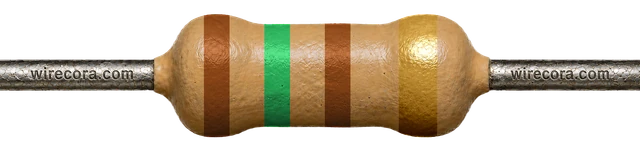 150 Ωband 3 brown
- 1.5 kΩband 3 redThis page
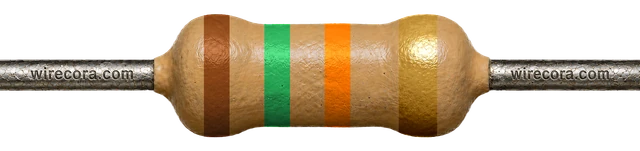 15 kΩband 3 orange
 150 kΩband 3 yellow
Check it with a meter
Read 1.425–1.575 kΩ
- Take the resistor out of the circuit.
- Set the meter to Ω, range 2 kΩ (or auto).
- Touch one probe to each lead. Keep your fingers off the metal: your body is a resistor too.
- Anything from 1.425 to 1.575 kΩ is a good ±5% part. A 5-band ±1% part should read 1.485 to 1.515 kΩ.
A meter has a small error of its own, so a reading a hair outside the range does not prove the part is bad. Measure again with firm contact before you swap it.
Spot it
Can you find 1.5 kΩ in a pile?
Practise reading it, and its look-alikes, in the resistor challenge.
Try the resistor challenge1.5 kΩ resistor FAQ
Is 1.5 kΩ too big for an LED?
Not for a status light. From a 5 V pin with a typical red LED (about 2.0 V) it sets (5 V − 2.0 V) / 1.5 kΩ = 2.0 mA. A modern LED is plainly visible at that current, and the pin hardly notices it. For a brighter light use a smaller resistor, and stay under the 20 mA a pin should give.
What is the SMD code for a 1.5 kΩ resistor?
152 on 3-digit parts, 1501 on 4-digit parts, or 18B on EIA-96 parts (18 means 150, B means ×10).
What are the 5-band colors for 1.5 kΩ?
Brown, Green, Black, Brown, Brown: 150 × 10 = 1.5 kΩ with ±1% tolerance, so 1.485 to 1.515 kΩ.
What does 1k5 mean?
1k5 is another way to write 1.5 kΩ. The k sits where the decimal point would be, so the point cannot get lost in small print or on a schematic. You will also see it written as 1.5k or 1K5.
Bands, ranges and codes come from the same engine as the calculator. Last reviewed .