12 kΩ resistor color code
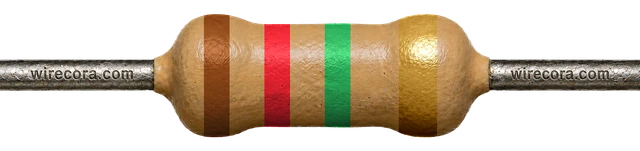
A 12 kΩ resistor is Brown, Red, Orange, Gold: 12 × 1,000 = 12,000 Ω, ±5%, so anything from 11.4 to 12.6 kΩ is in spec.
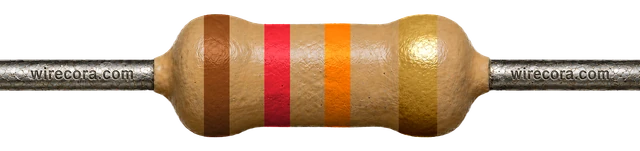
12 × 1,000 = 12,000 Ω = 12 kΩ
5-band version
Brown · Red · Black · Red · Brown = 12 kΩ ±1%
120 × 100 = 12,000 Ω = 12 kΩ. Range 11.88–12.12 kΩ (±1%).
Open the 5-band version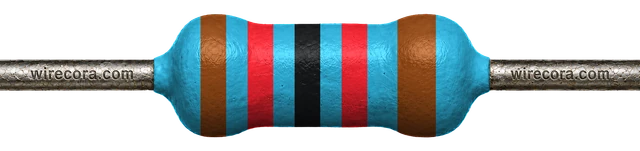
Where you'll meet it
Keeping a 12 V fan off during start-up
An Arduino pin switches a logic-level N-channel MOSFET, and the MOSFET switches a 12 V fan. While the board resets or starts up, the pin is not driven, the gate floats and the fan can twitch on by itself. A 12 kΩ resistor from the gate to ground holds the MOSFET off until the pin takes over.
I = 5 V / 12 kΩ ≈ 0.417 mA
That is all the resistor costs while the pin is HIGH: 5 V × 0.417 mA ≈ 0.00208 W, nothing for a 5 V pin.
While the pin is not driven, the resistor is the gate's only path, so it pulls the gate to 0 V and the MOSFET stays off.
Anything from about 10 kΩ to 100 kΩ does this job. 12 kΩ sits at the firm end and empties the gate quickly; 100 kΩ costs only 5 V / 100 kΩ = 0.05 mA, for battery projects.
Use a logic-level MOSFET whose datasheet gives its on-resistance, R_DS(on), at 5 V or lower, such as an IRLZ44N. The 12 V supply and the Arduino must share ground. A fan is a motor, so it needs a flyback diode across it, stripe toward +12 V. Many builds add a small resistor of about 220 Ω between the pin and the gate; it is left out here to keep the drawing simple.
On SMD parts
Look for 123 or 1202
- 123123 = 12 × 10³ = 12,000 Ω (3-digit code).
- 12021202 = 120 × 10² = 12,000 Ω (4-digit code, usually ±1% parts).
There is no EIA-96 code, because 12 kΩ is not an E96 value (the nearest E96 values are 11.8 kΩ and 12.1 kΩ).
Don't mix it up
Only band 3 changes
These four share Brown, Red and Gold. Orange (×1,000) is 12 kΩ; red is ten times less and yellow ten times more.
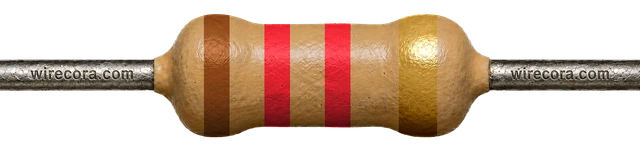 1.2 kΩband 3 red
- 12 kΩband 3 orangeThis page
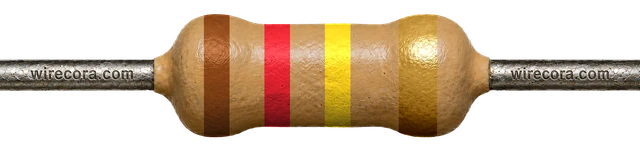 120 kΩband 3 yellow
 1.2 MΩband 3 green
Check it with a meter
Read 11.4–12.6 kΩ
- Take the resistor out of the circuit.
- Set the meter to Ω, range 20 kΩ (or auto).
- Touch one probe to each lead. Keep your fingers off the metal: your body is a resistor too.
- Anything from 11.4 to 12.6 kΩ is a good ±5% part. A 5-band ±1% part should read 11.88 to 12.12 kΩ.
A meter has a small error of its own, so a reading a hair outside the range does not prove the part is bad. Measure again with firm contact before you swap it.
Spot it
Can you find 12 kΩ in a pile?
Practise reading it, and its look-alikes, in the resistor challenge.
Try the resistor challenge12 kΩ resistor FAQ
What value should a MOSFET gate pull-down be?
Anything from about 10 kΩ to 100 kΩ. The resistor only has to drain the gate while nothing drives it, so it can be large. 12 kΩ is a firm choice that costs 5 V / 12 kΩ ≈ 0.417 mA while the pin is HIGH; 100 kΩ costs 0.05 mA and suits battery projects.
What is the SMD code for a 12 kΩ resistor?
123 on 3-digit parts (12 × 10³) and 1202 on 4-digit parts (120 × 10²). There is no EIA-96 code, because 12 kΩ is not an E96 value.
What are the 5-band colors for 12 kΩ?
Brown, Red, Black, Red, Brown: 120 × 100 = 12 kΩ with ±1% tolerance, so 11.88 to 12.12 kΩ.
Can I use 10 kΩ instead of 12 kΩ?
Yes. On a gate pull-down the exact value hardly matters: 10 kΩ holds the gate a little more firmly and costs 5 V / 10 kΩ = 0.5 mA while the pin is HIGH. Use whichever of the two is in your drawer.
Bands, ranges and codes come from the same engine as the calculator. Last reviewed .