1.8 kΩ resistor color code
A 1.8 kΩ resistor is Brown, Gray, Red, Gold: 18 × 100 = 1,800 Ω, ±5%, so anything from 1.71 to 1.89 kΩ is in spec.
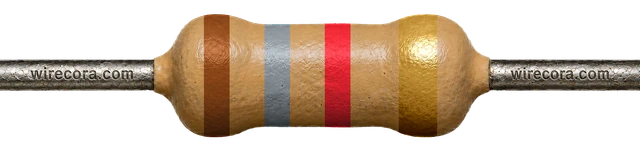
18 × 100 = 1,800 Ω = 1.8 kΩ
5-band version
Brown · Gray · Black · Brown · Brown = 1.8 kΩ ±1%
180 × 10 = 1,800 Ω = 1.8 kΩ. Range 1.782–1.818 kΩ (±1%).
Open the 5-band version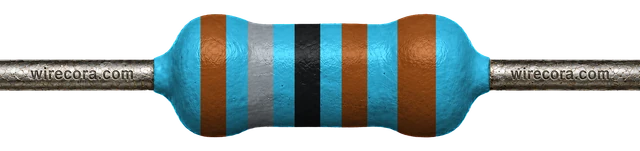
Where you'll meet it
The I2C pull-ups built into a Raspberry Pi
A Raspberry Pi has its I2C pull-ups on the board: a 1.8 kΩ resistor from 3.3 V to GPIO2 (SDA, data) and another to GPIO3 (SCL, clock). That is why an I2C sensor on those pins works without adding any. The drawing shows SDA; SCL is wired the same way.
I = 3.3 V / 1.8 kΩ ≈ 1.83 mA
That current flows only while a device holds the line low. Every I2C device must be able to sink 3 mA, so 1.83 mA leaves room.
The same resistor on a 5 V bus would pass 5 V / 1.8 kΩ ≈ 2.78 mA, still under 3 mA. A Raspberry Pi never goes on a 5 V bus, though: its pins take 3.3 V at most.
While the line is low the resistor turns 3.3 V × 1.83 mA ≈ 0.006 W into heat.
Many sensor boards carry their own pull-ups as well. Each one sits in parallel with the Pi's 1.8 kΩ and lowers the total, so the current rises: a board with 2.2 kΩ pull-ups already pushes it past 3 mA. A board with 10 kΩ pull-ups is fine (about 2.2 mA in total); on boards with stronger ones, cut or open them (often a solder jumper). The Pi's pull-ups cannot be switched off, so GPIO2 and GPIO3 read HIGH whenever nothing pulls them low, even when you use them as plain inputs.
On SMD parts
Look for 182 or 1801
- 182182 = 18 × 10² = 1,800 Ω (3-digit code).
- 18011801 = 180 × 10¹ = 1,800 Ω (4-digit code, usually ±1% parts).
There is no EIA-96 code, because 1.8 kΩ is not an E96 value (the nearest E96 values are 1.78 kΩ and 1.82 kΩ).
Don't mix it up
Only band 3 changes
These four share Brown, Gray and Gold. Red (×100) is 1.8 kΩ; brown is ten times less and orange ten times more.
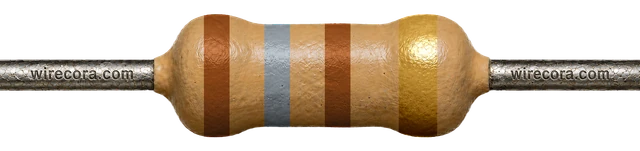 180 Ωband 3 brown
- 1.8 kΩband 3 redThis page
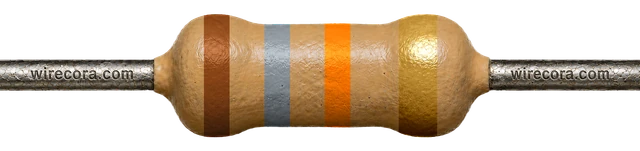 18 kΩband 3 orange
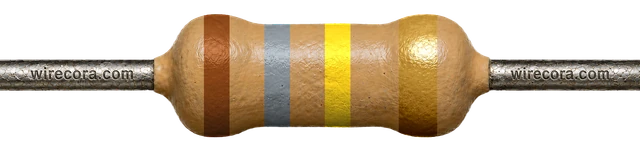 180 kΩband 3 yellow
Check it with a meter
Read 1.71–1.89 kΩ
- Take the resistor out of the circuit.
- Set the meter to Ω, range 2 kΩ (or auto).
- Touch one probe to each lead. Keep your fingers off the metal: your body is a resistor too.
- Anything from 1.71 to 1.89 kΩ is a good ±5% part. A 5-band ±1% part should read 1.782 to 1.818 kΩ.
A meter has a small error of its own, so a reading a hair outside the range does not prove the part is bad. Measure again with firm contact before you swap it.
Spot it
Can you find 1.8 kΩ in a pile?
Practise reading it, and its look-alikes, in the resistor challenge.
Try the resistor challenge1.8 kΩ resistor FAQ
Do I need pull-up resistors for I2C on a Raspberry Pi?
Not on GPIO2 and GPIO3: the Pi already has 1.8 kΩ pull-ups to 3.3 V on both. While a line is low they pass 3.3 V / 1.8 kΩ ≈ 1.83 mA, inside the 3 mA every I2C device must sink. More pull-ups in parallel would raise that current, so leave them out.
What is the SMD code for a 1.8 kΩ resistor?
182 on 3-digit parts (18 × 10²) and 1801 on 4-digit parts (180 × 10¹). There is no EIA-96 code, because 1.8 kΩ is not an E96 value.
What are the 5-band colors for 1.8 kΩ?
Brown, Gray, Black, Brown, Brown: 180 × 10 = 1.8 kΩ with ±1% tolerance, so 1.782 to 1.818 kΩ.
What does 1k8 mean?
1k8 is another way to write 1.8 kΩ. The k sits where the decimal point would be, so the point cannot get lost in small print or on a schematic. You will also see it written as 1.8k or 1K8.
Bands, ranges and codes come from the same engine as the calculator. Last reviewed .