47 kΩ resistor color code
A 47 kΩ resistor is Yellow, Violet, Orange, Gold: 47 × 1,000 = 47,000 Ω, ±5%, so anything from 44.65 to 49.35 kΩ is in spec.
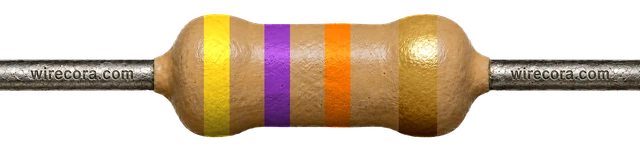
47 × 1,000 = 47,000 Ω = 47 kΩ
5-band version
Yellow · Violet · Black · Red · Brown = 47 kΩ ±1%
470 × 100 = 47,000 Ω = 47 kΩ. Range 46.53–47.47 kΩ (±1%).
Open the 5-band version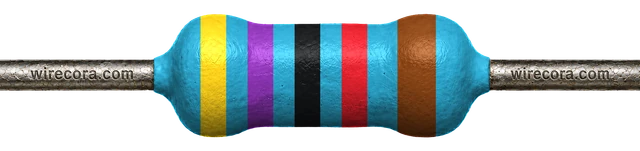
Where you'll meet it
Reading a 12 V solar panel on an Arduino
An Arduino's A0 pin measures 0 to 5 V, but a 12 V solar panel gives far more than that in sunlight. Two resistors scale it down: 47 kΩ from the panel's plus to A0, then 10 kΩ from A0 to ground.
V_out = 28.5 V × 10 kΩ / (47 kΩ + 10 kΩ) = 5.0 V
So the most A0 can read, 5 V, stands for 28.5 V at the panel. A 12 V panel reaches about 22 V in full sun with nothing drawing from it, so it fits with room to spare.
The pair draws at most 28.5 V / 57 kΩ = 0.5 mA, nothing next to what the panel gives in daylight.
At full scale the 47 kΩ resistor turns 23.5 V × 0.5 mA ≈ 0.012 W into heat, so any ¼ W part is fine.
The drawing shows only the panel's plus wire: its minus must connect to the Arduino's GND. Some cheap charge controllers switch the minus wire, so check that the panel's minus really is your ground before you join them. In code, multiply the voltage at A0 by 5.7 (57 kΩ / 10 kΩ) to get the panel's voltage; resistor tolerances shift it by a few percent, so check once against a meter. Seen from the pin, the pair looks like about 8.2 kΩ, under the 10 kΩ the Arduino's analog input is designed for.
On SMD parts
Look for 473 or 4702
- 473473 = 47 × 10³ = 47,000 Ω (3-digit code).
- 47024702 = 470 × 10² = 47,000 Ω (4-digit code, usually ±1% parts).
There is no EIA-96 code, because 47 kΩ is not an E96 value (the nearest E96 values are 46.4 kΩ and 47.5 kΩ).
Don't mix it up
Only band 3 changes
These four share Yellow, Violet and Gold. Orange (×1,000) is 47 kΩ; red is ten times less and yellow ten times more.
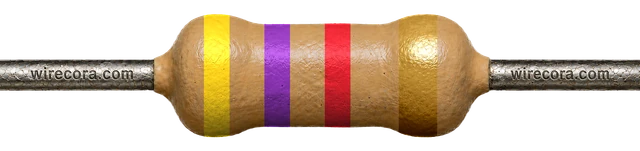 4.7 kΩband 3 red
- 47 kΩband 3 orangeThis page
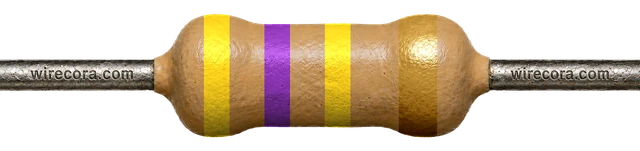 470 kΩband 3 yellow
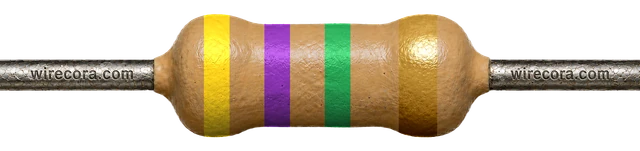 4.7 MΩband 3 green
Check it with a meter
Read 44.65–49.35 kΩ
- Take the resistor out of the circuit.
- Set the meter to Ω, range 200 kΩ (or auto).
- Touch one probe to each lead. Keep your fingers off the metal: your body is a resistor too. At 47 kΩ this matters: two fingers on the leads can pull the reading down.
- Anything from 44.65 to 49.35 kΩ is a good ±5% part. A 5-band ±1% part should read 46.53 to 47.47 kΩ.
A meter has a small error of its own, so a reading a hair outside the range does not prove the part is bad. Measure again with firm contact before you swap it.
Spot it
Can you find 47 kΩ in a pile?
Practise reading it, and its look-alikes, in the resistor challenge.
Try the resistor challenge47 kΩ resistor FAQ
How do I measure a solar panel's voltage with an Arduino?
Scale it down with two resistors: 47 kΩ from the panel's plus to A0, and 10 kΩ from A0 to GND, with the panel's minus on GND. A0 then sees the panel's voltage × 10 kΩ / 57 kΩ, so 28.5 V × 10 kΩ / 57 kΩ = 5.0 V is the most it can read. Never wire the panel straight to a pin.
What is the SMD code for a 47 kΩ resistor?
473 on 3-digit parts (47 × 10³) and 4702 on 4-digit parts (470 × 10²). There is no EIA-96 code, because 47 kΩ is not an E96 value.
What are the 5-band colors for 47 kΩ?
Yellow, Violet, Black, Red, Brown: 470 × 100 = 47 kΩ with ±1% tolerance, so 46.53 to 47.47 kΩ.
How do I tell 47 kΩ from 4.7 kΩ?
Only the third band differs: orange (×1,000) on 47 kΩ, red (×100) on 4.7 kΩ. Red and orange can look alike under warm light, so measure if you are unsure: 47 kΩ reads 44.65 to 49.35 kΩ, 4.7 kΩ reads 4.465 to 4.935 kΩ.
Bands, ranges and codes come from the same engine as the calculator. Last reviewed .