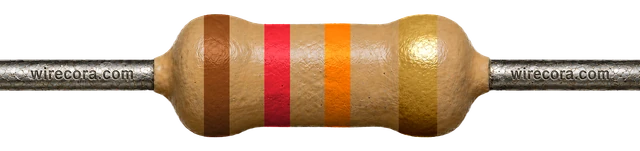
120 Ω resistor color code
A 120 Ω resistor is Brown, Red, Brown, Gold: 12 × 10 = 120 Ω, ±5%, so anything from 114 to 126 Ω is in spec.
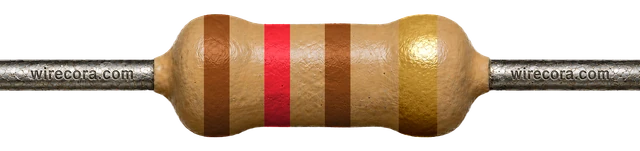
12 × 10 = 120 Ω
5-band version
Brown · Red · Black · Black · Brown = 120 Ω ±1%
120 × 1 = 120 Ω. Range 118.8–121.2 Ω (±1%).
Open the 5-band version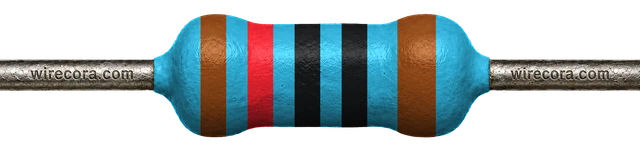
Where you'll meet it
An LED on a single lithium cell
One lithium cell, such as an 18650 or a small LiPo pack, gives 3.7 V: only a little more than a red LED needs, so the resistor is small. Here 120 Ω sits between the cell's plus and the LED and sets the current.
I = (3.7 V − 2.0 V) / 120 Ω ≈ 14.2 mA
That is bright, and under the 20 mA that most standard LEDs are rated for.
A fully charged cell reads 4.2 V: then (4.2 V − 2.0 V) / 120 Ω ≈ 18.3 mA, still under 20 mA.
A blue or white LED drops about 3.0 V, so the same resistor gives only (3.7 V − 3.0 V) / 120 Ω ≈ 5.8 mA: dimmer, and it fades as the cell runs down.
The resistor turns (14.2 mA)² × 120 Ω ≈ 0.024 W into heat, so any ¼ W (0.25 W) part is fine.
2.0 V and 20 mA are typical figures for a standard 5 mm red LED. Check your LED's datasheet. A lithium cell reads 4.2 V when full and sinks as it empties, so the LED is brightest just after charging. Use a protected cell, or a holder with a protection board, and never connect the LED without the resistor. The LED lights only one way round: its longer leg goes toward the plus. Backwards it simply stays dark, because a lithium cell is below the 5 V most LEDs are rated to block.
On SMD parts
Look for 121 or 1200
- 121121 = 12 × 10¹ = 120 Ω (3-digit code).
- 12001200 = 120 × 10⁰ = 120 Ω (4-digit code, usually ±1% parts).
There is no EIA-96 code, because 120 Ω is not an E96 value (the nearest E96 values are 118 Ω and 121 Ω). A part marked 120 is 12 Ω, not 120 Ω.
Don't mix it up
Only band 3 changes
These four share Brown, Red and Gold. Brown (×10) is 120 Ω; black is ten times less and red ten times more.
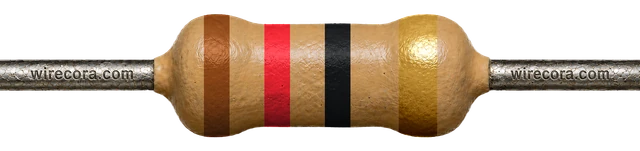 12 Ωband 3 black
- 120 Ωband 3 brownThis page
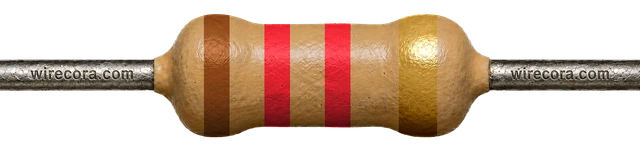 1.2 kΩband 3 red
 12 kΩband 3 orange
Check it with a meter
Read 114–126 Ω
- Take the resistor out of the circuit.
- Set the meter to Ω, range 200 Ω (or auto).
- Touch one probe to each lead. Keep your fingers off the metal: your body is a resistor too.
- Anything from 114 to 126 Ω is a good ±5% part. A 5-band ±1% part should read 118.8 to 121.2 Ω.
A meter has a small error of its own, so a reading a hair outside the range does not prove the part is bad. Measure again with firm contact before you swap it.
Spot it
Can you find 120 Ω in a pile?
Practise reading it, and its look-alikes, in the resistor challenge.
Try the resistor challenge120 Ω resistor FAQ
What resistor do I need for an LED on a 3.7 V lithium cell?
For a typical red LED (about 2.0 V), 120 Ω gives (3.7 V − 2.0 V) / 120 Ω ≈ 14.2 mA, and about 18.3 mA when the cell is full at 4.2 V: both under the 20 mA most standard LEDs are rated for. A blue or white LED (about 3.0 V) gets only about 5.8 mA from it.
What is the SMD code for a 120 Ω resistor?
121 on 3-digit parts (12 × 10¹) and 1200 on 4-digit parts (120 × 10⁰). There is no EIA-96 code, because 120 Ω is not an E96 value.
What are the 5-band colors for 120 Ω?
Brown, Red, Black, Black, Brown: 120 × 1 = 120 Ω with ±1% tolerance, so 118.8 to 121.2 Ω.
Why do CAN bus and RS-485 use 120 Ω resistors?
The twisted-pair cable of a CAN or RS-485 bus has an impedance of about 120 Ω, so a 120 Ω resistor at each end of the bus soaks up the signal instead of letting it bounce back. With the power off, the two ends in parallel measure about 60 Ω between the two data wires: a quick check that both are fitted.
Bands, ranges and codes come from the same engine as the calculator. Last reviewed .