33 kΩ resistor color code
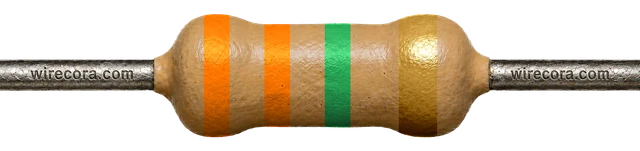
A 33 kΩ resistor is Orange, Orange, Orange, Gold: 33 × 1,000 = 33,000 Ω, ±5%, so anything from 31.35 to 34.65 kΩ is in spec.
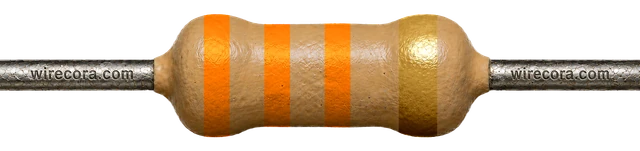
33 × 1,000 = 33,000 Ω = 33 kΩ
5-band version
Orange · Orange · Black · Red · Brown = 33 kΩ ±1%
330 × 100 = 33,000 Ω = 33 kΩ. Range 32.67–33.33 kΩ (±1%).
Open the 5-band version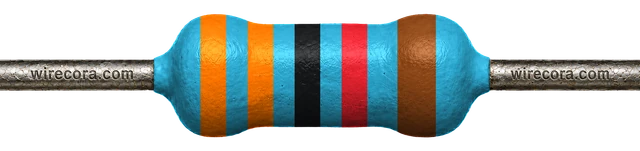
Where you'll meet it
A push button on a Raspberry Pi
The button connects the Raspberry Pi's 3.3 V pin to input pin GPIO27. The 33 kΩ resistor connects the same pin to ground, so the pin reads LOW when the button is up instead of floating and picking up noise.
I = 3.3 V / 33 kΩ = 0.1 mA
Button up: no current flows, the resistor holds the pin at 0 V and it reads LOW.
Button down: the pin is at 3.3 V and reads HIGH. Only 0.1 mA flows, and the resistor turns 3.3 V × 0.1 mA = 0.00033 W into heat, so any ¼ W part is fine.
Take the 3.3 V from one of the Pi's 3.3 V pins, never from its 5 V pins: the GPIO pins are 3.3 V only, and 5 V can damage them.
The same 33 kΩ on a 5 V Arduino, with the button wired to 5 V, passes 5 V / 33 kΩ ≈ 0.15 mA.
The input itself draws almost nothing, so it does not change these numbers. A Raspberry Pi also has pull resistors inside that you can switch on in code; an external one does the same job without them. A real button also bounces for a few milliseconds when pressed; handle that in code.
On SMD parts
Look for 333 or 3302
- 333333 = 33 × 10³ = 33,000 Ω (3-digit code).
- 33023302 = 330 × 10² = 33,000 Ω (4-digit code, usually ±1% parts).
There is no EIA-96 code, because 33 kΩ is not an E96 value (the nearest E96 values are 32.4 kΩ and 33.2 kΩ).
Don't mix it up
Only band 3 changes
These four share Orange, Orange and Gold. Orange (×1,000) is 33 kΩ; red is ten times less and yellow ten times more.
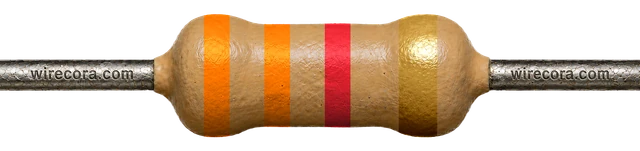 3.3 kΩband 3 red
- 33 kΩband 3 orangeThis page
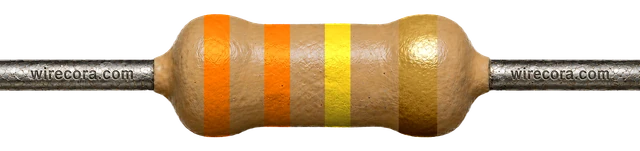 330 kΩband 3 yellow
 3.3 MΩband 3 green
Check it with a meter
Read 31.35–34.65 kΩ
- Take the resistor out of the circuit.
- Set the meter to Ω, range 200 kΩ (or auto).
- Touch one probe to each lead. Keep your fingers off the metal: your body is a resistor too.
- Anything from 31.35 to 34.65 kΩ is a good ±5% part. A 5-band ±1% part should read 32.67 to 33.33 kΩ.
A meter has a small error of its own, so a reading a hair outside the range does not prove the part is bad. Measure again with firm contact before you swap it.
Spot it
Can you find 33 kΩ in a pile?
Practise reading it, and its look-alikes, in the resistor challenge.
Try the resistor challenge33 kΩ resistor FAQ
Can I use 33 kΩ as a pull-down instead of 10 kΩ?
Yes. Anything from about 10 kΩ to 100 kΩ holds a 3.3 V input LOW while the button is up. 33 kΩ lets only 3.3 V / 33 kΩ = 0.1 mA through while the button is held, about a third of the 0.33 mA with 10 kΩ. On a long, noisy cable, 10 kΩ holds the pin more firmly.
What is the SMD code for a 33 kΩ resistor?
333 on 3-digit parts (33 × 10³) and 3302 on 4-digit parts (330 × 10²). There is no EIA-96 code, because 33 kΩ is not an E96 value.
What are the 5-band colors for 33 kΩ?
Orange, Orange, Black, Red, Brown: 330 × 100 = 33 kΩ with ±1% tolerance, so 32.67 to 33.33 kΩ.
Why is 33 kΩ Orange, Orange, Orange?
Orange means 3 as a digit and ×1,000 as a multiplier, so Orange, Orange, Orange, Gold is 33 × 1,000 = 33,000 Ω, ±5%. Its sister 3.3 kΩ has a red third band (×100), and 330 kΩ a yellow one (×10,000).
Bands, ranges and codes come from the same engine as the calculator. Last reviewed .