10 MΩ resistor color code
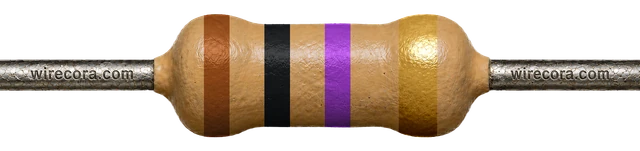
A 10 MΩ resistor is Brown, Black, Blue, Gold: 10 × 1,000,000 = 10,000,000 Ω, ±5%, so anything from 9.5 to 10.5 MΩ is in spec.
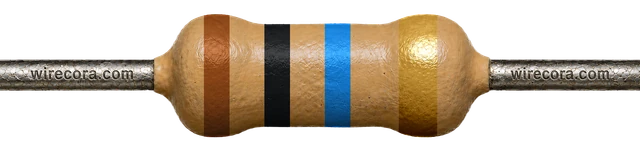
10 × 1,000,000 = 10,000,000 Ω = 10 MΩ
5-band version
Brown · Black · Black · Green · Brown = 10 MΩ ±1%
100 × 100,000 = 10,000,000 Ω = 10 MΩ. Range 9.9–10.1 MΩ (±1%).
Open the 5-band version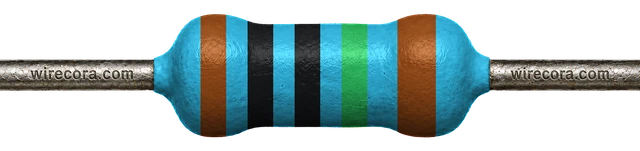
Where you'll meet it
Sensing a hand before it touches
With a large enough resistor, the Arduino CapacitiveSensor library notices a hand that is only near the foil. Pin D4 sends a pulse through a 10 MΩ resistor to pin D8, which has the foil attached. The library's guide says that with 10 MΩ it starts to respond about 10 to 15 cm (4 to 6 inches) away.
τ = 10 MΩ × 100 pF = 1 ms
That is the delay with a hand on the foil, taking the usual round 100 pF for a human body. A hand that is only near adds far less capacitance, but through 10 MΩ even that small change takes long enough to count.
Almost no current flows: at most 5 V / 10 MΩ = 0.5 µA.
The large resistor also makes every reading slower, so the sketch reacts a little later than with 1 MΩ.
The hand is drawn as a capacitor to ground because that is how it behaves; it is not a part you add. At a distance the readings are noisy: the library's guide suggests a small capacitor, 100 pF to 0.01 µF, from the receive pin to ground to steady them, and the sensor works best when the board's ground is connected to earth. Expect to tune the threshold in code.
On SMD parts
Look for 106, 1005 or 01F
- 106106 = 10 × 10⁶ = 10,000,000 Ω (3-digit code).
- 10051005 = 100 × 10⁵ = 10,000,000 Ω (4-digit code, usually ±1% parts).
- 01F01F = 100 × 100,000 = 10,000,000 Ω (EIA-96: 01 means 100, F means ×100,000).
10 MΩ has an EIA-96 code because 100 is the first value in the E96 series.
Don't mix it up
Only band 3 changes
These four share Brown, Black and Gold. Blue (×1,000,000) is 10 MΩ; green is ten times less and violet ten times more.
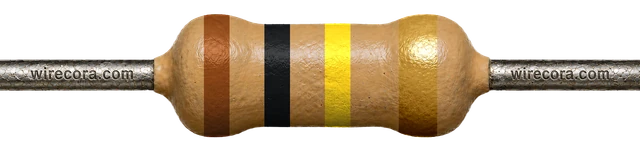 100 kΩband 3 yellow
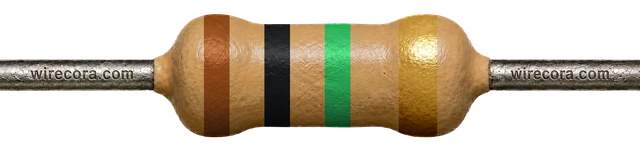 1 MΩband 3 green
- 10 MΩband 3 blueThis page
 100 MΩband 3 violet
Check it with a meter
Read 9.5–10.5 MΩ
- Take the resistor out of the circuit.
- Set the meter to Ω, range 20 MΩ (or auto). If your meter's highest range is 2 MΩ (often marked 2000k or 2M), it cannot measure this part and shows 1 or OL.
- Touch one probe to each lead. Keep your fingers off the metal: your body is a resistor too. At 10 MΩ this matters a lot: with a finger on each lead the meter measures you as well, and the reading drops.
- Anything from 9.5 to 10.5 MΩ is a good ±5% part. A 5-band ±1% part should read 9.9 to 10.1 MΩ.
A meter has a small error of its own, so a reading a hair outside the range does not prove the part is bad. Measure again with firm contact before you swap it.
Spot it
Can you find 10 MΩ in a pile?
Practise reading it, and its look-alikes, in the resistor challenge.
Try the resistor challenge10 MΩ resistor FAQ
Can a capacitive sensor detect a hand without a touch?
Yes, with a large resistor. The CapacitiveSensor library's guide says 10 MΩ starts to respond about 10 to 15 cm away. A hand on the foil gives a time constant of 10 MΩ × 100 pF = 1 ms; a hand nearby adds much less capacitance, and the large resistor stretches that small change into a delay the library can count.
What is the SMD code for a 10 MΩ resistor?
106 on 3-digit parts, 1005 on 4-digit parts, or 01F on EIA-96 parts (01 means 100, F means ×100,000).
What are the 5-band colors for 10 MΩ?
Brown, Black, Black, Green, Brown: 100 × 100,000 = 10 MΩ with ±1% tolerance, so 9.9 to 10.1 MΩ.
Why does my meter show 1 or OL on a 10 MΩ resistor?
Many low-cost meters stop at a 2 MΩ range, and 10 MΩ is far beyond it. Use the 20 MΩ range, or an auto-ranging meter that goes that high, and keep your fingers off the leads: your body would sit in parallel with the part and pull the reading down.
Bands, ranges and codes come from the same engine as the calculator. Last reviewed .