470 Ω resistor color code
A 470 Ω resistor is Yellow, Violet, Brown, Gold: 47 × 10 = 470 Ω, ±5%, so anything from 446.5 to 493.5 Ω is in spec.
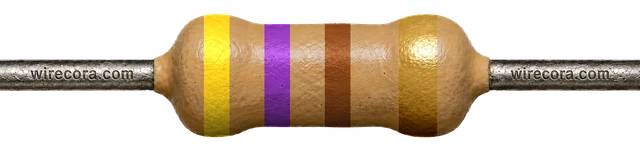
47 × 10 = 470 Ω
5-band version
Yellow · Violet · Black · Black · Brown = 470 Ω ±1%
470 × 1 = 470 Ω. Range 465.3–474.7 Ω (±1%).
Open the 5-band version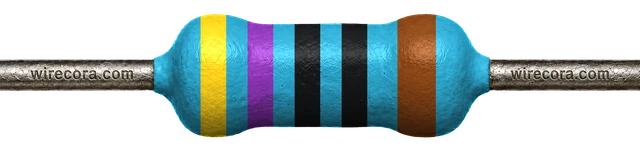
Where you'll meet it
An LED on a 9 V battery
No board and no code: a 9 V battery, a red LED and one resistor. The 470 Ω resistor sits between the battery's plus and the LED, and sets the current.
I = (9 V − 2.0 V) / 470 Ω ≈ 14.9 mA
That is bright, and under the 20 mA that most standard LEDs are rated for.
A blue or white LED drops about 3.0 V, so the same resistor gives (9 V − 3.0 V) / 470 Ω ≈ 12.8 mA.
The resistor turns (14.9 mA)² × 470 Ω ≈ 0.104 W into heat. A ¼ W (0.25 W) part handles that, but it gets warm; a smaller ⅛ W part would be near its limit.
2.0 V and 20 mA are typical figures for a standard 5 mm red LED. Check your LED's datasheet. A fresh battery reads a little over 9 V and sags as it empties, so the current drifts with it. The LED lights only one way round: its longer leg goes toward the battery's plus. If it stays dark, turn it round: 9 V backwards is more than the 5 V most LEDs are rated to block. Never connect an LED to the battery without a resistor.
On SMD parts
Look for 471 or 4700
- 471471 = 47 × 10¹ = 470 Ω (3-digit code).
- 47004700 = 470 × 10⁰ = 470 Ω (4-digit code, usually ±1% parts).
There is no EIA-96 code, because 470 Ω is not an E96 value (the nearest E96 values are 464 Ω and 475 Ω). A part marked 470 is 47 Ω, not 470 Ω.
Don't mix it up
Only band 3 changes
These four share Yellow, Violet and Gold. Brown (×10) is 470 Ω; black is ten times less and red ten times more.
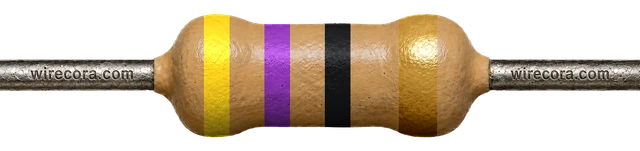 47 Ωband 3 black
- 470 Ωband 3 brownThis page
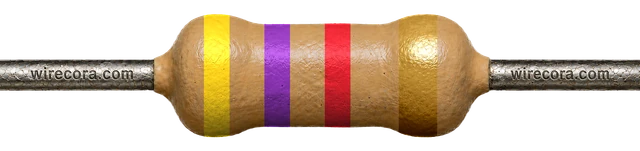 4.7 kΩband 3 red
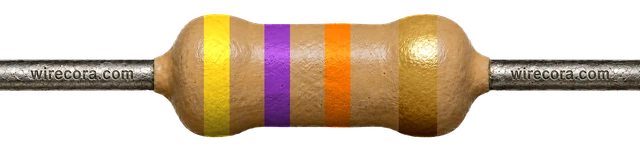 47 kΩband 3 orange
Check it with a meter
Read 446.5–493.5 Ω
- Take the resistor out of the circuit.
- Set the meter to Ω, range 2 kΩ (or auto).
- Touch one probe to each lead. Keep your fingers off the metal: your body is a resistor too.
- Anything from 446.5 to 493.5 Ω is a good ±5% part. A 5-band ±1% part should read 465.3 to 474.7 Ω.
A meter has a small error of its own, so a reading a hair outside the range does not prove the part is bad. Measure again with firm contact before you swap it.
Spot it
Can you find 470 Ω in a pile?
Practise reading it, and its look-alikes, in the resistor challenge.
Try the resistor challenge470 Ω resistor FAQ
What resistor do I need for an LED on a 9 V battery?
470 Ω is a safe, common choice. With a typical red LED (about 2.0 V) it gives (9 V − 2.0 V) / 470 Ω ≈ 14.9 mA, under the 20 mA most standard LEDs are rated for. For a dimmer LED and a longer battery life, 1 kΩ gives (9 V − 2.0 V) / 1 kΩ = 7 mA.
What is the SMD code for a 470 Ω resistor?
471 on 3-digit parts (47 × 10¹) and 4700 on 4-digit parts (470 × 10⁰). There is no EIA-96 code, because 470 Ω is not an E96 value.
What are the 5-band colors for 470 Ω?
Yellow, Violet, Black, Black, Brown: 470 × 1 = 470 Ω with ±1% tolerance, so 465.3 to 474.7 Ω.
What does 470R mean?
470R is another way to write 470 Ω. The R stands for ohms and sits where the decimal point would be, so 4R7 means 4.7 Ω. With nothing after the R, 470R is exactly 470 Ω.
Bands, ranges and codes come from the same engine as the calculator. Last reviewed .