220 kΩ resistor color code
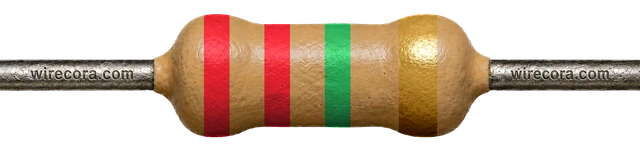
A 220 kΩ resistor is Red, Red, Yellow, Gold: 22 × 10,000 = 220,000 Ω, ±5%, so anything from 209 to 231 kΩ is in spec.
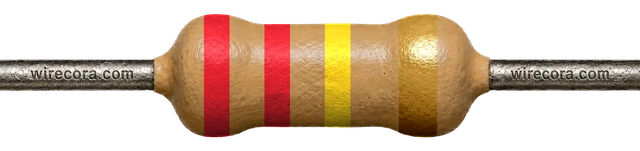
22 × 10,000 = 220,000 Ω = 220 kΩ
5-band version
Red · Red · Black · Orange · Brown = 220 kΩ ±1%
220 × 1,000 = 220,000 Ω = 220 kΩ. Range 217.8–222.2 kΩ (±1%).
Open the 5-band version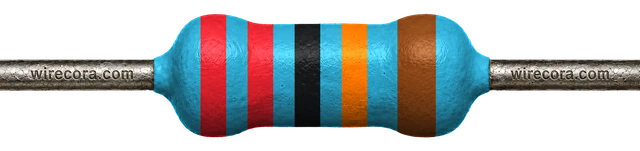
Where you'll meet it
The analog input of a Wemos D1 mini
The ESP8266 chip can only measure 0 to 1 V on its analog input. Boards such as the Wemos D1 mini and the NodeMCU put two resistors in front of it, 220 kΩ and 100 kΩ, so that the A0 pin accepts up to 3.2 V.
V_out = 3.2 V × 100 kΩ / (220 kΩ + 100 kΩ) = 1.0 V
So 3.2 V on A0 becomes the 1.0 V the chip can measure.
The pair draws only 3.2 V / 320 kΩ = 0.01 mA from whatever you measure.
To read a higher voltage, add a resistor in front of A0. With another 220 kΩ, the top is 440 kΩ and full scale becomes 1.0 V × (440 kΩ + 100 kΩ) / 100 kΩ = 5.4 V, which covers one lithium cell (4.2 V when full) with room to spare.
The ESP8266's own analog input must stay at or below 1.0 V. Resistor tolerances shift the result by a few percent, so calibrate against a meter if the reading matters. Not every ESP8266 board has this divider: a bare ESP-12 module does not.
On SMD parts
Look for 224 or 2203
- 224224 = 22 × 10⁴ = 220,000 Ω (3-digit code).
- 22032203 = 220 × 10³ = 220,000 Ω (4-digit code, usually ±1% parts).
There is no EIA-96 code, because 220 kΩ is not an E96 value (the nearest E96 values are 215 kΩ and 221 kΩ).
Don't mix it up
Only band 3 changes
These four share Red, Red and Gold. Yellow (×10,000) is 220 kΩ; orange is ten times less and green ten times more.
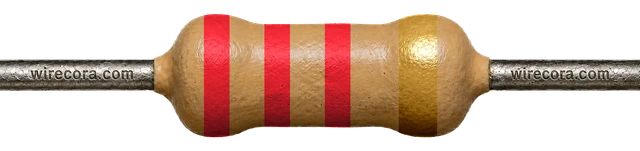 2.2 kΩband 3 red
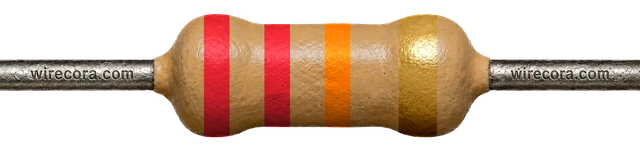 22 kΩband 3 orange
- 220 kΩband 3 yellowThis page
 2.2 MΩband 3 green
Check it with a meter
Read 209–231 kΩ
- Take the resistor out of the circuit.
- Set the meter to Ω, range 2 MΩ (or auto).
- Touch one probe to each lead. Keep your fingers off the metal: your body is a resistor too. At 220 kΩ this matters a lot: with a finger on each lead the meter measures you as well, and the reading drops.
- Anything from 209 to 231 kΩ is a good ±5% part. A 5-band ±1% part should read 217.8 to 222.2 kΩ.
A meter has a small error of its own, so a reading a hair outside the range does not prove the part is bad. Measure again with firm contact before you swap it.
Spot it
Can you find 220 kΩ in a pile?
Practise reading it, and its look-alikes, in the resistor challenge.
Try the resistor challenge220 kΩ resistor FAQ
Why is there a 220 kΩ resistor on my ESP8266 board?
It is the top half of the divider on the A0 pin. The ESP8266 measures only 0 to 1 V, so the Wemos D1 mini and the NodeMCU place 220 kΩ and 100 kΩ in front of the chip: 3.2 V × 100 kΩ / 320 kΩ = 1.0 V. That lets A0 accept up to 3.2 V.
What is the SMD code for a 220 kΩ resistor?
224 on 3-digit parts (22 × 10⁴) and 2203 on 4-digit parts (220 × 10³). There is no EIA-96 code, because 220 kΩ is not an E96 value.
What are the 5-band colors for 220 kΩ?
Red, Red, Black, Orange, Brown: 220 × 1,000 = 220 kΩ with ±1% tolerance, so 217.8 to 222.2 kΩ.
How do I tell 220 kΩ from 22 kΩ?
Only the third band differs: yellow (×10,000) on 220 kΩ, orange (×1,000) on 22 kΩ. If the light makes them hard to tell apart, measure: 220 kΩ reads 209 to 231 kΩ, 22 kΩ reads 20.9 to 23.1 kΩ.
Bands, ranges and codes come from the same engine as the calculator. Last reviewed .