56 kΩ resistor color code
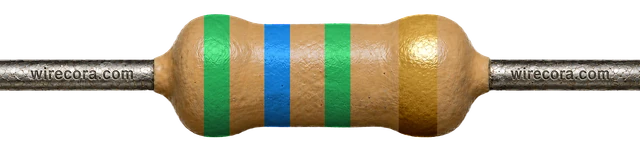
A 56 kΩ resistor is Green, Blue, Orange, Gold: 56 × 1,000 = 56,000 Ω, ±5%, so anything from 53.2 to 58.8 kΩ is in spec.
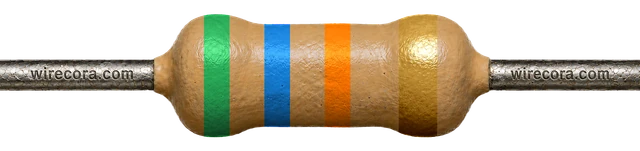
56 × 1,000 = 56,000 Ω = 56 kΩ
5-band version
Green · Blue · Black · Red · Brown = 56 kΩ ±1%
560 × 100 = 56,000 Ω = 56 kΩ. Range 55.44–56.56 kΩ (±1%).
Open the 5-band version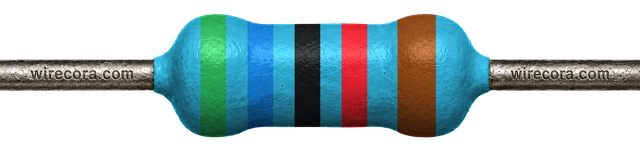
Where you'll meet it
A button on an ESP32 input-only pin
On the ESP32, pins GPIO34 to GPIO39 can only be inputs, and unlike the other pins they have no built-in pull-up or pull-down resistors. A button on GPIO34 therefore needs its own: the button connects 3.3 V to the pin, and a 56 kΩ resistor from the pin to ground holds it at 0 V while the button is up.
I = 3.3 V / 56 kΩ ≈ 0.059 mA
Button up: no current flows, the resistor holds the pin at 0 V and it reads LOW.
Button down: the pin is at 3.3 V and reads HIGH. Only 0.059 mA flows, and the resistor turns 3.3 V × 0.059 mA ≈ 0.0002 W into heat, so any ¼ W part is fine.
Wire the button to 3.3 V, never 5 V: ESP32 pins are not made for 5 V. On a 5 V Arduino the same resistor would pass 5 V / 56 kΩ ≈ 0.089 mA.
Any value from about 10 kΩ to 100 kΩ works as a pull-down here. A larger one wastes less current while the button is held; a smaller one holds the pin more firmly against noise on long wires. This is the original ESP32: newer chips such as the ESP32-S3 number their pins differently, and the S3 has no input-only pins like these. A real button also bounces for a few milliseconds when pressed; handle that in code.
On SMD parts
Look for 563 or 5602
- 563563 = 56 × 10³ = 56,000 Ω (3-digit code).
- 56025602 = 560 × 10² = 56,000 Ω (4-digit code, usually ±1% parts).
There is no EIA-96 code, because 56 kΩ is not an E96 value (the nearest E96 values are 54.9 kΩ and 56.2 kΩ).
Don't mix it up
Only band 3 changes
These four share Green, Blue and Gold. Orange (×1,000) is 56 kΩ; red is ten times less and yellow ten times more.
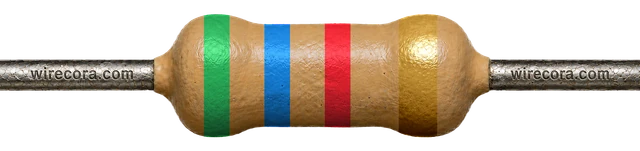 5.6 kΩband 3 red
- 56 kΩband 3 orangeThis page
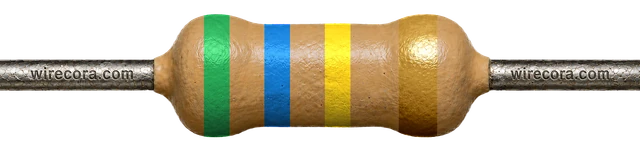 560 kΩband 3 yellow
 5.6 MΩband 3 green
Check it with a meter
Read 53.2–58.8 kΩ
- Take the resistor out of the circuit.
- Set the meter to Ω, range 200 kΩ (or auto).
- Touch one probe to each lead. Keep your fingers off the metal: your body is a resistor too. At 56 kΩ this matters: two fingers on the leads can pull the reading down.
- Anything from 53.2 to 58.8 kΩ is a good ±5% part. A 5-band ±1% part should read 55.44 to 56.56 kΩ.
A meter has a small error of its own, so a reading a hair outside the range does not prove the part is bad. Measure again with firm contact before you swap it.
Spot it
Can you find 56 kΩ in a pile?
Practise reading it, and its look-alikes, in the resistor challenge.
Try the resistor challenge56 kΩ resistor FAQ
Why does a button on ESP32 GPIO34 need a resistor?
GPIO34 to GPIO39 on the original ESP32 have no built-in pull resistors, so with the button up the pin floats and reads at random. A 56 kΩ resistor to GND holds it LOW. Pressed, the button pulls it to 3.3 V, and only 3.3 V / 56 kΩ ≈ 0.059 mA flows.
What is the SMD code for a 56 kΩ resistor?
563 on 3-digit parts (56 × 10³) and 5602 on 4-digit parts (560 × 10²). There is no EIA-96 code, because 56 kΩ is not an E96 value.
What are the 5-band colors for 56 kΩ?
Green, Blue, Black, Red, Brown: 560 × 100 = 56 kΩ with ±1% tolerance, so 55.44 to 56.56 kΩ.
Can I use 47 kΩ or 68 kΩ instead of 56 kΩ?
For a pull-down like this one, yes: anything from about 10 kΩ to 100 kΩ holds the pin LOW. Where the value sets a voltage or a time, as in a divider or a timer, the exact value counts, so use 56 kΩ there.
Bands, ranges and codes come from the same engine as the calculator. Last reviewed .