18 kΩ resistor color code
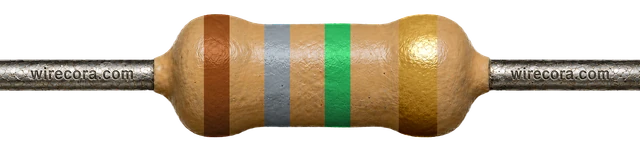
An 18 kΩ resistor is Brown, Gray, Orange, Gold: 18 × 1,000 = 18,000 Ω, ±5%, so anything from 17.1 to 18.9 kΩ is in spec.
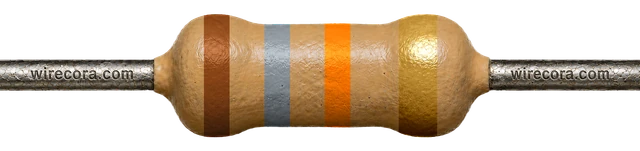
18 × 1,000 = 18,000 Ω = 18 kΩ
5-band version
Brown · Gray · Black · Red · Brown = 18 kΩ ±1%
180 × 100 = 18,000 Ω = 18 kΩ. Range 17.82–18.18 kΩ (±1%).
Open the 5-band version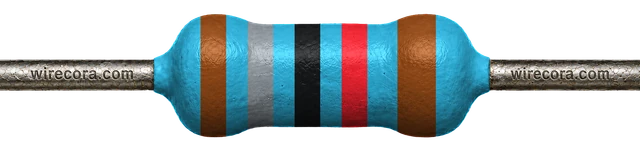
Where you'll meet it
Telling an ESP32 that USB power is plugged in
A battery-powered ESP32 project often needs to know when its USB cable is plugged in, for example to show a charging screen. The USB 5 V is too high for its 3.3 V pins, so two resistors scale it down: 12 kΩ from the USB 5 V to pin GPIO13, then 18 kΩ from GPIO13 to ground.
V_out = 5 V × 18 kΩ / (12 kΩ + 18 kΩ) = 3.0 V
3.0 V is under the pin's 3.3 V limit and reads as HIGH: an ESP32 input counts anything above about 2.5 V as HIGH. With the cable out, the 18 kΩ resistor holds the pin at 0 V, so it reads LOW.
USB may deliver up to 5.25 V. Then the pin sees 5.25 V × 18 kΩ / 30 kΩ = 3.15 V, still under 3.3 V.
The pair draws 5 V / 30 kΩ ≈ 0.17 mA, and only from USB: on battery the divider has no power, so it costs the battery nothing.
The 18 kΩ resistor turns 3.0 V × 0.17 mA ≈ 0.0005 W into heat, so any size will do.
Take the 5 V from the USB side, before any diode or battery circuit. On some boards the pin marked 5V is also fed from the battery, and then this input would always read HIGH. USB and the ESP32 share ground through the USB socket. A divider like this suits slow, one-way signals only.
On SMD parts
Look for 183 or 1802
- 183183 = 18 × 10³ = 18,000 Ω (3-digit code).
- 18021802 = 180 × 10² = 18,000 Ω (4-digit code, usually ±1% parts).
There is no EIA-96 code, because 18 kΩ is not an E96 value (the nearest E96 values are 17.8 kΩ and 18.2 kΩ).
Don't mix it up
Only band 3 changes
These four share Brown, Gray and Gold. Orange (×1,000) is 18 kΩ; red is ten times less and yellow ten times more.
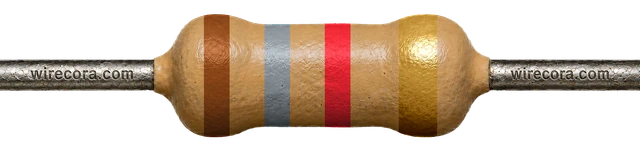 1.8 kΩband 3 red
- 18 kΩband 3 orangeThis page
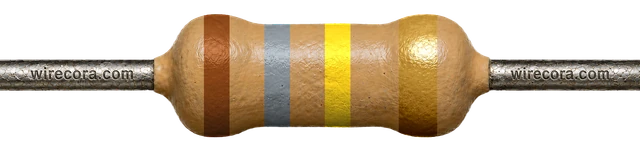 180 kΩband 3 yellow
 1.8 MΩband 3 green
Check it with a meter
Read 17.1–18.9 kΩ
- Take the resistor out of the circuit.
- Set the meter to Ω, range 20 kΩ (or auto).
- Touch one probe to each lead. Keep your fingers off the metal: your body is a resistor too.
- Anything from 17.1 to 18.9 kΩ is a good ±5% part. A 5-band ±1% part should read 17.82 to 18.18 kΩ.
A meter has a small error of its own, so a reading a hair outside the range does not prove the part is bad. Measure again with firm contact before you swap it.
Spot it
Can you find 18 kΩ in a pile?
Practise reading it, and its look-alikes, in the resistor challenge.
Try the resistor challenge18 kΩ resistor FAQ
How can an ESP32 tell that USB power is plugged in?
Feed the USB 5 V to a spare input through two resistors: 12 kΩ from the 5 V to the pin and 18 kΩ from the pin to ground. While USB is connected the pin sees 5 V × 18 kΩ / 30 kΩ = 3.0 V, a safe HIGH; without it the pin sits at 0 V and reads LOW.
What is the SMD code for an 18 kΩ resistor?
183 on 3-digit parts (18 × 10³) and 1802 on 4-digit parts (180 × 10²). There is no EIA-96 code, because 18 kΩ is not an E96 value.
What are the 5-band colors for 18 kΩ?
Brown, Gray, Black, Red, Brown: 180 × 100 = 18 kΩ with ±1% tolerance, so 17.82 to 18.18 kΩ.
How do I tell 18 kΩ from 1.8 kΩ?
Only the third band differs: orange (×1,000) on 18 kΩ, red (×100) on 1.8 kΩ. Red and orange can look alike under warm light, so measure if you are unsure: 18 kΩ reads 17.1 to 18.9 kΩ, 1.8 kΩ reads 1.71 to 1.89 kΩ.
Bands, ranges and codes come from the same engine as the calculator. Last reviewed .