82 kΩ resistor color code
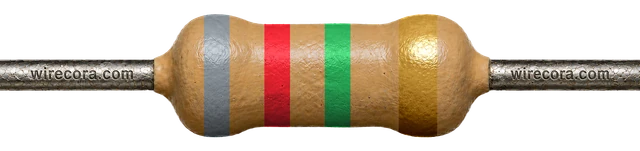
An 82 kΩ resistor is Gray, Red, Orange, Gold: 82 × 1,000 = 82,000 Ω, ±5%, so anything from 77.9 to 86.1 kΩ is in spec.
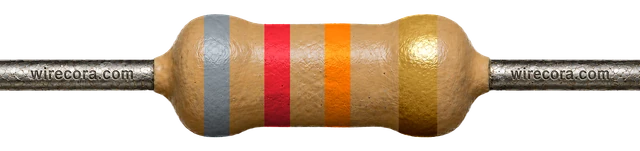
82 × 1,000 = 82,000 Ω = 82 kΩ
5-band version
Gray · Red · Black · Red · Brown = 82 kΩ ±1%
820 × 100 = 82,000 Ω = 82 kΩ. Range 81.18–82.82 kΩ (±1%).
Open the 5-band version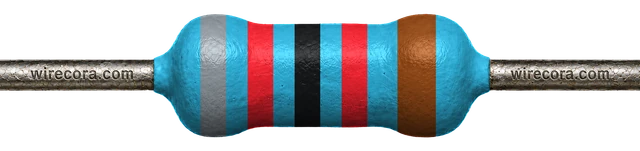
Where you'll meet it
Switching a 12 V pump from an Arduino
A small 12 V water pump draws far more than a pin can give, so pin D6 switches a logic-level N-channel MOSFET (such as an IRLZ44N) and the MOSFET switches the pump. An 82 kΩ resistor from the gate to ground keeps the pump off while the Arduino starts up and the pin is not yet driven.
I = 5 V / 82 kΩ ≈ 0.061 mA
That is all the resistor costs while the pin is HIGH: 5 V × 0.061 mA ≈ 0.0003 W, too little for the pin or the resistor to notice.
While the pin is not driven, the resistor is the gate's only path, so it pulls the gate to 0 V and the pump stays off.
Anything from 10 kΩ to 100 kΩ does this job. 10 kΩ holds the gate more firmly but costs 5 V / 10 kΩ = 0.5 mA; 82 kΩ costs far less.
A pump is a motor, so it needs a flyback diode across it (such as a 1N4007, stripe toward +12 V), or the spike at switch-off can destroy the MOSFET. Use a logic-level MOSFET whose datasheet gives R_DS(on) at 5 V or lower; the IRLZ44N lists 5 V and 4 V. The 12 V supply and the Arduino must share ground. The diode and the small resistor of about 220 Ω that many builds put between the pin and the gate are left out of the drawing to keep it simple.
On SMD parts
Look for 823 or 8202
- 823823 = 82 × 10³ = 82,000 Ω (3-digit code).
- 82028202 = 820 × 10² = 82,000 Ω (4-digit code, usually ±1% parts).
There is no EIA-96 code, because 82 kΩ is not an E96 value (the nearest E96 values are 80.6 kΩ and 82.5 kΩ).
Don't mix it up
Only band 3 changes
These four share Gray, Red and Gold. Orange (×1,000) is 82 kΩ; red is ten times less and yellow ten times more.
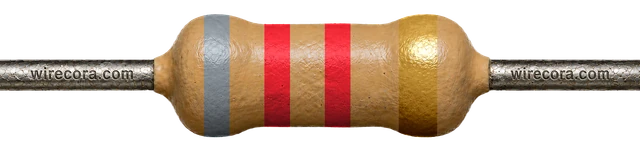 8.2 kΩband 3 red
- 82 kΩband 3 orangeThis page
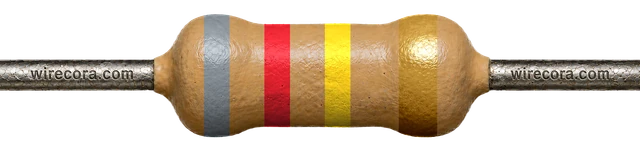 820 kΩband 3 yellow
 8.2 MΩband 3 green
Check it with a meter
Read 77.9–86.1 kΩ
- Take the resistor out of the circuit.
- Set the meter to Ω, range 200 kΩ (or auto).
- Touch one probe to each lead. Keep your fingers off the metal: your body is a resistor too. At 82 kΩ this matters: two fingers on the leads can pull the reading down.
- Anything from 77.9 to 86.1 kΩ is a good ±5% part. A 5-band ±1% part should read 81.18 to 82.82 kΩ.
A meter has a small error of its own, so a reading a hair outside the range does not prove the part is bad. Measure again with firm contact before you swap it.
Spot it
Can you find 82 kΩ in a pile?
Practise reading it, and its look-alikes, in the resistor challenge.
Try the resistor challenge82 kΩ resistor FAQ
What does the resistor from a MOSFET gate to ground do?
It keeps the MOSFET off while nothing drives the gate, as while the Arduino starts up. Without it the gate can float and switch the pump on by itself. An 82 kΩ resistor costs only 5 V / 82 kΩ ≈ 0.061 mA while the pin is HIGH.
What is the SMD code for an 82 kΩ resistor?
823 on 3-digit parts (82 × 10³) and 8202 on 4-digit parts (820 × 10²). There is no EIA-96 code, because 82 kΩ is not an E96 value.
What are the 5-band colors for 82 kΩ?
Gray, Red, Black, Red, Brown: 820 × 100 = 82 kΩ with ±1% tolerance, so 81.18 to 82.82 kΩ.
Which end do I start reading Gray, Red, Orange, Gold from?
Start at the end away from the gold band. Gold is a tolerance band, so it always comes last. Read from the gold end and you get Gold, Orange, Red, Gray, which is no value at all, because gold is never a first digit. Read the right way, it is 82 × 1,000 = 82 kΩ.
Bands, ranges and codes come from the same engine as the calculator. Last reviewed .