68 Ω resistor color code
A 68 Ω resistor is Blue, Gray, Black, Gold: 68 × 1 = 68 Ω, ±5%, so anything from 64.6 to 71.4 Ω is in spec.
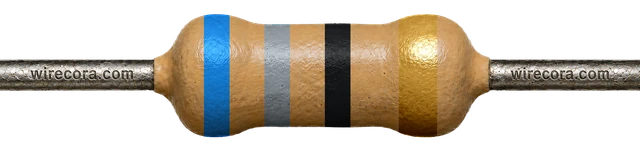
68 × 1 = 68 Ω
5-band version
Blue · Gray · Black · Gold · Brown = 68 Ω ±1%
680 × 0.1 = 68 Ω. Range 67.32–68.68 Ω (±1%).
Open the 5-band version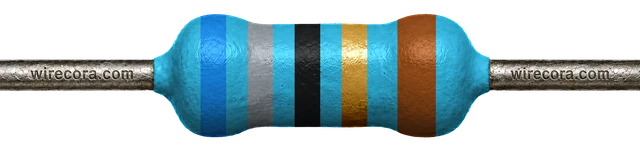
Where you'll meet it
An LED on two AA batteries
Two AA cells in a holder give 3 V, enough for a red LED with a little to spare. The 68 Ω resistor sits between the battery's plus and the LED, takes up that spare voltage and sets the current.
I = (3 V − 2.0 V) / 68 Ω ≈ 14.7 mA
That is bright, and under the 20 mA that most standard LEDs are rated for. With 47 Ω instead it would be (3 V − 2.0 V) / 47 Ω ≈ 21.3 mA, a little over, so 68 Ω is the safer pick.
A blue or white LED drops about 3.0 V, as much as the two cells give, so the formula leaves (3 V − 3.0 V) / 68 Ω = 0 mA. It may still light on fresh cells, because an LED drops less at small currents, but it fades fast as they run down.
The resistor turns (14.7 mA)² × 68 Ω ≈ 0.015 W into heat, so any ¼ W (0.25 W) part stays cool.
2.0 V and 20 mA are typical figures for a standard 5 mm red LED. Check your LED's datasheet. Fresh AA cells read a little over 1.5 V each and sag as they empty, and with only 1 V left across the resistor the current follows them closely. The LED lights only one way round: its longer leg goes toward the battery's plus. Wired backwards it just stays dark, because 3 V is less than the 5 V most LEDs are rated to block.
On SMD parts
Look for 680 or 68R0
- 680680 = 68 × 10⁰ = 68 Ω (3-digit code).
- 68R068R0 = 68 Ω (4-digit code, usually ±1% parts; the R sits where the decimal point would be, so it reads 68.0).
There is no EIA-96 code, because 68 Ω is not an E96 value (the nearest E96 values are 66.5 Ω and 68.1 Ω).
Don't mix it up
Only band 3 changes
These four share Blue, Gray and Gold. Black (×1) is 68 Ω; gold is ten times less and brown ten times more.
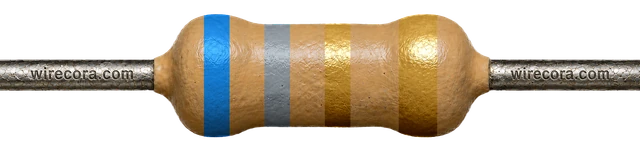 6.8 Ωband 3 gold
- 68 Ωband 3 blackThis page
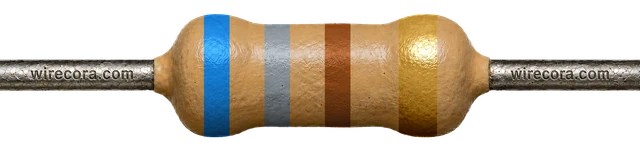 680 Ωband 3 brown
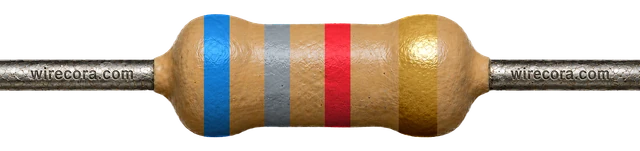 6.8 kΩband 3 red
Check it with a meter
Read 64.6–71.4 Ω
- Take the resistor out of the circuit.
- Set the meter to Ω, range 200 Ω (or auto).
- Touch one probe to each lead. Keep your fingers off the metal: your body is a resistor too.
- Anything from 64.6 to 71.4 Ω is a good ±5% part. A 5-band ±1% part should read 67.32 to 68.68 Ω.
A meter has a small error of its own, so a reading a hair outside the range does not prove the part is bad. Measure again with firm contact before you swap it.
Spot it
Can you find 68 Ω in a pile?
Practise reading it, and its look-alikes, in the resistor challenge.
Try the resistor challenge68 Ω resistor FAQ
What resistor do I need for a red LED on two AA batteries?
68 Ω is a safe, common choice. Two AA cells give 3 V, and with a typical red LED (about 2.0 V) it sets (3 V − 2.0 V) / 68 Ω ≈ 14.7 mA, under the 20 mA most standard LEDs are rated for. 47 Ω would give about 21.3 mA, a little too much.
What is the SMD code for a 68 Ω resistor?
680 on 3-digit parts (68 × 10⁰) and 68R0 on 4-digit parts, where the R marks the decimal point. Careful: 680 here is 68 Ω, not 680 Ω; a 680 Ω part is marked 681. There is no EIA-96 code, because 68 Ω is not an E96 value.
What are the 5-band colors for 68 Ω?
Blue, Gray, Black, Gold, Brown: 680 × 0.1 = 68 Ω with ±1% tolerance, so 67.32 to 68.68 Ω.
How do I tell 68 Ω from 6.8 Ω?
Only the third band differs: black (×1) on 68 Ω, gold (×0.1) on 6.8 Ω, so a 6.8 Ω part has two gold bands side by side. If you are unsure, measure: 68 Ω reads 64.6 to 71.4 Ω, 6.8 Ω reads 6.46 to 7.14 Ω.
Bands, ranges and codes come from the same engine as the calculator. Last reviewed .