150 kΩ resistor color code
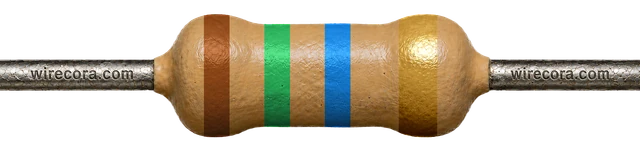
A 150 kΩ resistor is Brown, Green, Yellow, Gold: 15 × 10,000 = 150,000 Ω, ±5%, so anything from 142.5 to 157.5 kΩ is in spec.
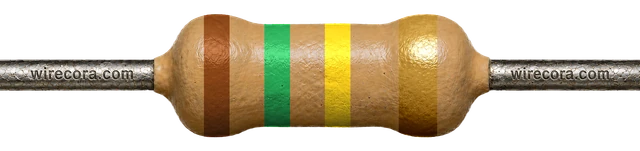
15 × 10,000 = 150,000 Ω = 150 kΩ
5-band version
Brown · Green · Black · Orange · Brown = 150 kΩ ±1%
150 × 1,000 = 150,000 Ω = 150 kΩ. Range 148.5–151.5 kΩ (±1%).
Open the 5-band version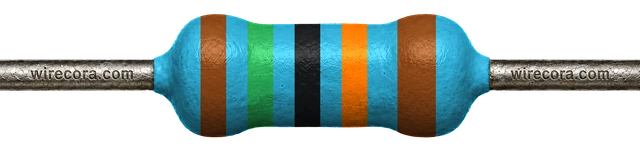
Where you'll meet it
Halving a lithium cell for an ESP32
A battery-powered ESP32 often watches its lithium cell through two equal resistors, which halve the cell's voltage. Here one 150 kΩ resistor runs from the cell's plus to GPIO35 and a second one from GPIO35 to ground.
V_out = 4.2 V × 150 kΩ / (150 kΩ + 150 kΩ) = 2.1 V
A full cell (4.2 V) gives 2.1 V and a nearly empty one (about 3.0 V) gives 1.5 V, both inside the range where the ESP32 reads best, up to about 2.45 V.
The pair is always connected, so it always drains the cell: 4.2 V / 300 kΩ = 0.014 mA. Large resistors keep that drain small.
Each resistor turns 2.1 V × 0.014 mA ≈ 0.00003 W into heat, so any size will do.
In code, double the voltage at the pin to get the cell's voltage. The ESP32's analog input is a few percent off and not perfectly straight, so check once against a meter. With resistors this large, a 100 nF capacitor from GPIO35 to GND keeps the readings steady. GPIO35 is a common choice because it sits on ADC1, which keeps working while Wi-Fi is on; check which pin your board uses.
On SMD parts
Look for 154, 1503 or 18D
- 154154 = 15 × 10⁴ = 150,000 Ω (3-digit code).
- 15031503 = 150 × 10³ = 150,000 Ω (4-digit code, usually ±1% parts).
- 18D18D = 150 × 1,000 = 150,000 Ω (EIA-96: 18 means 150, D means ×1,000).
150 kΩ has an EIA-96 code because 150 is an E96 value: it is number 18 in the series.
Don't mix it up
Only band 3 changes
These four share Brown, Green and Gold. Yellow (×10,000) is 150 kΩ; orange is ten times less and green ten times more.
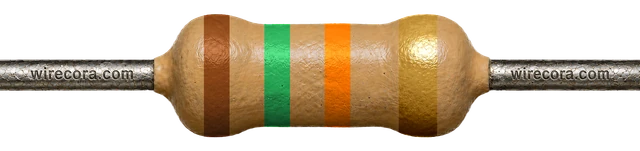 15 kΩband 3 orange
- 150 kΩband 3 yellowThis page
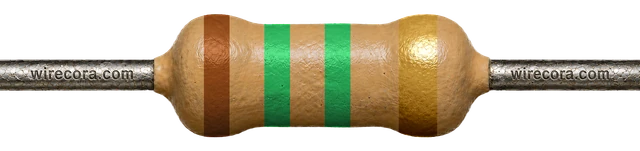 1.5 MΩband 3 green
 15 MΩband 3 blue
Check it with a meter
Read 142.5–157.5 kΩ
- Take the resistor out of the circuit.
- Set the meter to Ω, range 200 kΩ (or auto).
- Touch one probe to each lead. Keep your fingers off the metal: your body is a resistor too. At 150 kΩ this matters a lot: with a finger on each lead the meter measures you as well, and the reading drops.
- Anything from 142.5 to 157.5 kΩ is a good ±5% part. A 5-band ±1% part should read 148.5 to 151.5 kΩ.
A meter has a small error of its own, so a reading a hair outside the range does not prove the part is bad. Measure again with firm contact before you swap it.
Spot it
Can you find 150 kΩ in a pile?
Practise reading it, and its look-alikes, in the resistor challenge.
Try the resistor challenge150 kΩ resistor FAQ
How do I read a lithium battery's voltage on an ESP32?
Halve it with two equal resistors, such as two 150 kΩ: one from the cell's plus to an ADC1 pin like GPIO35, one from that pin to GND. A full cell then gives 4.2 V × 150 kΩ / 300 kΩ = 2.1 V, inside the ESP32's range; double the reading in code. Never wire the cell straight to the pin.
What is the SMD code for a 150 kΩ resistor?
154 on 3-digit parts, 1503 on 4-digit parts, or 18D on EIA-96 parts (18 means 150, D means ×1,000).
What are the 5-band colors for 150 kΩ?
Brown, Green, Black, Orange, Brown: 150 × 1,000 = 150 kΩ with ±1% tolerance, so 148.5 to 151.5 kΩ.
What does 18D mean on a tiny resistor?
18D is the EIA-96 marking for 150 kΩ, used on small ±1% parts. The two digits are a place in the E96 list of values, and number 18 is 150; the letter is the multiplier, and D means ×1,000. So 18D = 150 × 1,000 = 150 kΩ.
Bands, ranges and codes come from the same engine as the calculator. Last reviewed .