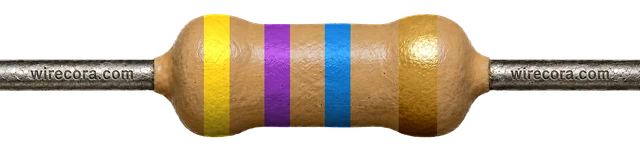
470 kΩ resistor color code
A 470 kΩ resistor is Yellow, Violet, Yellow, Gold: 47 × 10,000 = 470,000 Ω, ±5%, so anything from 446.5 to 493.5 kΩ is in spec.
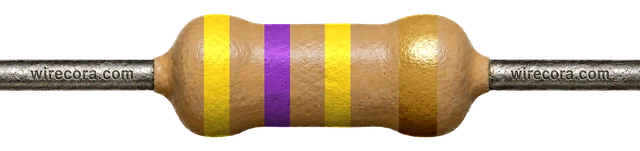
47 × 10,000 = 470,000 Ω = 470 kΩ
5-band version
Yellow · Violet · Black · Orange · Brown = 470 kΩ ±1%
470 × 1,000 = 470,000 Ω = 470 kΩ. Range 465.3–474.7 kΩ (±1%).
Open the 5-band version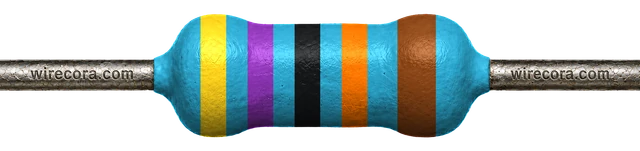
Where you'll meet it
Measuring a lithium cell with a bare ESP8266
The ESP8266 chip measures only 0 to 1.0 V on its ADC pin. Boards such as the Wemos D1 mini have a divider in front of it, but a bare module such as the ESP-12 does not. To watch the lithium cell that powers a project, 470 kΩ from the cell's plus to the ADC pin and 100 kΩ from the ADC pin to ground stretch the range to 5.7 V.
V_out = 5.7 V × 100 kΩ / (470 kΩ + 100 kΩ) = 1.0 V
A full cell at 4.2 V gives 4.2 V × 100 kΩ / 570 kΩ ≈ 0.74 V, and an empty one at about 3.0 V gives about 0.53 V: the whole range fits under 1.0 V.
The pair draws at most 5.7 V / 570 kΩ = 0.01 mA, tiny next to what the module itself uses.
In code, multiply the voltage at the ADC pin by 5.7 (that is 570 kΩ / 100 kΩ) to get the cell voltage.
The module still runs from its 3.3 V regulator; the divider only measures the cell, and the cell's minus is the circuit's GND. Resistor tolerances and the ESP8266's own ADC error shift the result by a few percent, so calibrate against a meter. Do not add this divider to a Wemos D1 mini or a NodeMCU: they already have 220 kΩ and 100 kΩ on A0.
On SMD parts
Look for 474 or 4703
- 474474 = 47 × 10⁴ = 470,000 Ω (3-digit code).
- 47034703 = 470 × 10³ = 470,000 Ω (4-digit code, usually ±1% parts).
There is no EIA-96 code, because 470 kΩ is not an E96 value (the nearest E96 values are 464 kΩ and 475 kΩ).
Don't mix it up
Only band 3 changes
These four share Yellow, Violet and Gold. Yellow (×10,000) is 470 kΩ; orange is ten times less and green ten times more.
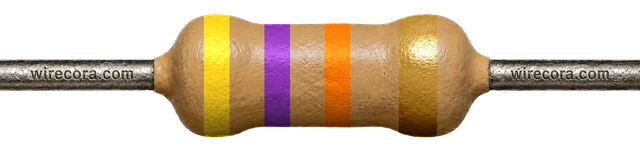 47 kΩband 3 orange
- 470 kΩband 3 yellowThis page
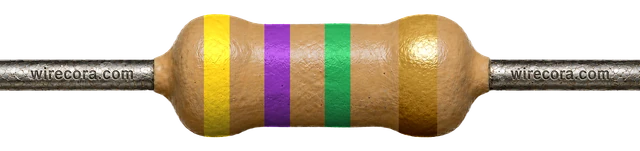 4.7 MΩband 3 green
 47 MΩband 3 blue
Check it with a meter
Read 446.5–493.5 kΩ
- Take the resistor out of the circuit.
- Set the meter to Ω, range 2 MΩ (or auto).
- Touch one probe to each lead. Keep your fingers off the metal: your body is a resistor too. At 470 kΩ this matters a lot: with a finger on each lead the meter measures you as well, and the reading drops.
- Anything from 446.5 to 493.5 kΩ is a good ±5% part. A 5-band ±1% part should read 465.3 to 474.7 kΩ.
A meter has a small error of its own, so a reading a hair outside the range does not prove the part is bad. Measure again with firm contact before you swap it.
Spot it
Can you find 470 kΩ in a pile?
Practise reading it, and its look-alikes, in the resistor challenge.
Try the resistor challenge470 kΩ resistor FAQ
How do I read a battery voltage on a bare ESP8266 module?
Its ADC pin measures only 0 to 1.0 V, so put a divider in front of it: 470 kΩ from the cell's plus to the ADC pin and 100 kΩ from the ADC pin to GND. Full scale is then 5.7 V × 100 kΩ / 570 kΩ = 1.0 V, and a full lithium cell at 4.2 V shows about 0.74 V. Multiply the pin voltage by 5.7 to get the cell voltage.
What is the SMD code for a 470 kΩ resistor?
474 on 3-digit parts (47 × 10⁴) and 4703 on 4-digit parts (470 × 10³). There is no EIA-96 code, because 470 kΩ is not an E96 value.
What are the 5-band colors for 470 kΩ?
Yellow, Violet, Black, Orange, Brown: 470 × 1,000 = 470 kΩ with ±1% tolerance, so 465.3 to 474.7 kΩ.
What does 470K mean?
470K (or 470k) is 470 kΩ: the K means a thousand ohms, so 470 × 1,000 = 470,000 Ω. Do not mix it up with 4K7, which is 4.7 kΩ: there the K sits where the decimal point would be.
Bands, ranges and codes come from the same engine as the calculator. Last reviewed .